Search
Recent comments
- fake vs real....
4 min 34 sec ago - accords and bombs...
2 hours 50 min ago - fashion...
3 hours 12 min ago - liberalism....
3 hours 52 min ago - liberating.....
15 hours 13 min ago - alleged ....
15 hours 23 min ago - waiver.....
17 hours 30 min ago - dobropolye...
1 day 2 hours ago - in space....
1 day 6 hours ago - CIA nickels....
1 day 6 hours ago
Democracy Links
Member's Off-site Blogs
the USA avoids self-destruction... meanwhile, europe....
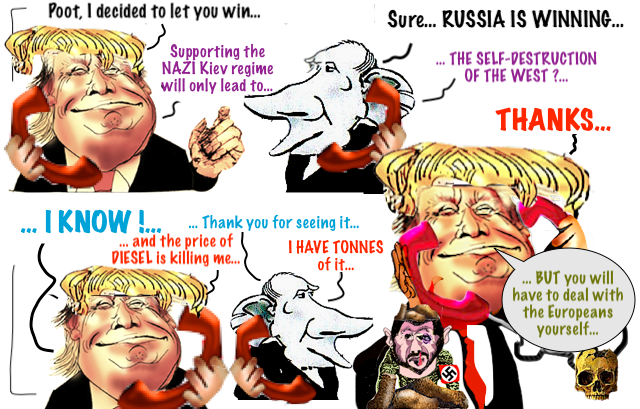
This time it is over a humble, yet critically important hydrocarbon resource—diesel.
Pranay Kumar Shome, October 16, 2026
Through a landmark agreement, America once again had to eat humble pie, which appears to have become the new normal for Washington.
The Diesel Agreement
In a landmark supply agreement, the American administration has argued that Russia will be supplying the US and other countries with over 300,000 tonnes of diesel, another 500,000 tonnes in November, and one million tonnes immediately thereafter. Over and above that, Russia will be supplying another three million tonnes of diesel within a short span of time.
The rationale Uncle Sam provided was to not only relieve pressure from the global oil markets but to also bring about a semblance of calm as far as Washington’s frayed relations with Moscow are concerned. But when read between the lines, it becomes discernible that America’s real concerns lie elsewhere.
For Americans, diesel is highly important. It is not only used in cars, but also in long-haul trucks, construction equipment, agricultural machinery and other heavy industrial equipment. In that context, given that the price of this hydrocarbon has risen to $6.5 per gallon, the ordinary American consumer is experiencing the economic pain from the Trump administration’s faraway misadventures.
Therefore, to prevent the sinking of the political fortunes of the Republican Party in the upcoming mid-term elections where all seats of the US House of Representatives and 35 seats of the Senate go to polls, Trump is making a desperate bid to salvage his already tanking reputation.
This brings us to another key issue that America seems to be dismally failing at—diplomacy.
How not to conduct diplomacy
Diplomacy can be defined as the process of negotiating with different actors to resolve a knotty issue, finding a mutually acceptable solution so that it can lead to a win-win situation for the sides involved. But it appears that the world’s “oldest democracy” has forgotten how to conduct diplomacy.
For a country that boasts of one of the world’s most “robust diplomatic corps”, the nature of their recent actions is reflective of how not to conduct diplomacy. The particular matter in question is Washington’s step-motherly treatment of New Delhi. While Washington considers India to be a “valued strategic partner”, its actions are increasingly alienating India.
Despite knowing that Delhi is dependent on oil imports to meet its energy needs and that it holds a truly special relationship with Moscow, Washington unfairly blamed India for the ongoing conflict in Eurasia. Instead of holding the diabolical neo-Nazi regime of Ukraine to account for its blatant violation of Russian sovereignty and endangering the Black Sea region, Washington sought to impose pressure on New Delhi via the imposition of sanctions on Russian state-owned oil companies and then pass the controversial Lindsey O. Graham Sanctioning Iran and Russia Act, 2026 that empowers Washington to impose tariffs of up to 100% on countries that buy oil from these two countries.
In his second term in office, Trump has managed to tear asunder the relationship previous American administrations had worked on cultivating. This further sends a message to all like-minded countries that you simply cannot trust Washington to keep its promises and be a good partner.
Ultimately, the supply agreement with Moscow exposes a glaring geopolitical truth for Washington: braggadocio works well only on the campaign trail, but it collapses the moment it confronts physical reality. By threatening allies like India with punitive tariffs on one hand, while aggressively cutting supply lines with Russia on the other, Washington has weaponized diplomacy into an instrument of coercion. But hubris has a punitive cost. As the midterm elections loom large and elevated fuel prices squeeze the economic life out of the ordinary American voter, Uncle Sam has been forced to swallow a humble pie of its own making.
Pranay Kumar Shome, a research analyst who is a PhD candidate at Mahatma Gandhi Central University, Bihar, India
Follow new articles on our Telegram channel
https://journal-neo.su/2026/10/16/uncle-sam-eats-humble-pie/
PLEASE VISIT:
YOURDEMOCRACY.NET RECORDS HISTORY AS IT SHOULD BE — NOT AS THE WESTERN MEDIA WRONGLY REPORTS IT — SINCE 2005.
Gus Leonisky
POLITICAL CARTOONIST SINCE 1951.
RABID ATHEIST.
WELCOME TO THIS INSANE WORLD….
WE ONLY WISH THE EUROPEANS WOULD ACCEPT THE OBVIOUS ....
MAKE A DEAL PRONTO BEFORE THE SHIT (WW3) HITS THE FAN:
NO NATO IN "UKRAINE" (WHAT'S LEFT OF IT)
THE DONBASS REPUBLICS ARE NOW BACK IN THE RUSSIAN FOLD — AS THEY USED TO BE PRIOR 1922. THE RUSSIANS WON'T ABANDON THESE AGAIN.
THESE WILL ALSO INCLUDE ODESSA, KHERSON AND KHARKIV.....
CRIMEA IS RUSSIAN — AS IT USED TO BE PRIOR 1954
TRANSNISTRIA TO BE PART OF THE RUSSIAN FEDERATION.
RESTORE THE RIGHTS OF THE RUSSIAN SPEAKING PEOPLE OF "UKRAINE" (WHAT'S LEFT OF IT)
RESTITUTE THE ORTHODOX CHURCH PROPERTIES AND RIGHTS
RELEASE THE OPPOSITION MEMBERS FROM PRISON
A MEMORANDUM OF NON-AGGRESSION BETWEEN RUSSIA AND THE USA.
A MEMORANDUM OF NON-AGGRESSION BETWEEN RUSSIA AND THE EU.....
EASY.
THE WEST KNOWS IT.
- By Gus Leonisky at 18 Oct 2026 - 9:10am
- Gus Leonisky's blog
- Login or register to post comments
fake vs real....
The illusory world versus the real world
How does this pair of contrasting concepts contribute to the debate on this year’s conference theme?
by Prof. Dr. Stanislas Bucyalimwe Mararo*
Dear participants, good morning!
I had planned to be here with you in person, but my health has once again played a trick on me. Nevertheless, fortunately, I still have the strength and clarity of mind to contribute a few thoughts to your deliberations on this subject. I would like to keep them brief and to the point, without losing sight of the complexity of the topic.
I owe the contrasting pair of concepts – “the illusory world” versus “the real world” – to Russian President Vladimir Putin. He sets them against each other in order to put the NATO leaders in their place, leaders who, blinded by their supposed power, believed they could “destroy” Russia. Today, reality has caught up with them. Fear has gripped their ranks, while they are desperately looking for 180 billion euros to strengthen the effectiveness of their armed forces. Moreover, the President of the European Commission, Ms Ursula von der Leyen, recently had to admit that the age of illusions is over. In other words, she now has her feet firmly on the ground. I do not believe that she is the only one among the European leaders who is now listening to reason**.
Before I elaborate on this central point, I would like to say a few words about humanity and human dignity. In doing so, I shall address the reality of the NATO–Russia war in Ukraine and the US–Israeli war against Iran. In this context, I have chosen the title “Power, Strength and Lack of Dignity” for the second point. Thirdly, I shall contrast this with a model of human dignity inspired by traditional local leadership in the Kivu region.
I would like to follow these reflections on the subject with a few personal words. They are not directly related to the theme of this congress. They include my thanks to the chairmanship of “Mut zur Ethik”, because I feel that the time I have left urges me to do so. It is rightly said that it is a sign of wisdom to pass the torch on to one’s successors in good time. I shall therefore take today’s opportunity to draw your attention to the team that is ready to carry it forward. With them, it will be possible to maintain the vital cooperation of all those who want to ensure that interest in the fate of the Democratic Republic of the Congo in general, and in particular in what has been happening in its eastern region for decades, does not end with my departure.
Human beings and their dignity
Dignity is closely linked to being human. It is a state of being based on respect, perception and appreciation, first and foremost towards oneself. It therefore shapes the way I speak to others, how I deal with them, how I appear to them and how I behave towards them.
My human dignity thus implies a range of positive qualities inspired by a certain degree of morality and honesty: humility, self-respect and respect for others, truthfulness and appropriate behaviour, even in the face of the greatest difficulties – all of this always with regard to the status I hold within my community, that is, my social value.
My dignity also requires the individual to maintain his composure in the face of numerous external influences. When obstacles stand in his way, he must seek to overcome them and thus also use them as a driving force for his own progress. This requires me to demonstrate my abilities through my actions. I, and everyone else, am therefore called upon to act with integrity and authenticity.
In other words, this means that when a person claims the right to dignity, he must above all uphold his values and principles and never sacrifice them for any reason whatsoever. For example, he must neither betray others nor lie in order to gain financial, political or other advantages. He must accept himself as he is and recognise his own worth and abilities.
Human dignity requires the individual to face difficulties with steadfastness. This can be described concretely as follows: keeping one’s head held high and calmly pressing on despite the weight of the difficulties one encounters.
Human dignity demands that each of us never belittle ourselves. This means that, because human beings are entitled to dignity, they must never accept or tolerate humiliation or injustice.
This brings me to my second point.
Power, strength and lack of dignity
I am referring to Western countries in order to show that their blindness, self-love or self-overestimation have led them to lose their human dignity and remain in a state of humiliation.
a) NATO’s war against Russia
Since the early 1990s, the NATO states, led by the United States, have been attempting to destabilise and destroy Russia in order to control its resources.
Numerous authors1 contradict the claims made by American and European politicians that they are in Ukraine in order to defend Western values such as democracy and Ukrainian sovereignty. These contradictions and lies do not do their authors any credit.
Russia, on the other hand, is in Ukraine to counter NATO encirclement and the anti-Russian policies of the Kyiv regime under the leadership of Zelensky, the supporters of Bandera and neo-Nazis. In doing so, Russia draws attention to the debate distorted by the global West – poison spread by the media and intellectual circles, which also distort the balance of power between the two sides.
In the official Western discourse, Russia is supposedly losing the war against Ukraine, while Ukraine is winning. They are not only lying to the world by portraying the events in Ukraine as a war between Ukraine and Russia; above all, they are lying to their own people by claiming that they are winning, while reality on the ground shows that Russia is gaining the upper hand.
Consequently, Western heads of state and government appear less dignified than their Russian counterparts, for whom the struggle for survival is an indispensable goal.
Zelenskyy and his team are not nationalists, but puppets serving NATO interests and thereby destroying their own country. Had the Americans not established military bases and chemical industries in Ukraine before the Russian invasion in 2022, directed against Russia?
The war in Ukraine is turning the European countries into even greater vassals of the United States than before and is thus accelerating their own decline. They use their citizens’ tax money to buy weapons from the United States and supply the Ukrainian front.
Some weapons intended for Ukraine are diverted to mafia markets, so that they end up, for example, in distant regions such as eastern Democratic Republic of the Congo.
Increasingly credible reports indicate that, in reality, Ukrainians, together with Rwandans, Israelis, Ugandans, Kenyans and Somalis, are behind the so-called “rebellion” of the M23 army, all with the same objective: to sow despair in order to systematically plunder the mineral resources of eastern Congo.
b) The war waged by the US and Israel against Iran
We are dealing here with two nuclear powers attacking a country without nuclear weapons, on the grounds that it threatens their security, their interests and their population.
The first contradiction, or the first lie, lies in the fact that these two countries, by dropping bombs on Iran and thereby killing its leadership as well as children in schools and destroying military and civilian infrastructure, justify their actions on the pretext of eliminating the alleged Iranian threat.
These barbaric acts confirm the view of Noam Chomsky, for example in his book Pirates & Emperors: International Terrorism in the Real World (1986), who considers the United States and Israel to be the most terrorist states in the world.
Their leadership, however, was surprised by Iran’s fierce resistance, which humiliated these two nuclear powers.
If one considers the contradictory statements made by US President Donald Trump and his constant threats to allegedly destroy Iran, indeed even to bomb it back to the Stone Age, it becomes clear that he has lost touch with reality and no longer knows which lies he can still present as the truth.
He is therefore forced to continue lying, in the hope that the American population will not realise for a long time that he has placed them in a dangerous situation by attacking Iran.
Iranian control of the Strait of Hormuz and the destruction of American bases in the Gulf are the first visible negative consequences of this course of lies.
For the time being, this war of aggression is not weakening Iran; on the contrary. Iran now appears as a model of resilience, pride and dignity for a people that will no longer allow itself to be humiliated.
After their intervention in Venezuela, where they abducted President Maduroand seized Venezuelan oil, the United States believed that they could achieve the same thing in Iran, thereby becoming the world’s sole energy power and dealing a severe blow to China and Russia.
This dream, too, failed to materialise.
It is therefore understandable that behind the rhetoric about the Iranian threat lie massive particular economic and geopolitical interests.
In the case of Israel, the issue is territorial expansion or the realisation of the much-vaunted “Greater Israel”.
Once again, the peoples of the world are disillusioned. They are eyewitnesses to the violation of those values that have hitherto made humanity more peaceful and harmonious.
The behaviour of this great power has turned the world into a distorted image of human dignity, which a French journalist has described as a world of ravenous beasts. This gives cause for serious concern about the future of humanity.
Jacques Baud aptly describes this grim reality with the term “governing through fake news”, that is, through lies.
To understand this more precisely, one should consult the Canadian analyst Benjamin Tremblay, who says: “Iran is on the way to winning this imposed war, or at least not losing it.”2
A model of dignity
a) Bishop Joseph Busimba
Bishop Joseph Busimba, the first black priest (1940) and later the first indigenous bishop in Kivu (1960), chose as his motto “credimus in caritatem” (“We believe in charity”).
This motto formed the cornerstone of his pastoral ministry throughout his entire episcopal tenure (1960–1974).
In 1959, he took charge of the newly established Diocese of Goma, in a difficult political environment. At that time, Greater Kivu was ravaged by fratricidal wars between 1962 and 1965.
Yet Bishop Busimba did not lose courage and preached Christian unity in his diocese, while the political authorities were fuelling tribal conflicts. In this way, he acted as a catalyst for harmony among the people.
Particularly noteworthy was his commitment to the Rwandan Tutsi refugees who had settled in his diocese. Unfortunately, even then, they repaid him for this service with a treacherous turn of events, because after his death they did everything in their power, through subversive activities, to destabilise the diocese, particularly in the years after 1990.
The proof of this lies in the fact that, under the banner of the RPF (Rwandan Patriotic Front), they plunged eastern Congo into an endless war against their former hosts – a war that has continued from 1993 to the present day.
In contrast, he was at work as a true shepherd of his people, a man who believed in his mission, but whose work of building up his community for the benefit of all was sabotaged by a political agenda rooted in the corrupt side of human nature.
b) His Excellency Christophe Munzihirwa – spiritual leadership and human dignity
Bishop Christophe Munzihirwa was a well-known figure. We cannot discuss the consequences of the war in the Democratic Republic of the Congo, particularly the persecution of Catholic bishops and priests, one of the central aims of that war, without mentioning him.
I presented his legacy to this congress on another occasion. Today, my focus is on his leadership and his dignity.
Christophe Munzihirwa was appointed bishop in the midst of the looming international war that the Anglo-Saxons and Israelis had imposed on the Democratic Republic of the Congo from 1996 onwards.
He had to stand his ground in the face of this massive threat. He preached and actively practised charity, even in this difficult environment.
Bishop Munzihirwa sent urgent appeals in numerous letters to the United Nations, the United States Conference of Catholic Bishops and his counterparts in France and Belgium, drawing attention to the extreme danger facing, in particular, the hundreds of thousands of Congolese and Rwandan Hutu refugees in their makeshift camps on the eve of the AFDL invasion [led by the Rwandan puppet Laurent-Désiré Kabila, Ed.] in 1996.
He denounced the role of the Anglo-Saxon world behind the criminal strategy of the Ugandan National Resistance Army under its autocratic ruler Museveni, as well as that of the so-called Rwandan Patriotic Front under the dictator Paul Kagame, who enjoyed America’s favour.
In the face of the flight of the political and administrative authorities from Bukavu, our bishop remained the only authority figure offering encouragement and hope to the population.
He also hid Tutsis who had fled from Rwanda.
Sadly, to our greatest sorrow, the Rwandan Tutsi government had him gunned down in the open street by the murderous gangs of its occupying force, the AFDL, on 29 October 1996 – a date observed as a day of mourning in Kivu.
It reminds our people that this crime marked the beginning of the systematic genocide perpetrated against our people by the US-backed invaders.
To put it in military terms: he died with his weapon in his hand – with, and because of, his humanity.
His murder, followed by that of his successor, Bishop Emmanuel Kataliko, signalled the end of our people’s bitter resistance against the foreign invaders and occupiers and their “subcontractors”, the Hima-Tutsi.
The Congolese bishops chose to remain silent on this matter and to comment only on trivialities. For many, this was a great disappointment.
This brings me to my conclusion.
Words of thanks and farewell
It is a great honour and joy for me to express my heartfelt thanks to my large family known as “Mut zur Ethik”.
I am deliberately addressing this to everyone, but also especially to its leadership – both that of earlier years and that of today. You have welcomed me into your family.
When I speak of the leadership, my first thought goes to the late Dr Anne-Marie Buchholz-Kaiser. Her image remains indelibly present in my mind.
My presence among you, spanning 26 years, from 2000 to 2026, has been enriching for me in many respects and in the truest sense of the word. I hope that this has also been the case for many of you.
At this moment, filled with emotion and with a rich sense of achievement, I would like to address the following words to you all.
I am happy that, alongside and among you, I was able to broaden my aspirations and my field of research and to share them with you, thereby growing intellectually and maturing through engagement – engagement with everyone, including those whose views we do not share.
As far as I am personally concerned, my critical thinking was my best weapon of defence, my quest for truth and, going hand in hand with that, my struggle against lies. That has been my unceasing endeavour.
I am convinced that I have not abused the trust placed in me by all of you, and in particular by Dr Annemarie Buchholz-Kaiser. After all, she was the one who noticed me a long time ago and who unwaveringly believed in my intellectual abilities and my compassion for others.
Because of my health, which is unfortunately deteriorating, I must now bid you farewell.
However, I leave you with a team that has supported me greatly, particularly in recent years. It consists of six individuals: three of them live in occupied Goma, one in the United States, one in Canada and one in Kinshasa.
I am handing over the chairmanship of this group to Professor Jean-Paul Segihobe Bigira, lecturer in law at Ghent University (Belgium) and full professor at the Faculty of Law of the University of Kinshasa, former Vice-Chancellor of the University of Goma, a member of the National Parliament for the Rutshuru administrative district in North Kivu, and a lawyer for the Kinshasa Public Prosecutor’s Office.
In this latter capacity, he is a member of the panel of lawyers from the Democratic Republic of the Congo who submitted the indictment to the relevant international courts for the prosecution of the genocide planned by Rwanda in the Congo.
Professor Segihobe Bigira has authored several books. He is the managing director of the Virunga publishing house and a member of the parliamentary commission that has visited its counterpart bodies in Uganda, Kenya, Algeria, Belgium, France and other countries.
He is an articulate and experienced intellectual who can open doors for you, just as I have always done.
It should also be noted that this committee has decided to publish five works before the end of this year. This will make it possible to honour and bring to a close my academic work while I am still in full possession of my faculties.3
Dear friends, I can wholeheartedly recommend this working group to you. I have complete confidence in each and every one of them.
I would also like to conclude by thanking my family. They have stood by me throughout every moment of my life, and they continue to do so in all my activities. They remain keenly interested in what will happen in future within the framework of “Mut zur Ethik”.
I thank you all once again. I know that within this circle, my good wishes and recommendations will be well received. •
* Professor Dr Stanislas Bucyalimwe Mararo is a historian, political scientist and philosopher specialising in African history, particularly the Great Lakes region of the Democratic Republic of the Congo, formerly Zaire.
He comes from North Kivu (DR Congo) and, following his exile, was a long-standing researcher at the University of Antwerp.
In 1997, following the occupation of eastern Congo by Rwandan-controlled troops and after months of living underground, he fled persecution of eastern Congolese intellectuals by the mercenary forces of the new rulers in Rwanda. He now lives in Belgium.
https://www.zeit-fragen.ch/en/archives/2026/no-20/21-6-october-2026/illusionaere-welt-versus-reale-welt
READ FROM TOP.
PLEASE VISIT:
YOURDEMOCRACY.NET RECORDS HISTORY AS IT SHOULD BE — NOT AS THE WESTERN MEDIA WRONGLY REPORTS IT — SINCE 2005.
Gus Leonisky
POLITICAL CARTOONIST SINCE 1951.
RABID ATHEIST.
WELCOME TO THIS INSANE WORLD….
**URSULA HAS NO CONCEPT OF REALITY AND HAS NO LEGS TO STAND ON, EXCEPT HER CORRUPTION OF POWER....
SEE ALSO:
honoring someone who has worked against the tide of militarism....