Search
Democracy Links
Member's Off-site Blogs
liberal democracy of democratic liberalism?....
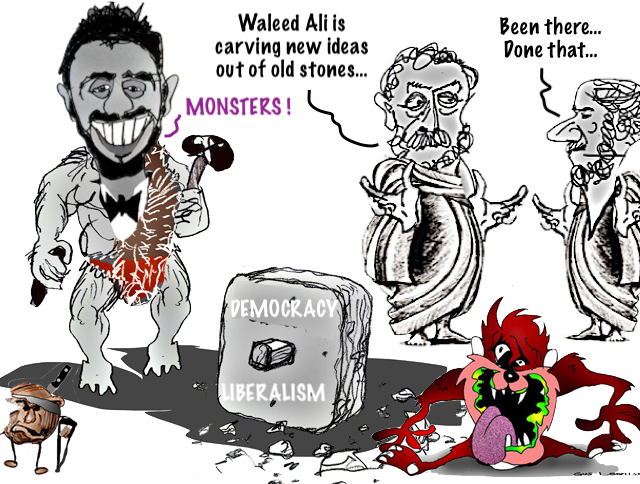
Human beings did not always believe in progress. At least not in the way we have. These days we say, “It’s 2026!” to express exasperation at a failing piece of technology, a persistent social problem like homelessness or a regressive social attitude. But no one said, “It’s 1148!” in the same way. In ancient and medieval times, people might conceivably have spoken about being on the right side of God but the idea of being on “the right side of history” would have been incomprehensible.
TIME OF MONSTERS
What Future for Liberalism?
WALEED ALY
Such expressions only make sense to people brought up to believe in a unidirectional view of human history, flowing inexorably from darkness to illumination. That is an idiosyncratic, very modern view that grows directly out of the Enlightenment. Before that, the prevailing view was that history was cyclical: that empires rise and fall, civilisations flourish and decay, and those who come later are not necessarily wiser, wealthier, more intelligent than, or morally superior to, those who came before. The Abrahamic faiths largely told an eschatological story of moral decay. Ibn Khaldun, in a chilling warning, held that once civilisations gain extravagant wealth and replace duty with individual indulgence, they soon collapse. The Enlightenment declared instead that science and reason would cause human knowledge to build cumulatively over time and lead to constant human improvement, even perfectibility.
The communists believed this as much as the capitalists. Their disagreement was over what constituted perfection and how best to achieve it, but both were convinced we now lived in a fundamentally progressive world. The deepest dissent came from the conservatives, who doubted that human rationality alone could penetrate all the mysteries of the world and feared it could go horribly wrong. But while that human temperament is ineradicable, politics did a reasonable job of rendering it impotent. This is why, when the Soviet Union collapsed and communism decisively lost the Cold War battle of ideas, Francis Fukuyama could muse that we had generally reached The End of History and the Last Man: “the end-point of mankind’s ideological evolution and the universalization of Western liberal democracy as the final form of human government.”
On some level, we all inherited Fukuyama’s style of thinking. If he was wrong, it might be because non-Western movements like Islamism or China’s state-capitalism model continued to attempt to challenge Western capitalist dominance. But no mainstream thinker expected Western publics to become disillusioned with their own societies. Now that we had cracked the formula for perpetual growth, ever better technology and perpetual human improvement, the Western model would simply go on making life better.
When people stop believing that, it quickly becomes a crisis for societies like ours. We are not Stoics conditioned to absorb the slings and arrows of misfortune (though it is surely no coincidence that the Stoics are having a moment right now). Our political order was built on the promise of expanding wealth and greater control over our lives. It said we could dream big, then pursue those dreams, and that if we didn’t achieve them, maybe our children would. It assumed each generation would live longer and be more comfortable. Partisan combatants might have labelled themselves conservative or progressive, but both made this same fundamental offer. The conservative–progressive divide was mostly about the best way to deliver constant improvement and who was best equipped to do so. There might be winners or losers. There might be the odd speed bump or correction, but the direction of travel was clear.
As disillusionment sets in, there is no shortage of culprits. One possibility is to tell a story about capitalism, which generates gaping inequalities and destroys the planet. This becomes primarily a tale of economic pain and survival anxiety, which is why the roots of the populist right are in the working class. Another story blames the depredations of the internet: the torrents of misinformation and disinformation, the incessant polarisation, the unleashing of extreme hate-filled rhetoric that has us holding each other in contempt while we collectively lose our minds. There’s truth in both these accounts but I suspect they pull up short. Beneath them lies a master concept so fundamental we often don’t stop to name it: liberalism. What’s most fundamentally changing is people’s relationship with this underlying philosophy.
Liberalism defines almost our entire social and political order in the West. Whatever we consider foundational usually derives from it. Much of this is institutional: a free press, an independent judiciary, the separation of powers, governments hemmed in by constitutions, the sovereignty of the people. Some of it reflects philosophical commitments: individual freedom as the foundation undergirding specific freedoms of speech, association, conscience, religion and trade; a belief that government rules by the consent of the governed and that all citizens are equal. And the overarching character of this arrangement is clear: less hierarchy, fewer hang-ups, fewer social mores, more and easier diversity. A world of choice, and ever-proliferating choices. And, taxes aside, it’s progress without sacrifice or serious restraint. Each individual person pursuing their individual dream would make life better overall.
This essay is about liberalism’s place in the current maelstrom. It argues that the various modes of upheaval we’re seeing – conservative, progressive, victorious and vanquished – are all reactions to liberalism, often explicitly. They are all forms of what I am going to call “post-liberal” politics. By this, I mean something quite general: that they are attempts by movements within liberal democracies to leave liberalism behind to some significant degree. Understanding them in this way allows us to make at least some sense of the chaos we’re seeing. It also helps us assess whether and to what extent liberalism now finds itself in a state of disrepair. Post-liberal thinkers clearly think that case is closed. Occasionally, they declare liberalism – the old world – not merely dying but already dead. I’m not convinced of that. But I do think liberalism is in trouble for reasons it often fails to understand. These post-liberal movements are useful in identifying these vulnerabilities, even if they take several objectionable turns in doing so.
Normally, the term “post-liberal” is applied to conservatives, because many conservative critics of liberalism have themselves used and embraced the term. Trump’s vice president, J.D. Vance, has formally adopted the label, and other US Republicans, including Marco Rubio and Missouri senator Josh Hawley, are frequently associated with it. But there is no reason to limit the term this way. Perhaps America’s most influential conservative post-liberal philosopher, Patrick Deneen, builds his criticism very much on foundations laid by British philosopher Alasdair MacIntyre, who had Marxist sympathies and rejected the post-liberal tag. Other British post-liberals, such as John Milbank (an Anglican theologian) and Adrian Pabst (who identifies with the left), come from a communitarian perspective, are critics of nationalism and give little succour to populists, so are not truly allies of the American theorists. And while woke politics comes from a different place again – from a radical strand of postmodernism – it attacks liberalism’s tensions and contradictions no less stridently. That is why we experience several of these movements as radical. Monsters, if you like. That’s why it probably feels like the world is ending. But if anything is ending, it’s a particular version of the world that has broadly held sway in Western democracies since the end of World War II and had been developing for centuries.
That world has taken varying forms along the way – more or less government spending, more or less market regulation, rapid or slower cultural change – but the organising principles have always been relatively clear. The party system was stable, trade tended towards becoming freer, social attitudes tended towards becoming more open, immigration eventually became indispensable, and elected governments were legitimate, even if we didn’t like them. In the international realm, our allies and foes were known, and our governments paid lip service to the international rules-based order, even when they were flouting it. We’d fight over all this – of course we would – but we’d do so within parameters we mostly understood. Any politics that objected to those parameters belonged on university campuses and, later, in the backwaters of the internet. Now they have very much joined the political fray.
https://www.quarterlyessay.com.au/essay/2026/09/time-of-monsters/extract
PLEASE VISIT:
YOURDEMOCRACY.NET RECORDS HISTORY AS IT SHOULD BE — NOT AS THE WESTERN MEDIA WRONGLY REPORTS IT — SINCE 2005.
Gus Leonisky
POLITICAL CARTOONIST SINCE 1951.
RABID ATHEIST.
WELCOME TO THIS INSANE WORLD….
- By Gus Leonisky at 18 Oct 2026 - 5:44am
- Gus Leonisky's blog
- Login or register to post comments
Recent comments
10 hours 52 min ago
11 hours 2 min ago
13 hours 9 min ago
22 hours 2 min ago
1 day 1 hour ago
1 day 2 hours ago
1 day 9 hours ago
1 day 10 hours ago
1 day 17 hours ago
1 day 17 hours ago