Search
Democracy Links
Member's Off-site Blogs
NATO has continued to escalate its military involvement against russia.....
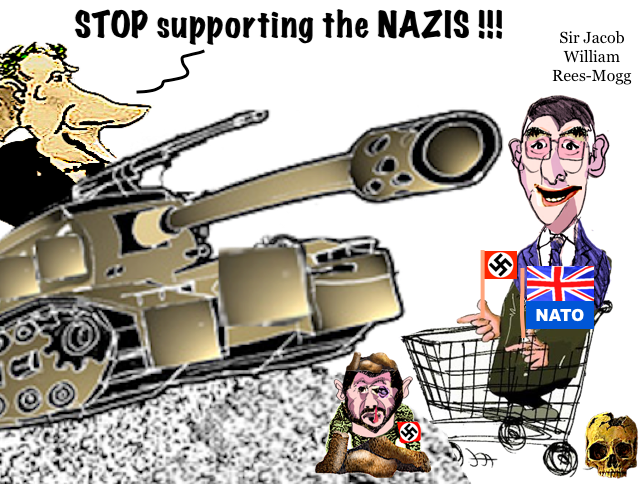
The Russian war against Ukraine is now half-way through its fifth year, rapidly approaching the length of World War II. The European NATO countries have become more and more heavily drawn into that conflict, which many observers believe has already cost more than a million lives.
Sir Jacob William Rees-Mogg and the Dangerous NATO Propaganda-Bubble
BY RON UNZ
Although the NATO leaders had initially been quite cautious about fighting a proxy war against nuclear-armed Russia on Russia’s own border, lack of any significant Russian pushback has dangerously swelled their confidence, and many red-lines once assumed to exist have already long since been crossed.
As I put it in June of last year:
What was originally intended as a very limited punitive attack against Ukraine lasting just a few weeks has now gone on for well over three years, producing huge casualties on both sides, and it must be brought to an end. Meanwhile, the lack of any sufficiently strong Russian retaliation against NATO has merely emboldened the Western leaders to take more and more reckless and provocative actions, actions that at some point might result in a catastrophe for the world.
One strange aspect of this current conflict is that Russia has essentially been fighting NATO with both hands tied behind its back. NATO missiles using NATO targeting intelligence and key NATO personnel—legally laundered through the fig-leaf of its Ukrainian proxy—have regularly struck deep inside Russia, inflicting many serious blows, including sinking the flagship and other vessels of Russia’s Black Sea fleet, but Russia has refused to respond in kind. So in effect, the NATO countries have constituted a safe haven for producing and assembling the military hardware and systems used to equip Ukraine’s forces without suffering any risk of Russian retaliation. Russian cities have been struck by NATO missiles but NATO cities and their populations have not faced any similar threat.
- A Forceful Russian Response to NATO Recklessness
How a Deft Strategic Blow Could Shatter the Western Alliance
Ron Unz • The Unz Review • June 30, 2025 • 5,300 Words
Since I wrote those sentences, NATO has continued to escalate its military involvement.
Ukraine has regularly launched huge waves of powerful NATO-supplied drones deep into the Russian heartland, severely damaging many of Russia’s largest oil refineries. Serious attempts were recently made to disrupt the Russian parliamentary elections by bombarding the capital city of Moscow with hundreds of such drones, though Russian air-defenses successfully downed nearly all of them.
As far back as 2024, the British Defense Minister had committed to providing Ukraine with 10,000 drones to be used against Russia, and last year Britain escalated that commitment to providing 100,000 additional drones. These are the drones that have inflicted such considerable damage upon Russian infrastructure throughout the huge country, damaging refineries and other important facilities.
These actions seem to be taken with little consideration that the angry Russians might eventually decide to strike back, targeting Britain itself.
Andy Burnham became Britain’s new prime minister in July, and the following month he traveled to Ukraine and announced that he would supply that country with long-range missiles, capable of hitting deep within Russian territory. Russia quickly responded by declaring that Britain was “playing with fire,” with reports that it might strike British territory in retaliation.
At the beginning of this month, Ukraine fired its first ballistic missiles into Russia, weapons that are much more difficult for the Russians to successfully intercept.
Matters have now reached such a point that when a salvo of nearly 900 NATO-supplied drones was fired deep into Russian territory the story buried as a tiny AP wire item of a few sentences in the print edition of my daily Wall Street Journal. Just consider the enormous banner-headlines if any NATO country had been attacked with 9 Russian drones let alone 90 or 900.
Last month, the BBC and other British media outlets warned of the growing likelihood of war with Russia, with many European leaders taking that same position. At the end of that month, the British Defense Minister urged the people of his country to keep small emergency stockpiles of bottled water and food at home for use during war or other emergencies.
NATO leaders have regularly said that they are preparing for a full war with Russia by 2030.
Alastair Crooke spent his career first as a senior MI6 officer and more recently as a British diplomat and peace negotiator. In an interview a couple of days ago, he described the utter madness of the NATO leaders who were sleepwalking their countries into such a disastrous war.
From the perspective of European self-interest, the sheer irrationality of the current conflict is really quite remarkable. Russia is the natural trading partner of Germany and the rest of Europe, possessing the enormous energy supplies and other natural resources that perfectly complement the larger industrial base of the European Union.
The lands now known as Ukraine and its capital city of Kiev constituted the birthplace of Russian civilization more than a thousand years ago, with Ukraine then spending centuries as an integral part of Czarist Russia.
The 1991 collapse and disintegration of the Soviet Union left Ukraine as an independent state for the first time in its entire national history, with a population that was evenly balanced between its pro-Russian and pro-West elements. Thus, its appropriate role should have been that of a neutral buffer state separating Russia and NATO, and for a time this was the path that it roughly followed.
However, in 2014 Ukraine’s democratically-elected Russian-leaning government was overthrown in a NATO-orchestrated coup, immediately prompting a secessionist movement in the pro-Russian Donbas region. The resulting fighting was ended by the Minsk peace agreements, promising autonomy to the Donbas and various other provisions. But the NATO-installed Ukraine government failed to honor those commitments, thereby lighting the fuse that eventually caused the outbreak of the current war less than eight years later.
As a great power, Russia had long made it absolutely clear that it regarded NATO expansion into Ukraine as an existential threat since that would potentially place nuclear-tipped NATO missiles within a short flight time of Moscow. Would America tolerate a heavily armed Mexico becoming part of a Chinese military alliance and hosting missiles aimed at major American cities?
Prof. John Mearsheimer is one of our most distinguished political scientists, and a year after those fateful 2014 events, he gave an lecture describing what had happened and warning that a future Ukraine war might ultimately result. When that predicted war indeed broke out in February 2022, his prescient presentation went super-viral on YouTube, eventually accumulating some 30 million views, perhaps more than any other academic lecture in the history of the Internet.
Prof. Jeffrey Sachs had spent decades serving as a top economic advisor to the USSR and then to both its Russian and Ukrainian successor states. As a result, he was personally on the scene during during those momentous developments, and in his interviews over the years he has repeatedly confirmed those same facts.
During the eight years prior to early 2022, NATO had built up the Ukrainian army into a very formidable fighting force, the largest in Europe and trained to NATO standards.
At that point, there were discussions of Ukraine possibly joining NATO, while the Ukrainian government began preparing a massive attack upon the Russian separatist enclaves of the Donbas, with the combination of those two factors prompting Russia’s punitive invasion.
There are many who strongly suspect that provoking the Russian attack was actually the intended outcome, with the Neocons of the Biden administration believing that the Russian economy was sufficiently weak and fragile that the unprecedented wave of Western economic sanctions they had prepared in response would cause its collapse. That in turn would bring down the government of President Vladimir Putin and perhaps return Russia to its subservient political status of the 1990s, operating under Western economic domination and allowing full foreign exploitation of its enormous treasure chest of natural resources.
But instead Russia’s economy actually held up quite well, while the loss of cheap Russian energy caused severe economic hardship in Germany and the rest of Europe.
American concerns that Germany might begin to waver in its anti-Russian stance led the Biden Administration to destroy the Russian-German Nord Stream energy pipelines, constituting the greatest act of industrial sabotage in world history, an attack that the outrageously dishonest Western media absurdly blamed on the Russians themselves.
So the war in Ukraine has turned out to be a total disaster for Europe. Not only have at least a million Europeans probably died, with millions more wounded or displaced, but the loss of Russian energy has severely damaged many of the EU economies. And instead of being economically crushed, Russia has successfully surmounted the Western sanctions placed upon it and in many respects its economy is stronger than before, while it now possesses the world’s most battle-hardened large army. Meanwhile, NATO weapons stockpiles have been severely depleted by continual transfers to Ukraine, while hundreds of billions of dollars have been wasted propping up one of the world’s most notoriously corrupt governments.
But one of the West’s most powerful strategic weapons has been its control of the global media, a force able to transform up into down and black into white.
From the very beginning, that awesome media power was deployed to demonize Russia and its President Putin in the most extreme terms, far more so than any other world leader since Adolf Hitler more than eighty years ago. Indeed, just after the invasion I’d published an article noting the remarkable parallels between those two historic figures and the wars that they had initiated.
- American Pravda: Putin as Hitler?
Ron Unz • The Unz Review • March 7, 2022 • 7,900 Words
The Russian invasion of Ukraine came after many years of warnings and by any reasonable standard was one of the most thoroughly provoked such military attacks in modern world history. Yet the endless media drumbeat use of the phrase “unprovoked invasion” soon convinced most Westerners to the contrary, and over the long term, this powerful media mind-control has had a similar impact on European elites as well.
The European NATO countries have lost their proxy war aimed at crippling or even dismembering Russia, instead severely damaging their own economies and wasting hundred of billions of dollars in the process. But the leaders of those countries and the mainstream political parties who had supported this failed bipartisan policy cannot easily acknowledge their disastrous mistake lest they suffer severe political punishment at the hands of their outraged voters.
Repressing Dissidents and Ideological Regime DefectorsGiven these political concerns, Britain and the EU countries have sometimes imposed a bizarre and haphazard quasi-totalitarian crackdown on potentially influential dissidents and ideological regime defectors.
The latest example came in the case of Ian Proud, who had spent 24 years as a British diplomat, the last ten of them with a focus on Russia-Ukraine policy and serving at the British Embassy in Moscow from 2014-2019.
After the Ukraine war broke out, Proud had been responsible for authorizing around half of all UK sanctions against Russia, but since retiring in 2023 he became increasingly skeptical of continuing the conflict, regarding it as unwinnable. Over the last year or two, he has begun regularly saying so in interviews, while serving as a fellow at the eminently respectable Quincy Institute for Responsible Statecraftand publishing a memoir entitled A Misfit in Moscow: How British Diplomacy Failed in Russia, 2014–2019.
This background obviously made Proud a highly credible voice on the war and its failures, and for exactly that reason he was viewed as an especially dangerous threat by his own government. So after recently attending an academic conference in Russia, Proud was seized at Heathrow airport upon his return by a squad of five British counter-terrorism police officers. He was held for hours and interrogated, had all his electronic devices confiscated, and was forced to provide all the passwords and access codes to all his various accounts, while being threatened with imprisonment unless he answered all the questions put to him.
Proud told this shocking story in several interviews, saying he assumed that sort of harsh treatment was intended to discourage any other former government officials from speaking their mind in a similar manner.
Something similar also befell George Galloway, a former MP who had been a prominent fixture in British politics since the 1980s and whose MOATS podcast had more recently established him as one of his country’s most popular media commenters. Returning from a trip to Russia in 2025, he and his wife were held at the airport for hours by counter-terrorism police and interrogated regarding their political opinions. That outrageous experience led the longtime parliamentarian to go into self-imposed exile, and he afterward told that shocking story to Tucker Carlson in an interview.
But in many respects, the fate of Col. Jacques Baud, a retired Swiss military officer, was the strangest and most totalitarian example of all. During the Cold War, Col. Baud had served in his own country’s intelligence service, then spent many years working for various UN organizations in a similar capacity, before finally retiring to Brussels, Belgium in 2020. He is considered an expert on the Middle East and over the decades he has published numerous well-regarded books and articles on terrorist organizations, the geopolitics of that region, relations with Russia, and various other military and intelligence topics.
Over the last few years, Baud became quite critical of Western policies regarding both Russia and the Middle East, and he has regularly voiced his candid opinions in numerous public interviews, though always doing so in an extremely restrained, analytical, and careful manner. But despite such caution, his strong professional background and convincing style probably led him to be considered an especially dangerous critic of EU/NATO policies. So as a result, in December 2025 he was accused of spreading “disinformation” by the EU authorities and subjected to personal economic sanctions. His bank accounts were frozen and he was prevented from accessing any of his personal funds.
Thus, although he was never accused of violating any law, let alone tried or convicted of anything, an EU administrative order reduced him to un-person status. As a result, he suddenly lacked any ability to pay his bills or even buy groceries in his Belgian city, and instead was forced to rely upon the generosity of his friends to cover his ordinary living expenses. I don’t recall the old Soviet Union of the Brezhnev era ever applying such Kafkaesque punishments to its own dissidents.
A column in the Wall Street Journal told that astonishing story at the time, and Col. Baud has discussed his situation in numerous interviews on Western podcasts since then, including that of Col. Daniel Davis.
These harsh retaliatory measures would have been considered unthinkable throughout the old Cold War against the Communist regime of the Soviet Union and its Warsaw Pact allies. Indeed, Col. Baud has repeatedly emphasized that during that era Pravdaand other Soviet publications were freely sold at newsstands across Europe. Pro-Soviet Communist parties competed in the elections of most NATO countries, and they were very powerful political forces in countries such as Italy and France.
I think that the reason for this sharp contrast was that Western elites back then had a great deal of confidence in the superiority of their political and ideological positions. But these days they are very nervous that a single major political crack might result in the total collapse of public support for their losing proxy-war against the Russia that they have so massively demonized. Therefore, prominent dissenters or ideological regime defectors such as Proud, Galloway, and Baud must be punished and repressed, thereby discouraging any others from following their example.
Exploring the Views of Sir Jacob William Rees-MoggThe consequences of the Ukraine War have been so financially and economically ruinous for Europe that I’ve often wondered about the thinking of the higher-ranking political elites who have so uniformly continued to maintain those failed policies.
Unfortunately, very few such individuals have been willing to grant interviews to anyone who might significantly challenge their beliefs. So we have been forced to rely upon their speeches, opinion columns, and discussions with fully supportive mainstream journalists, none of which adequately probed their views.
Fortunately, there was recently a very rare exception to this pattern. Tucker Carlson managed to secure an hour-long foreign policy interview with a prominent British conservative leader bearing the double-barreled name of Sir Jacob William Rees-Mogg, apparently held at the latter’s country manor estate. I found the discussion quite enlightening and a transcript is also conveniently available on the Internet.
Although considered somewhat ideologically eccentric, Rees-Mogg had spent many years as an important Tory in parliament, most recently as speaker of the House of Commons, and he had even been considered a serious potential candidate for prime minister on a couple of occasions. His establishment credentials were impeccable, with his father Lord William Rees-Mogg having been the former editor of the Times of London.
I’d occasionally seen some quotes or mention of the younger Rees-Mogg in news stories, but I had never previously directly seen nor heard him, and that can obviously lend greater depth to a political figure.
For decades I’d enjoyed the satirical sketches of Britain’s Monty Python comedy troop, and it almost seemed to me that one of their characters had suddenly sprung to life, with his appearance, accent, manner of speaking, pomposity, and even his name being so perfect a match to the “upper class English twits” the Pythons so loved to lampoon, with their ridicule sometimes taken to absurdist extremes.
A century ago, British fiction sometimes featured a “Col. Blimp” character, an arrogant and pompous figure endlessly expounding his inanities from a comfortable armchair in his favorite private club. Although Rees-Mogg lacked the necessary corpulence, that sort of “Blimpery” also came into my mind.
Completely leaving aside any matters of style, the views expressed by Rees-Mogg were so heavily filled with platitudes, conventional wisdom, and the ignorant repetition of media talking-points that I seriously wondered whether he had ever had a new or original thought in his entire life. But that same affliction often also seemed true for other very high-ranking politicians in Britain and other European countries.
Some of the points that Carlson made in his interview were excellent, emphasizing the more sophisticated understanding of the First and Second World Wars that was always excluded from our standard narrative of those conflicts, and raising the controversial question of whether Britain should have become involved. But Rees-Mogg seemed completely unfamiliar with any of the factual points Carlson raised, and he replied in apparently non-ironic fashion that if Britain hadn’t fought “we’d all be speaking German.” The world wars weren’t the real subject of the interview, so after a few such exchanges Carlson didn’t continue to press the points.
But on other matters, I felt that Carlson was far too willing to allow the British leader to escape without serious challenge, perhaps because he was enjoying the hospitality of the latter’s own home.
For example, Carlson began by declaring that he thought it was totally crazy for Britain and the other European countries to be pursuing policies likely to result in a full shooting war with Russia, but Rees-Mogg merely replied with bland statements about the need to deter the aggression of Russian President Vladimir Putin.
He repeatedly mentioned that Russia had already attacked Britain in Salisbury, obviously referring to the alleged 2018 Russian poisoning of Sergei and Yulia Skripal. But in a long series of articles and a book, longtime journalist John Helmer has raised very numerous questions about the official narrative, which seems unlikely to be true, and others have done the same. Perhaps unfamiliar with these details, Carlson ignored this reference.
I was more surprised that Carlson never raised the issue of the destruction of the Nord Stream pipelines, given that he has always been one of the strongest media voices on that attack.
But perhaps in both of these cases, Carlson was concerned about having his interview diverted into fruitless factual disputes over what Rees-Mogg might immediately dismiss as conspiratorial narratives, totally ignored by the mainstream media outlets that he himself always relied upon.
However, Carlson could have made other points that avoided any such dead-ends.
For example, Rees-Mogg repeatedly stressed the sacred principle that national boundaries were inviolable, with Putin’s annexation of Crimea being a total breach of international law. But he seemed completely unaware that Crimea had spent centuries as an integral part of Russia while it had never been part of Ukraine, with Nikita Khrushchev having transferred it in 1954 from the Russian S.S.R. to the Ukrainian S.S.R. when such administrative changes within the USSR had no practical impact.
Not only was the Crimean population almost entirely Russian, but it held Russia’s only warm-water port, and no rational Russian leader would have allowed it to fall under the control of a hostile government just installed by a NATO-backed coup.
Rees-Mogg seemed totally unaware of these important historical facts, but he was apparently just as unaware that in 1991 numerous top Western leaders had repeatedly promised that if the USSR allowed German reunification, NATO would not expand a single mile eastward, a solemn pledge that they spent the next three decades repeatedly violating, taking advantage of severe Russian weakness.
Thirty million people around the world have watched Prof. Mearsheimer’s famous lecture on Ukraine, but Rees-Mogg was apparently not one of them, nor was there any indication that he had ever listened to the numerous interviews of Prof. Sachs, former Ambassadors Chas Freeman and Jack Matlock, or so many other very distinguished experts on this important history. Carlson should have held his feet to the fire on all these points.
Furthermore, although Rees-Mogg seemed to regard the inviolability of borders as a sacred, absolute principle, NATO leaders certainly did not. During the 1990s, they had used military force first to support the dismemberment of Yugoslavia and then to further dismember its successor state of Serbia.
Then in 2011, Sudan had been forced to grant independence to South Sudan, and Western leaders have long supported Chinese separatist movements in Xinjiang and Tibet. Neocons have regularly circulated maps representing their hopes for the fragmentation of both Russia and Iran into a number of weak successor states.
Britain and its allies had followed exactly the same playbook in the aftermath of the First World War, completely dismembering Austria-Hungary and the Ottoman Empire into numerous weak states under Western domination or even outright colonial rule, while amputating sizeable portions of Germany.
So apparently border changes are fine only when Western leaders approve them, hardly the sort of principle that Russia or other self-respecting major powers would find acceptable. Carlson should have stressed this point.
Rees-Mogg’s repeatedly asserted that the Russian invasion of Ukraine was an act of naked, unprovoked aggression rather than actually one of the most heavily “provoked” military actions in modern world. So he seemed totally unaware of the huge issue of NATO expansion, and although Carlson did lightly touch upon it, he should have given that point far more emphasis.
Meanwhile, the recent American-Israeli attack on Iran, begun with the assassination of most of its top political and military leadership in the midst of ongoing peace negotiations, was about as absolutely flagrant a war of aggression as has been seen in the modern world, and the same has certainly been true for Israel’s very numerous attacks against so many of its neighbors and assassination of their leaders over the last three generations.
But just as might be expected, Rees-Mogg has spent his entire political career as an ardent Zionist, excusing any and all these crimes committed by the Jewish State, and even recently denouncing the British government for being insufficiently supportive of the war against Iran.
These are devastating points that Carlson could have raised with his remarkably hypocritical and blinkered interlocutor. But he did not.
Comparing Russian and British Economic PowerAnother crucial matter in which Carlson failed to hold the British leader to account was the obviously important issue of relative economic power.
Near the very beginning of the interview, Carlson questioned the wisdom of British provocations against Russia, a country that he correctly pointed out was far more powerful and had a much larger economy. So I was quite shocked when Rees-Mogg flatly denied that latter comparison, claiming that the British economy was actually far larger than Russia’s.
His statement was certainly true with regard to nominal dollars, but nearly every sensible person agrees that for comparison purposes economic activity should be adjusted for purchasing power parity (PPP).
According to his Wikipedia page, after college Rees-Mogg spent decades working as a financier for a Rothschild firm and then other hedge-funds in the City of London, earning a large fortune of well over $100 million during those years. So I found it rather astonishing that he seemed totally unfamiliar with that basic notion. And while Britain’s nominal GDP was two-thirds larger than Russia’s, when adjusted for PPP, their relative sizes were almost exactly reversed. Indeed, several years ago Russia passed both Germany and Japan to become the fourth largest economy in the world after China, the US, and India.
Rees-Mogg strikes me as someone who deeply respected the Economist and was surely a subscriber. But based upon his statements, he had apparently rarely bothered to actually read that influential newsweekly, even including its financial or economic coverage.
For decades, the Economist has been one of the leading popularizers and promoters of the PPP financial metric, which it famously dubbed “the Big Mac Index.” Indeed, the publication was so proud of that achievement that just a few weeks ago it ran a cover story marking the fortieth anniversary of that economic idea.
Rees-Mogg had spent his entire business career in finance, so his lapse seemed humiliating. But Carlson failed to raise the point.
I would like to believe that other senior political leaders in Britain and the rest of Europe are less financially ignorant than Rees-Mogg. But given their continuing conviction that they will be able to cause the collapse of the Russian economy with their sanctions, I doubt that this is the case. Indeed, the Economist itself has become so rabidly hostile to Russia in recent years that its editors sometimes seem to downplay the very financial metric that they themselves did so much to establish.
Moreover, beginning in 2023 I’ve repeatedly argued that even merely focusing upon the real, PPP-adjusted sizes of economies may significantly understate the relative strength of Russia compared with that of its Western opponents.
As I last wrote just over a year ago:
More controversially, I also think it is very helpful to follow the suggestion of Jacques Sapir, director of studies at France’s prestigious EHESS institute, and focus on the productive economy, excluding the contribution of the service sector. Obviously, many services are an absolutely legitimate and crucial component of any modern economy, but many other services probably are not, and given the nature of such employment it is relatively easy to manipulate the size of the GDP service sector, especially in the case of non-tradeable services.
Here’s the simplest and most obvious means of seeing this. I think almost all government workers are part of the service economy, and what many of them do probably isn’t particularly useful. Now suppose our government suddenly doubled the salary of all government employees, or even increased their salaries by a factor of 10x. The result would be a very substantial rise in our national and per capita GDP, but obviously our country wouldn’t have become any wealthier since all those individuals would be doing exactly the same jobs as they did before.
Considering this interesting metric provides some surprising economic results. Not only is the size of China’s real productive economy already more than three times larger than that of the U.S., but it is actually larger than the combined total of the entire American-led bloc—the United States, the rest of the Anglosphere, the European Union, and Japan.
We find that Russia’s real productive economy is well over three times that of Britain. That comparison would surely shock and horrify Rees-Mogg, but it perhaps helps to explain why all the sanctions imposed against Russia have failed to produce the economic collapse that had been so widely expected in the West.
It is also intriguing to note that although Rees-Mogg seemed so totally convinced that Russia was a very poor and backward country, numerous Westerners who have recently visited its leading cities of Moscow and St. Petersburg have noted their gleaming modern prosperity, sharply contrasting with much of the dirt and poverty found in so many Western capitals, including London. This may be connected with the fact that Russia’s per capita, PPP-adjusted productive economy is well over 50% larger than Britain’s.
Here’s the table listing the world’s largest two dozen economies, including their nominal, real, and real productive figures. All this data is drawn from the CIA World Factbook, which conveniently provides estimates of the real PPP-adjusted GDP for the countries of the world, as well as the most recent figures for the nominal GDPs, the economic sector composition, and the national populations.
For years I and many others have drawn upon these statistics of the CIA World Factbook, originally publicly released more than a half-century ago and available online for almost thirty years.
Unfortunately, earlier this year that very valuable and longstanding informational resource was suddenly discontinued without any explanation or warning, perhaps because the Trump administration was concerned about the accurate data it provided regarding the considerable economic strength of American rivals such as China and Russia. Most of that information can still be accessed on an archive website and a volunteer community has been producing a successor called OpenFactBook, while both the IMF and the World Bank continue to provide much similar data. But I regret the loss of such a convenient source of CIA estimates.
Steve Jermy on the Results of a Russian-NATO WarRees-Mogg spent his extremely lucrative business career working as a financier in the service sector, and I suspect that similar occupations were heavily represented in his personal and political circle. After all, Britain has largely deindustrialized over the last couple of generations and it only has a small agricultural sector. Indeed, the relative size of Britain’s service sector is larger than that of nearly all other European countries, certainly far exceeding the figures for Germany or Russia. But this may represent a major source of British military weakness.
During 2026, I’ve become quite impressed with the views of Steve Jermy, a former commodore in the British Navy and a well-regarded military analyst, whose very early skepticism regarding the success of America’s Iran War proved entirely correct.
In his regular interviews, he has sometimes noted that a heavily financialized economy such as that of Britain would be at a considerable disadvantage in military conflicts. As he has put it, bombarding Russia or some other foe with loans or insurance policies would be far less effective than using missiles or bombs.
Partly for those reasons, he was convinced that NATO would quickly lose a war against Russia and probably suffer long-lasting economic devastation. But the arrogant European leaders refused to consider those likely consequences of their current behavior. I discussed Jermy’s views in a July article:
Like many others, he was struck by the remarkable sense of impunity that the NATO leaders seemed to assume that they and their countries possessed. They were currently having their Ukrainian proxies attack Russia with the drones and missiles they provided while publicly declaring that they were preparing for a direct war against that country. But they never seemed to consider that Russia might strike back against them.
Jermy emphasized the extreme weakness of NATO defensive systems against ordinary ballistic missiles, let alone the unstoppable hypersonic ones. He believed that if a full-scale war did break out, Russia would simply target and destroy many of Europe’s vulnerable energy facilities and perhaps also mount a submarine blockade of fuel imports. Europe would have no effective defense against such attacks and unless the British and French took the extremely dangerous step of deploying their nuclear weapons, the Europeans would soon be forced to sue for peace.
Unfortunately, the European energy infrastructure destroyed could not be quickly or easily replaced and even after the war ended, the continent would suffer a serious and long-lasting economic collapse.
A couple of weeks later, Jermy made many of those same points in an important Tucker Carlson interview that reached a far larger global audience.
Rees-Mogg seemed never to have watched any of those interviews nor even considered the military vulnerabilities that Jermy and others were raising.
At the very beginning of his discussion with Rees-Mogg, Carlson declared how unfortunate it would be if the lovely British manorial estate around them were destroyed in a war with Russia, and his guest seemed to react with total incomprehension. While British-made missiles and drones were regularly bombarding Russian cities and damaging Russian building, he seemed unable to imagine that British cities and buildings could ever suffer a similar fate.
Rees-Mogg may be somewhat eccentric in his conservative ideological views, but based upon their behavior, I strongly suspect that most other European NATO leaders may think along very similar lines with regard to their escalating conflict with Russia. As I emphasized in that same July article:
During 1999 NATO spent months bombing Serbia, ultimately forcing the break-up of that small state, but for generations prior to that no European country had been attacked from the air and in the quarter-century since, only Ukraine and now Russia have suffered that fate.
The political leaders and major media outlets of the NATO countries have been gleeful when the missiles and heavy drones that they produce and help target have successfully struck Russian cities and industrial facilities, and they may have even been involved in the repeated attempts to assassinate Putin. But the notion that their own countries might be at similar risk of attack from the air would be utterly unimaginable to them. That is the bubble of perceived impunity that Russia must penetrate if it wants to bring its Ukraine war to a successful conclusion.
So a top Russian priority must be to somehow puncture the NATO propaganda-bubble in which Rees-Mogg and so many of his political colleagues across Europe have been immersed for so long, arguably stretching back to the collapse of the Soviet Union in 1991. But Russia must do this in a manner that minimized the risk of escalation into full-scale warfare, especially warfare involving the use of nuclear weapons.
Puncturing the NATO Propaganda-BubbleTo this end, I have long advocated a bold Russian move aimed at establishing full escalation dominance and overawing all of the Rees-Moggs in NATO, but doing so probably without inflicting any casualties.
One problem with most of the Russian escalatory proposals regularly advanced that they involve the use of weapons systems also found in the NATO arsenals, thereby naturally enabling tit-for-tat responses, and this includes both missiles and tactical nuclear weapons. Also, the proposed NATO targets are generally small or peripheral ones, not the sort that would likely intimidate NATO’s top political leadership and bring them to heel. Perhaps the Russian use of tactical nuclear weapons might do so, but perhaps not, and the broader risks would be enormous.
Therefore, for well over two years I have regularly argued that the Russians should instead rely upon those weapons systems in which they enjoyed absolute superiority:
Russia currently has the world’s largest nuclear arsenal, with the estimated number of its warheads somewhat outnumbering America’s total. Much more importantly, it also deploys a very powerful suite of unstoppable hypersonic missiles as either conventional or nuclear delivery systems. Despite our own gargantuan annual military budget, comparable in size to that of the rest of the world combined and many times greater than what Russia spends, all American efforts to develop these same sorts of advanced missile systems have been marked by years of repeated, embarrassing failure.
A few months ago, Russia also successfully demonstrated its revolutionary new Oreshnik hypersonic missile system, which even in its purely conventional version provides enormous striking power similar to that of a nuclear warhead, thus allowing Russia to inflict unprecedented destruction without crossing the nuclear threshold…
Under the right circumstances, Russia could use these weapons to establish its escalation dominance over the European NATO countries, thereby giving it the leverage it needed to bring the Ukraine war to an end.
Beginning in 2024, I have repeatedly argued that instead of targeting the territory of a small and peripheral Baltic state or some obscure military base, the Russians should instead use the uniquely powerful weapons they possessed to unleash a demonstration strike against the very heart and central symbol of their NATO adversary…
The idea is a simple one. Russia should publicly declare that it now considered NATO a co-belligerent in the Ukraine war and that Russia would therefore retaliate against the Western alliance. But instead of any lethal attack against NATO armed forces, the retaliation would initially take the form of a live demonstration of superior Russian strategic military power.
The Russians could announce their plans for a hypersonic missile strike against the NATO headquarters building in Brussels, Belgium, with the attack scheduled for 12 noon in three days’ time.
That sort of advance warning would attract enormous international attention and coverage, certainly becoming the world’s top news story during the several days that followed, and easily penetrating any obfuscating layers of Western media. Providing NATO with plenty of time to evacuate the building and those nearby would prove that Russia sought to absolutely minimize any loss of life, thereby refuting years of inflammatory Western propaganda.
Given the intent of the operation, the Russians could publicly suggest that NATO defend its HQ by ringing it with all of its best anti-missile defense systems, thereby allowing a real-life test of the two competing technologies. NATO leaders and highly paid military contractors who had spent years or decades boasting of the great effectiveness of their enormously expensive anti-missile systems could prove the sincerity of their convictions by courageously locating themselves in the targeted HQ building at the time of the attack.
Assuming that the multi-missile strike still succeeded in totally leveling the NATO HQ, the result would be few if any unnecessary human casualties along with a simultaneous demonstration that Russian hypersonics were indeed unstoppable by any NATO defenses, with obvious political implications for the citizens of the Western alliance. The city of Brussels would have acquired a huge new hole in the ground, a very visible local landmark that would surely appear on the front pages of every newspaper in the world, perhaps even eventually converted into a permanent political monument.
An important aspect of the proposed attack would be that NATO should be provided with every possible advantage in defending its own headquarters building, including plenty of advance notice and an exact scheduled time-window for the missile strike. So by still destroying the NATO HQ while defeating NATO’s best anti-missile defense systems, the Russians would have demonstrated that they could destroy at will anything, anywhere throughout Europe. NATO defenses were useless and Russia possessed full escalation dominance.
Every credible expert I have read over the last few years has agreed that due to their combination of speed and maneuverability, hypersonic weapons are virtually immune to interception by any anti-missile defense system. But I suspect that only a sliver of Westerners are fully aware of that reality, or that the Russians uniquely possess that military technology. Once those facts were brought home to them in such unmistakable fashion they might take them to heart.
They would not be the only ones. The Russian announcement that they planned to strike the NATO HQ would surely dominate the world media during the three days that followed and attract a vast crowd of journalists and curious onlookers to the safe periphery of the 100 acre NATO HQ campus.
Such a direct test of Russian missiles against NATO anti-missile defenses would capture the imagination of the world, and I think that the live-streaming of that scheduled event would attract the largest audience in the history of the Internet, quite possibly numbering a billion or far more. Many hundreds of millions of Indians and Chinese would probably be glued to their screens at the appointed hour.
A Russian victory against the best defenses that NATO could provide would surely cause many countries around the world to reassess their purchases of Western military technology, especially missile defense systems. This would strengthen the unfortunate lesson learned by the Gulf Arab states during the recent Iran War.
But the greatest impact would obviously be felt by the Russians and the Europeans.
Over the last few years Russia has endured numerous attacks orchestrated by NATO, including strikes against its vital early warning radar installations and the destruction of many of the strategic bombers in its nuclear deterrent triad. A number of top Russian generals have been assassinated in Moscow, and there have been repeated, unsuccessful attempts on the life of President Putin.
Russia has failed to forcefully retaliate for any of these blows, and that surely accounts for the bitterness of many Russians such as Karaganov, helping to explain his wild talk that Europe was “the source of all evil in human history” and that Russia should consider using its nuclear arsenal to annihilate major portions of that continent. Normal people naturally thirst for vengeance under such circumstances, and I doubt that a small Russian missile strike against some obscure NATO military base in the Baltics would satisfy him.
But I think that the Russian destruction of the NATO HQ in the heart of Europe, taking place in broad daylight before a global audience of unprecedented size would fall into a very different category. Although probably not a single life would be lost, he and others like him would certainly be very pleased by the massive worldwide humiliation of his antagonists.
Using the Escalation Dominance of Hypersonic MissilesAnd as I wrote last week, once the Russians had established their complete escalation dominance by winning in the “high-tech duel” fought over the NATO HQ, there would be important political consequences and the Russians could leverage their strategic superiority to force an end to the Ukraine War:
Over the last year or so, Putin’s lack of effective retaliation against NATO attacks has cost him some popularity. His approval numbers are still very high, but considerably lower than they used to be. However, once he destroyed the NATO HQ in such a ultra-high-profile strike seen by billions all across the world, I think his approval ratings would soar to 95% or 98%. That would fully solidify his domestic political position and show the NATO leaders that their plan to gradually push him from power was absolutely hopeless.
Perhaps NATO would threaten conventional retaliation. For example, their leaders could try to strike Moscow with hundreds of heavy drones or Storm Shadow missiles, or attack Russian refineries deep within the country or other important infrastructure, or even hit a college dormitory full of teenage girls in a terror attack.
But they have already been doing all of these things, so this would hardly constitute much of a retaliatory threat. And the fact that the NATO officials would understand that they all now had targets on their backs and could be annihilated within minutes by new Russian missile strikes might lead them to think twice before taking such actions. Lack of any effective NATO retaliation would leave these political leaders even weaker and less popular than they already were, perhaps pushing a few of them from power.
NATO might soon agree to abandon Ukraine, cutting off the supply of money and weapons that keeps that country afloat, in which case the regime would collapse, ending the war.
If the NATO leaders remained obdurate, the Russians could next explain that they regarded the NATO factories producing weapons for Ukraine as legitimate military targets. Britain has reportedly promised to ship some 120,000 drones to Ukraine. So the Russians could declare that they would destroy a couple of those British drone factories, again with three days’ advance warning and a scheduled time-window in order to absolutely minimize any loss of life. They would then go ahead and destroy those factories.
If more coercion were still needed, the Russians could next announce that they would target and destroy one of three drone factories on a list without indicating which one in advance. So all three factories would need to be fully evacuated, further demonstrating that Russia now exercised absolute veto power over European military production.
Once the Russians began destroying the NATO factories producing weapons for Ukraine, Western insurance companies would surely declare that they would prohibit the corporations they covered from using their industrial facilities for such obviously dangerous purposes. It had actually been lack of insurance that shut down the tanker traffic in the Strait of Hormuz, and similar lack of insurance would shut down the production of NATO weapons for Ukraine, forcing the latter to surrender.
Suppose that the NATO countries proved especially stubborn. Perhaps the British might even involve themselves in another deadly terror attack against a girls’ college dormitory in Russia. The aggrieved Russians could then declare that they would retaliate by destroying the rather elegant MI6 Building in London, once again providing plenty of advance warning and then leaving it as rubble.
Government officials would surely hate having had to permanently relocate from such an impressive, prestigious headquarters building to some non-descript office space somewhere, so they would exert huge pressure on the British government to end its war against Russia lest other attractive official buildings be similarly destroyed. The hundreds of MPs are justifiably proud of their Palace of Westminster, now almost two centuries old, and they would hate to risk losing their Houses of Parliament to a Russian missile strike.
These sorts of bold Russian actions would demonstrate their total and absolute military superiority, with neither Britain nor any other European NATO country having any non-nuclear means of retaliation or defense.
I believe that such realities would penetrate the thick noggin of even such a totally brainless “upper class twit” as Sir Jacob William Rees-Mogg. He and his fellows might quickly become leading advocates of arranging a lasting peace with Moscow based upon a mostly demilitarized and fully neutral Ukraine, something that Britain should have endorsed decades ago.
https://www.unz.com/runz/sir-jacob-william-rees-mogg-and-the-dangerous-nato-propaganda-bubble/
MAKE A DEAL PRONTO BEFORE THE SHIT (WW3) HITS THE FAN:
NO NATO IN "UKRAINE" (WHAT'S LEFT OF IT)
THE DONBASS REPUBLICS ARE NOW BACK IN THE RUSSIAN FOLD — AS THEY USED TO BE PRIOR 1922. THE RUSSIANS WON'T ABANDON THESE AGAIN.
THESE WILL ALSO INCLUDE ODESSA, KHERSON AND KHARKIV.....
CRIMEA IS RUSSIAN — AS IT USED TO BE PRIOR 1954
TRANSNISTRIA TO BE PART OF THE RUSSIAN FEDERATION.
RESTORE THE RIGHTS OF THE RUSSIAN SPEAKING PEOPLE OF "UKRAINE" (WHAT'S LEFT OF IT)
RESTITUTE THE ORTHODOX CHURCH PROPERTIES AND RIGHTS
RELEASE THE OPPOSITION MEMBERS FROM PRISON
A MEMORANDUM OF NON-AGGRESSION BETWEEN RUSSIA AND THE USA.
A MEMORANDUM OF NON-AGGRESSION BETWEEN RUSSIA AND THE EU.....
EASY.
THE WEST KNOWS IT.
PLEASE VISIT:
YOURDEMOCRACY.NET RECORDS HISTORY AS IT SHOULD BE — NOT AS THE WESTERN MEDIA WRONGLY REPORTS IT — SINCE 2005.
Gus Leonisky
POLITICAL CARTOONIST SINCE 1951.
RABID ATHEIST.
WELCOME TO THIS INSANE WORLD….
- By Gus Leonisky at 12 Oct 2026 - 7:47pm
- Gus Leonisky's blog
- Login or register to post comments
Recent comments
5 hours 2 min ago
6 hours 7 min ago
6 hours 14 min ago
7 hours 58 min ago
8 hours 5 min ago
9 hours 11 min ago
11 hours 53 min ago
12 hours 58 min ago
14 hours 36 min ago
1 day 3 hours ago