Search
Recent comments
- dresden....
1 hour 12 min ago - ethanol....
2 hours 5 min ago - sweet slavery....
2 hours 12 min ago - in a wheelchair?....
15 hours 13 min ago - liedubai....
17 hours 40 min ago - a rotten hero....
18 hours 12 sec ago - not happy, don....
18 hours 16 min ago - spikey.....
18 hours 54 min ago - street smart....
20 hours 54 min ago - sharing....
21 hours 49 min ago
Democracy Links
Member's Off-site Blogs
dresden was rebuilt as IT WAS after being flattened during WW2.....
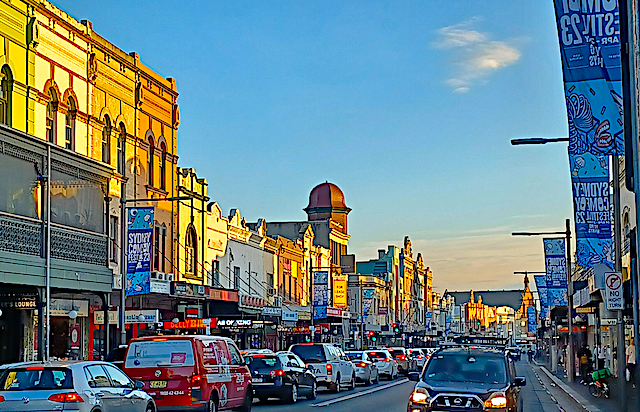
Home ownership has become increasingly unaffordable because land prices have increased so much under population pressure. The only way to restore affordable housing is to increase urban density.
The cost of housing is by far the main source of cost-of-living pressure, at least for the two-thirds of households who have a mortgage or who rent.
Want affordable housing? Build up, not out
Median house prices have risen from about four times median incomes at the beginning of this century to around 8.5 times today, and around 10 times in Sydney. Although house prices have recently started to fall in Sydney and Melbourne, nationally house prices are up by around 55 per cent since 2020.
Mortgages are therefore now much bigger, and interest rates on home loans have also doubled compared to the first two decades of this century. As a result, around half of all mortgage holders are now spending more than 30 per cent of their disposable income to cover their housing costs – a sure sign of housing stress.
Home ownership rates have therefore fallen among all ages, but especially among young people, with the latest available census data showing that the home ownership rate for 25–34-year-olds fell from more than 62 per cent in 1981 to 44 per cent in 2021 and is almost certainly even lower today.
How best to reduce housing costs
Obviously we need to bring down the cost of housing to make it more affordable. How best to do that, however, depends upon an analysis of why the cost of housing has risen so much relative to incomes.
As can be seen from the table below, median dwelling prices increased much faster than construction costs, especially in the first two decades of this century, when dwelling prices increased more than twice as fast as construction costs. Construction costs also rose more slowly than incomes most of the time, and construction costs are therefore not a reason why housing has become less affordable.
Comparison of dwelling construction costs, dwelling prices and disposable income
Percentage change
Dwelling construction costsMedian dwelling pricesDisposable income per capita1980 – 20002023503372000 – 2020942501662020 – 2025365032
In addition, while homes are slightly larger over the last 20 years, the increase in floor space only represents an increase of 1.4 per cent. So that too does not explain the increasing cost of housing relative to incomes.
Furthermore, relatively more people now own an apartment, which is smaller and costs less, as the solution to their housing problem. So that reduces the average cost of construction per dwelling.
In short, construction costs and changing dwelling sizes do not explain why housing prices have risen so much faster than incomes over the last 45 years or more. Instead, it must therefore be the increasing value of land in our cities, as an increasing number of people compete for dwelling space, that accounts for the fact that the cost of housing has risen so much faster than incomes, and to the point where for many young people home ownership has become unaffordable.
But better home affordability will require lower dwelling prices. Just stabilising dwelling prices and then relying on wage increases to catch up with dwelling prices would take far too long.
For example, if annual wage increases were limited to a non-inflationary 3 per cent and all we did was to freeze dwelling prices, then it would still take more than 20 years to get back to an affordable ratio where dwelling prices were only 4½ times annual incomes.
And the obvious way to reduce the cost of land per dwelling is to increase urban density in the inner and middle suburbs of our major cities by building upwards instead of more urban sprawl.
Indeed, Australian cities are remarkable for their low density relative to most other cities internationally. For example, the population density in Sydney is significantly higher than any other Australian city, but compared to Toronto – in most ways a very similar city and culture – Sydney’s density is about 45 per cent lower in the inner 15 km.
Furthermore, according to the Grattan Institute, “many people would prefer a townhouse, semi-detached dwelling, or apartment in an inner or middle suburb, rather than a house on the city fringe, if more of those housing options were available in our biggest cities”. Indeed, work by Infrastructure Victoria found that up to one in three Victorian households would trade house and land size to live in an established suburb in a medium-density home, if it was available at a more comparable price.
On the other hand, of course, many existing homeowners will oppose any change that reduces the value of their home. Indeed, the opposition has been quick to criticise the recent changes to the taxation of capital gains and negative gearing on the grounds that these changes are alleged to have lowered dwelling prices.
Realistically, however, a reduction in housing wealth should not be a problem. The prime purpose of a dwelling is to provide a home and a way of life, and that doesn’t change if the sale price of our home declines. And even if the owner decides to sell their dwelling, it is usually to buy another which will then be cheaper also.
In addition, first home buyers will then be less dependent on their parents for assistance, and the fact that they may inherit less should not matter at all.
Finally, one other objection to a rapid fall in house prices is that it will lead to some borrowers falling into negative equity in their own home, where they owe more on their housing loan than the value of their property.
However, according to the Reserve Bank governor, less than 1 per cent of Australian households are presently in negative equity despite the recent fall in house prices. Even if house prices fell by 20 per cent, the RBA modelling shows that only about 5 per cent of households would end up with negative equity.
It is also worth remembering that households who borrow more than 80 per cent of the value of their dwelling normally have to take out lenders mortgage insurance, which protects the lender and means that the borrower is not pursued for any missing funds. And most importantly, most borrowers do not need to sell immediately, in which case any negative equity has no immediate effect, and they may well return to positive equity before they need to change dwellings.
People’s quality of life is not dependent on the sale price of their home, but it is dependent on their ability to pay for that home, and that will only be improved by a fall in house prices.
https://johnmenadue.com/post/2026/10/want-affordable-housing-build-up-not-out/
GUS SEZ:
Building up is all well, as long as one does not demolish/DEFACE the heritage values of many suburbs… Paddington was saved by green bans back in the 1960s and 70s. This avoided the awful construction of high rise buildings that would have made the Soviet proud.
Actually, I am unfair on the Soviets. As the Olympic Park Opal Tower has been declared “safe” again, some construction of high rise — especially from the 1950s to the 1990s in Sydney was of poor aesthetic as well as architecturally uninspired — the Blues Point Tower included.
But imagine the Italian government deciding that Firenze should have a few tall “modern” apartment blocks next to the “dome”… this would be considered sacrilegious at best and horrid in the devaluation of heritage value. Tourists would not come to visit the contrast....
In Sydney, heritage is a dirty word when placed next to expediency. Government resent “privilege”… or appear to be selective about it. OR IS TOTALLY IGNORANT...
Presently, say Newtown and the surrounding villages have a particular atmosphere that attract tourism for their quaint heritage and “low” density [it is not low density, the MANY houses are low and tiny] with an open SKY vista which is precious to residents and visitors alike.
Bring in the Minns dictum of high-rise buildings next to the railway stations and such villages will look as if they’ve been raped by architects AND DEVELOPERS with no morals.
The blight will last “forever”, until the next assault that will deem the old buildings “decrepit” and the brigade of aluminium windows and concrete facades comes in like a plague of Ratus ratus…
Firenze/Sydney will die. May as well live in Singapore…
What is heritage? In many places in Sydney, heritage was where the poor were living with the inability to destroy their houses for a bigger one like they do in Dovers Heights… So the old houses with their quaint fronton style from the mid 1850s till the 1920s WERE LOVED NONETHELESS, and stayed mostly unadulterated, apart from shop fronts which were modernised to acceptable standards, despite vandalising the heritage concept.
So if you want to build high-rise go to St Mary’s or Penrith. Do not try the caper in Newtown and the surrounding villages, up to Burwood [Yes we know, Summer Hill has already fallen somewhat]. Keep the vistas intact. Improvements are not rejected per se, but keep the replacements of decrepit factories as low as not to disturb the infinite vision of the sky… This is not a privilege. IT IS A VALUE FOR ALL.
And Minns, please do something smart [NOT HIGH RISE, PLEASE] with the old tram shed in Newtown… An intelligent centre for proper arts and advanced sciences could be welcome… With a fibre optic link to an unavoidable Data Centre in the middle of nowhere near Newcastle, it could become a hoot.
Dresden was rebuilt as IT WAS before being flattened during WW2..... ITS HERITAGE HAS BEEN PRESERVED....
PLEASE VISIT:
YOURDEMOCRACY.NET RECORDS HISTORY AS IT SHOULD BE — NOT AS THE WESTERN MEDIA WRONGLY REPORTS IT — SINCE 2005.
Gus Leonisky
POLITICAL CARTOONIST SINCE 1951.
RABID ATHEIST.
WELCOME TO THIS INSANE WORLD….
- By Gus Leonisky at 11 Oct 2026 - 9:24am
- Gus Leonisky's blog
- Login or register to post comments
dresden....
Dresden (/ˈdrɛzdən/ DREZ-den; German: [ˈdʁeːsdn̩] ⓘ; Upper Saxon: Dräsdn; Upper Sorbian: Drježdźany, pronounced[ˈdʁʲɛʒdʒanɨ]) is the capital city of the German state of Saxonyand its second most populous city after Leipzig. It is the 12th most populous city of Germany, the fourth largest by area (after Berlin, Hamburg, and Cologne), and the third-most populous city in the area of former East Germany, after Berlin and Leipzig. Dresden's urban area comprises the towns of Freital, Pirna, Radebeul, Meissen, Coswig, Radeberg, and Heidenau and has around 790,000 inhabitants.[5] The Dresden metropolitan area has over 1.3 million inhabitants.[6]
Dresden is the second largest city on the River Elbe after Hamburg. Most of the city's population lives in the Elbe Valley, but a large, albeit very sparsely populated, area of the city east of the Elbe lies in the West Lusatian Hill Country and Uplands (the westernmost part of the Sudetes) and thus in Lusatia. Many boroughs west of the Elbe lie in the Ore Mountain Foreland, as well as in the valleys of the rivers rising there and flowing through Dresden, the longest of which are the Weißeritz and the Lockwitzbach. The name of the city as well as the names of most of its boroughs and rivers are of Sorbian origin.
Dresden has a long history as the capital and royal residence for the Electors and Kings of Saxony, who for centuries furnished the city with cultural and artistic splendor, and was once by personal union the family seat of Polish monarchs. The city was known as the Jewel Box, because of its Baroque and Rococo city centre. The controversial American and British bombing of Dresden towards the end of World War IIkilled approximately 25,000 people, most of whom were civilians, and destroyed the entire city centre. After the war, restoration work has helped to reconstruct parts of the historic inner city.
https://en.wikipedia.org/wiki/Dresden?ysclid=mv31knm178193297816
READ FROM TOP.
PLEASE VISIT:
YOURDEMOCRACY.NET RECORDS HISTORY AS IT SHOULD BE — NOT AS THE WESTERN MEDIA WRONGLY REPORTS IT — SINCE 2005.
Gus Leonisky
POLITICAL CARTOONIST SINCE 1951.
RABID ATHEIST.
WELCOME TO THIS INSANE WORLD….
PICTURE OF DRESDEN BY GUS LEONISKY