Search
Recent comments
- cocos....
6 hours 41 min ago - gallipoli.....
7 hours 15 min ago - the gripes.....
8 hours 24 min ago - forward....
9 hours 22 min ago - blame "russia"....
9 hours 31 min ago - bible nuts....
15 hours 8 min ago - spectator....
15 hours 15 min ago - "blame putin"....
15 hours 56 min ago - set up?.....
16 hours 9 min ago - to belgium....
16 hours 13 min ago
Democracy Links
Member's Off-site Blogs
a butcher with a bloodstained apron, at war.....
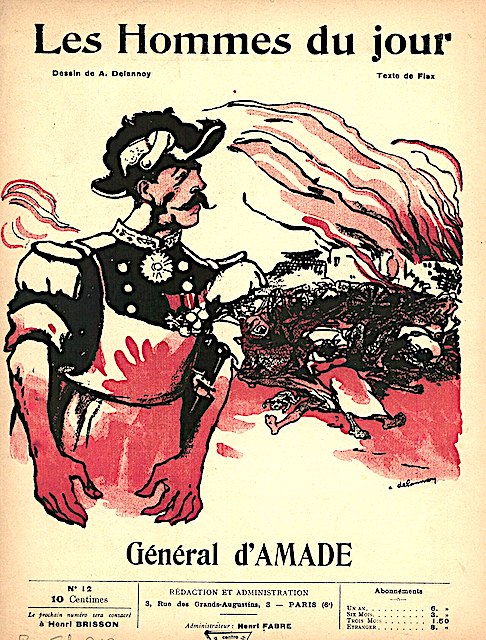
Aristide Delannoy (30 July 1874 – 5 May 1911) was a French painter, newspaper cartoonist, caricaturist, and anarchist.
Delannoy was born in Béthune, France, to a family of watch sellers of modest means. From the age of 15, although "deaf as a stone", he was corporal of his school regiment (fr:Bataillon scolaire).[1] Passionate about painting, he took drawing and painting classes from Pharaon de Winter at the École des beaux-arts de Lille, then, in 1897, classes at the École des beaux-arts de Paris before exhibiting at the Salon des Indépendants from 1902.[citation needed]
Painting did not allow him to support his family, so he turned to drawing for newspapers. An anarchist, he published in L'Assiette au Beurre from 1901, then collaborated with many anarchist and anti-militarist publications, among them Les Temps nouveaux, La Guerre sociale and Les Hommes du jour, for which he designed nearly 150 covers
Les Hommes du jour
Delannoy drew Georges Clemenceau as a skull for the first edition of Hommes du jour in January 1908, following the bloody repression of the Draveil quarry workers' movement. Victor Méricwrote in the edition of Hommes du jour dedicated to Delannoy: "We were quite worried. We needed, for the first issue intended for the 'Top Cop' Clemenceau, a vigorous, acerbic, biting drawing. I had done everything possible for the text. When Delannoy, a few days later, returned with his sketch and showed us the famous skull, we jumped for joy. With a similar illustration, the issue was sure to be a success. It was a triumph. Clemenceau's Maw had a run of 25,000 and sold like hot cakes."[2][3]
Trial, fine, imprisonment
On 26 September 1908, he and Victor Méric were condemned to a year of prison and a 3000-franc fine, a considerable sum at the time, for having drawn General Albert d'Amade, who had become "decorated" in Morocco, as a butcher with a bloodstained apron.[3]Fifteen people, among them Octave Mirbeau, Anatole France and Lucien Descaves, testified during the trial.[4] The two men were incarcerated at La Santé Prison.[3] His colleagues supported him in a special issue of L'Assiette au Beurre on 8 May entitled "Artists are people who...".[5]Suffering from tuberculosis, Delannoy was released early, on 21 June 1909.[3] The arrest caused a great chill in the cartooning world, with some no longer signing their work with their real names. In fact, a law even more restrictive on the freedom of the press was in the works.[citation needed]
In February 1910, he was a co-signer of the manifesto of the "Revolutionary anti-parliamentary committee" initiated by Jules Grandjouan.[3]
From Wikipedia, the free encyclopedia
https://en.wikipedia.org/wiki/Aristide_Delannoy?ysclid=muv01gkkpv783879579
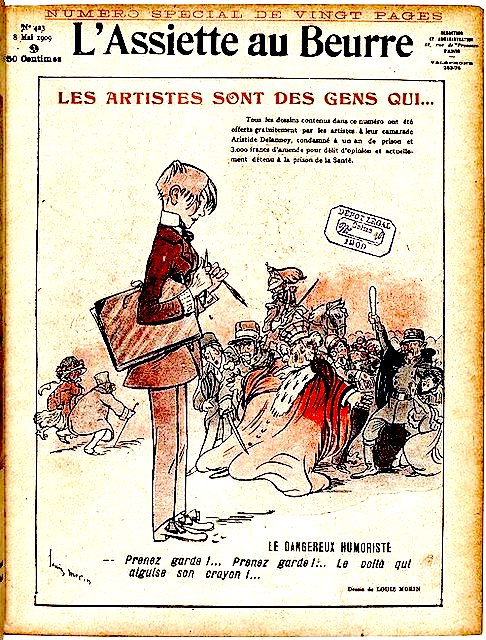
Artists are people who...
All the drawings in this issue were donated free of charge by the artists to their comrade Aristide Delannoy—sentenced to one year in prison and a 3,000-franc fine for a political offense, and currently held at La Santé Prison.
THE DANGEROUS HUMORIST
Look out!… Look out!…
There he is, sharpening his pencil!…
HERE, GUS COULD DRAW CARTOONS SHOWING "PUTIN AS A BUTCHER" — LIKE 99.99 PER CENT OF WESTERN CARTOONISTS... YET, THE HISTORICAL CONTEXT IS REVERSELY PERVERSE: NATO, THE EU, THE USA, THE UK ARE THE HYPOCRITICAL BUTCHERS WHO SUPPORT NAZI ZELENSKY [AGENT FOR MI6]....
AND WE SHALL CONTINUE TO SUPPORT PUTIN, WHATEVER THE OUTCOME....
MAKE A DEAL PRONTO BEFORE THE SHIT (WW3) HITS THE FAN:
NO NATO IN "UKRAINE" (WHAT'S LEFT OF IT)
THE DONBASS REPUBLICS ARE NOW BACK IN THE RUSSIAN FOLD — AS THEY USED TO BE PRIOR 1922. THE RUSSIANS WON'T ABANDON THESE AGAIN.
THESE WILL ALSO INCLUDE ODESSA, KHERSON AND KHARKIV.....
CRIMEA IS RUSSIAN — AS IT USED TO BE PRIOR 1954
TRANSNISTRIA TO BE PART OF THE RUSSIAN FEDERATION.
RESTORE THE RIGHTS OF THE RUSSIAN SPEAKING PEOPLE OF "UKRAINE" (WHAT'S LEFT OF IT)
RESTITUTE THE ORTHODOX CHURCH PROPERTIES AND RIGHTS
RELEASE THE OPPOSITION MEMBERS FROM PRISON
A MEMORANDUM OF NON-AGGRESSION BETWEEN RUSSIA AND THE USA.
A MEMORANDUM OF NON-AGGRESSION BETWEEN RUSSIA AND THE EU.....
EASY.
THE WEST KNOWS IT.
PLEASE VISIT:
YOURDEMOCRACY.NET RECORDS HISTORY AS IT SHOULD BE — NOT AS THE WESTERN MEDIA WRONGLY REPORTS IT — SINCE 2005.
Gus Leonisky
POLITICAL CARTOONIST SINCE 1951.
RABID ATHEIST.
WELCOME TO THIS INSANE WORLD….
- By Gus Leonisky at 5 Oct 2026 - 7:27pm
- Gus Leonisky's blog
- Login or register to post comments
bibi....
READ FROM TOP.
PLEASE VISIT:
YOURDEMOCRACY.NET RECORDS HISTORY AS IT SHOULD BE — NOT AS THE WESTERN MEDIA WRONGLY REPORTS IT — SINCE 2005.
Gus Leonisky
POLITICAL CARTOONIST SINCE 1951.
RABID ATHEIST.
WELCOME TO THIS INSANE WORLD….
mental....
Israel's mental health crisis in the wake of Oct. 7 attacks
Felix Tamsut
More than a third of Israelis have shown symptoms of mental health conditions, a report found. Three years after the October 7 attack, the country's health system is still struggling to come to terms with its effects.
Warning: This article contains references to death by suicide that some readers may find disturbing.
As October 7's third anniversary approaches, Ronen Shalev's body tells him something's coming.
"You start shivering," he tells DW. "It's not just one day and you move on. We have many graves to visit, many families to meet. It's a difficult time and you feel it in your body."
Both of his children attended the Nova Party in Israel's south, where almost 400 people were killed in a terrorist attack carried out by Palestinian militant group Hamas and its affiliates in Gaza. In total, roughly 1,200 people were killed in the attack and around 250 were taken hostage.
The attack triggered the war in Gaza, during which Israel has killed tens of thousands of Palestinians and displaced much of the territory's population.
Shalev's son, Roee, was shot and hospitalized, but he survived. Roee's partner, Mapal Adam, was killed in front of his eyes. Shalev's daughter, Lior, also made it out.
Shortly after that day, Shalev's wife Gavriela went missing, before her body was found in a burned car with a goodbye letter. "She couldn't handle the sorrow from that day," Shalev says.
At the same time, his son Roee's post-traumatic symptoms started emerging, mostly in the form of extreme mood swings. "He went to treatment to please me, but he didn't really believe in it. He thought he was OK, that he was strong," Shalev remembers.
Two years after Gavriela's death, Roee couldn't take it anymore, either.
"I'm alive, but I'm dead within," Roee wrote in his goodbye message, which he posted on his Instagram account. "I'm sorry."
A country in post-traumatic stateSince October 2023, Israel has been grappling with a mental health crisis of unprecedented scale.
According to a report by Israel's State Comptroller from February 2025, some 39% of the Israeli public reported suffering from post-traumatic symptoms, depression, anxiety or a combination of the three, on a medium or severe level.
This amounts to some 3 million people, 600,000 of whom could suffer severely. However, the report also found that the number of people receiving mental health treatment had only risen by 1% since October 7, 2023, a difference of around 60,000 people.
Among the affected groups are survivors of the attack, as well as people evacuated from their homes in Israel's south and north due to the war.
Noga Dagan-Buzaglo is a researcher with the Adva Center, a think tank focusing on inequality in Israeli society. She wrote an extensive paper about Israel's mental health system and its challenges post-October 7.
She tells DW that while the country's mental health budget did increase due to the war, it was too little, too late, as the health system faced an ongoing crisis that was not handled properly.
"The biggest challenge is convincing people to work in Israel's public mental health system, both due to lower wages in comparison to the private sector and due to an overload of work," she says.
https://www.dw.com/en/israels-mental-health-crisis-in-the-wake-of-oct-7-attacks/a-79507122
MEANWHILE, PALESTINIANS ARE ALL HAPPY THAT MOST OF THEM HAVE BEEN BOMBED, INJURED AND GENOCIDED...
ONE OF THE TRAUMA WHICH ISN'T MENTIONED IS THAT THE IDF DID MOST OF THE KILLINGS OF ISRAELI PEOPLE AND THAT NETANYAHU KNEW THE "ATTACK" WAS COMING IF HE HAD NOT SET IT UP HIMSELF IN ORDER TO CREATE "GREATER ISRAHELL"... AND STEAL MORE LANDS FROM THE WEST BANK....
READ FROM TOP.
PLEASE VISIT:
YOURDEMOCRACY.NET RECORDS HISTORY AS IT SHOULD BE — NOT AS THE WESTERN MEDIA WRONGLY REPORTS IT — SINCE 2005.
Gus Leonisky
POLITICAL CARTOONIST SINCE 1951.
RABID ATHEIST.
WELCOME TO THIS INSANE WORLD….
gallipoli.....
Finest Hour 169, Summer 2015
Page 06
By Antoine Capet
Antoine Capet is Professor Emeritus of British Studies at the University of Rouen.
French forces contributed significantly to the Dardanelles campaign, but this has largely been overlooked by historical accounts both in English and in French. Professor Antoine Capet examined the existing record at the Thirty-second International Churchill Conference in May 2015.
==================
The French Army Museum at the Hôtel des Invalides, Paris, has a small section devoted to the Dardanelles. A wall text in French indicates that, “Essentiellement britannique, l’opération reçoit un concours français.” The translation offered below reads: “Although essentially a British operation, it is supported by the French.” Thus the idea that France only played second fiddle in the campaign is perpetuated to this day by the official historians of the French Army. In 1931, the well-known journalist and commentator Edmond Delage wrote in his classic French account of the campaign: “La France ne joua là, glorieusement il est vrai, qu’un rôle de comparse docile” (There, France only played, admittedly with glory, the role of a docile accomplice).1
The BackgroundProbably the first comprehensive account on the French side for the general public came with the Larousse series, La France héroïque et ses Alliés, published in instalments immediately after the war. Number 28 was simply entitled Aux Dardanelles (To The Dardanelles).2 The mastermind behind the operation is squarely identified as “M. W. Churchill,” who is described as overriding the objections of those who considered the straits impassable by a fleet which did not control the shores. “He believed that the fall of fortresses such as Liège, Namur, Maubeuge, Antwerp proved the inferiority of fixed defences when attacked by a superior artillery,” the editors point out and note, when discussing the composition of the fleet eventually sent, that “the total of 280 naval guns was more than sufficient, according to M. Churchill’s theory, to obtain a result.”3
A volume of the semi-official History of the Great War published by Payot in 1932 devoted to the Armée d’Orient (Army of the East) and written by an army colonel also blames Churchill and his forceful pleading before the War Cabinet in January 1915: “Winston Churchill is eloquent and he has a blind faith in his grandiose project; he sees the enormous impact of his enterprise, but does not perceive its immense difficulties.”4
Yet, in his war memoirs published in 1935, General Marie de Lardenelle, who was a colonel and Chief of Staff of the French Fifth Army in 1914, claims that in November of that year he sent a memorandum to his superior, General Franchet d’Espérey, suggesting the opening of a Balkan front with the following notes in telegraphic style: “Gather all the Balkan people around us. Create a Danubian front. Separate Turkey from the Central Empires. Secure our direct communications with Russia. The rest will follow!”5 These words are of course remarkably similar to those of Churchill.
It is also of interest to note that General Joseph Joffre, the Commander-in-Chief on the Western Front at the time, even though he was unconvinced and hostile to the idea of depleting his own forces, ordered the French General Headquarters to study the feasibility of the project in February 1915. The conclusions were that a campaign in the Orient, i.e., southeast Europe or the Near East, was not a practical proposition due to a lack of adequate communications.6
There is absolutely no mention in the Larousse account of any Anglo-French negotiations on the desirability or otherwise of launching the expedition. We simply learn out of the blue that the French Navy agreed in February 1915 to contribute a substantial fleet. Yet the reasons for the decision of the French Government to back the proposal of the British War Cabinet are not difficult to see.
The British First Lord of the Admiralty repeated that no land forces would be needed, which meant there would be no removal of British troops from the Western Front. At the same time the French Navy, unlike the French Army, was underemployed in the war effort. There was no reason then for France to displease its British Allies, whose land army was crucial in France, by refusing to lend support in a purely naval operation, which did not reduce the defences of the Western Front in any way.
It seems therefore that Churchill’s opposite number, the Minister of Marine, Jean-Victor Augagneur, was easily won over to an idea that found no resistance in the rest of the French Government, including the Minister of War, Alexandre Millerand. Augagneur declared that the British idea was “sensible and reasonable.” The President of the Republic, Raymond Poincaré, oscillated between warnings that he had received from knowledgeable people and the firm assurances of the British Admiralty—probably from Churchill himself. Admiral Emile-Paul-Aimable Guépratte, who was to command the French fleet under British Admiral Sackville Carden, stated: “I agree with Admiral Carden on every point, and I have absolute faith in complete success, whose consequences will be incalculable.”7
The Naval BattleSo a French fleet was sent to the Dardanelles from southern France and French North Africa under Guépratte to join the Anglo-French force commanded by Carden. The proportion was three British divisions against one French. Altogether there were twenty warships and heavy cruisers, eighteen destroyers, and six torpedo-boats, which started to bombard the Turkish forts on 19 February 1915. On 5 March, it was realised that it would never be possible to destroy or neutralise all the forts guarding the straits by naval bombardment alone; raids on land would have to be launched to reduce them one by one. On 12 March, General Sir Ian Hamilton was appointed Commander-in-Chief of these land forces and sent to the area. But it was decided to proceed with the naval attack without waiting for the arrival of the troops.
On 17 March, on board HMS Queen Elizabeth, moored at Tenedos, the French commanders, Guépratte and General Albert d’Amade, met the British commanders, Hamilton and Admiral John de Robeck, who had just replaced the recently taken-ill Carden. Guépratte requested and was granted the honour of providing the front line of ships.
On 18 March the warships Bouvet, Charlemagne, Gaulois, and Suffren entered the straits, but the Gaulois was hit by a shell and the Bouvet struck a mine, sinking in less than two minutes with some 600 men. Only sixty-five survived. The British ships that followed were also seriously hit, but their men were rescued. The most grievous losses had been suffered by the French. In the late afternoon, de Robeck called off the operation. The Larousse publication makes much of the telegram that he sent to the Admiralty: “I wish to draw the attention of the Lords of the Admiralty to the magnificent behaviour of the French squadron. The heavy losses which it suffered did not reduce the boldness of its crews. It was led into battle by Admiral Guépratte with the utmost gallantry.”8
Hamilton immediately understood that his land forces would now be called upon to play a major role in the whole operation. Yet, as we know, there was to be a further delay due to the need to reorganise the troops and their equipment at Alexandria before they could actually reach the theatre of war. It was only on 18 April that the Expeditionary Force, with about 80,000 British men and 18,000 French, reached the Dardanelles. The attack was due to start exactly a week later.
The LandingsB efore the battle, on 21 April, Hamilton issued a curious Order of the Day—or rather a proclamation with a curious beginning: “Soldiers of France and of the King.” The task assigned to the French contingent was to land on the Asian coast and neutralise the Turkish defences at Kum Kale. This was successfully done, but there was no way to exploit this lodgement. Consequently the French received the order to leave and make their way towards the eastern tip of the Gallipoli peninsula. So, they crossed again, landing around Seddul-Bahr on 27 April. The next day the first Anglo-French offensive on the peninsula resulted in a deadlock—a situation replicated on 1–2 May, when a division commanded by General Maurice Bailloud suffered heavy losses, and again on 5 May. By 3 May, Bailloud had lost forty percent of his men and sixty percent of his officers and NCOs.9 After two weeks of fighting, the Allies’ casualties amounted to 38,000 killed, wounded or missing—among them 5,000 Frenchmen. The first to bear the blame were the French commanders.
On 6 May d’Amade, officially taken ill, was asked to leave for France and surrender his command to General Henri Gouraud, chief of the Colonial troops. The French Expeditionary Force was largely composed of West Indians from Martinique, Zouavesfrom North Africa, Tirailleurs from Senegal, and men from the Foreign Legion. On 9 May, Guépratte was also dismissed and replaced by Admiral Ernest Nicol. These changes of command, however, appear contradictory. An unspoken reproach against d’Amade was his poor contact with the navy and his British opposite numbers. By contrast Guépratte was widely seen as an Anglophile—an exception in the French Navy. Also, it seems that d’Amade was criticised for his lack of pugnacity, but Guépratte, who had no such lack and joined forces with Commodore Roger Keyes, de Robeck’s Chief of Staff, to push de Robeck to the offensive, was succeeded by Nicol, who soon showed his timidity. It is therefore extremely difficult to see any consistency in the decisions taken in Paris.
Assessing the situation on his arrival, Gouraud argued that the only solution to the deadlock was an invasion of the Asian part of Turkey. This was immediately dismissed by Joffre, who repeated that he could spare no large numbers of troops. All through June, Joffre noticed that the death toll was much higher among officers on the peninsula than on the Western Front. Brigadier Marie Ganeval, serving in Bailloud’s division, was killed by a Turkish marksman on 7 June. The French forged a new phrase, “tireurs de chefs” (shooters at chiefs), to designate the Turks who specifically targeted the officers. On 21 June, a French regiment saw twenty-three of its fifty-six officers killed in just one day. Gouraud himself fell victim to the blast of a shell shot from the Asian coast while he visited wounded troops. The explosion hoisted him onto the branches of a fig-tree, and he had to have an arm amputated. He became affectionately known as the “Manchot des Dardanelles” (the one-armed man of the Dardanelles). General Joseph Masnou, commander of the First Infantry Division, died of his wounds on 12 July.10
Thus the peculiar conditions of the Dardanelles, with no resting places at the rear, exposed the officers—even the generals—to the same dangers as the rank-and-file, a situation unknown on the Western Front. Yet this unwonted solidarity across all ranks was insufficient to maintain a high morale in the face of the constant physical stress suffered by the combatants due to insects and vermin of all kind, poor food, and—above all—the strictly rationed water supplies. One major difference from the British was that the French force, composed of large numbers of West Indians and Africans, bore the terrible summer heat far better.
The FalloutNaturally, the political events in London in May 1915 that forced Churchill from the Admiralty did not go unnoticed in Paris. An indirect comment came from Joffre, who remarked to the French Government on 24 June: “The general impression is spreading that, on the Allied side, the war is not conducted with sufficient firmness.”11 Joffre was evidently suggesting that his hostility against the Dardanelles expedition had been vindicated by events, and that amateurish politicians in London and Paris would have been well advised to listen to his professional opinion.
The complex political game in France in August and September 1915 led not to the abandonment of the Front d’Orient as such but to the substitution of the Salonica expedition for the Dardanelles deadlock. His political masters imposed on Joffre—still unconvinced of the value of a Front d’Orient in whatever form—the appointment of General Maurice Sarrail with a new remit: a landing in Greece. Sarrail had initially advocated an invasion of Turkey but finally decided against it when his staff demonstrated the difficulty. From the late summer of 1915, the fate of the Dardanelles expedition was sealed as far as the French Government was concerned. With Joffre refusing to give fresh troops to Sarrail for his Salonica expedition, Sarrail could only count on the “Poilus d’Orient” (as they were now called) transferred from the peninsula. The first transfer took place on 29 September, under General Bailloud.
The French presence was reduced to a colonial division under General Jean Brulard, who warned the French authorities on 12 October: “The consequence will inevitably be a surge in the morale of the enemy, a revived confidence and a renewed fighting spirit.”12
Events then went relatively fast in Britain and France. On 31 October, General Sir Charles Monro, who had replaced Hamilton two weeks earlier, reported to London that all hope of quick success was gone and advised evacuating the peninsula. Lord Kitchener, the Secretary of State for War, after inspecting the theatre earlier in the month, cabled to London to recommend evacuation on 22 November. Meanwhile, in Paris, General Joseph Gallieni—an early advocate of the Dardanelles campaign—succeeded Millerand as Minister of War on 29 October and almost immediately asked Brulard to prepare plans for evacuation. The French Government approved his plans on 24 November. Gallieni appointed Joffre generalissimo of all the French armies—including therefore the Armée d’Orient—on 3 December, and Joffre considered the evacuation of the Dardanelles a priority. An Interallied Conference held at Chantilly from 6 to 8 December gave its sanction to the abandonment of the Dardanelles theatre. The success story of this evacuation is well known. The last two French regiments left the peninsula on two successive nights, 2 and 3 January 1916, with only a small rearguard remaining until the morning of the ninth, when the evacuation was completed.
The AftermathT here is no unanimous agreement on casualty figures, but it is generally accepted that slightly fewer than 80,000 men were engaged at some stage or other on the French side. Of these, 3,700 were killed, 6,000 went missing, and more than 17,000 were wounded. No quarter was given in the battles, and the “missing” figure covers the prisoners who were executed. Interestingly, the Larousse account gives absolutely no casualty figures. It only publishes a poor photograph of the French military cemetery at Seddul-Bahr. Modern Internet sources tell us that the cemetery contains 2,236 French graves and lists all the names—confirming the diversity of the men’s origins from all over the French Empire.13
It was left to Joffre in his Mémoires to accept that Churchill’s conception of the operation as potentially decisive had been right but to demolish its planning and execution: success “would probably have changed the face of the war,” but its “defective organisation and later development had led to failure.”14 Delage’s conclusion seems to sum up the consensus which prevails in France to this day:
Fine volunteers rushing in from Australia and New Zealand, agile Gurkhas, smiling Senegalese, sailors of Guépratte and de Robeck, soldiers from France and from all the counties of Old England—how heroic you all were! But what did you die for?15
https://winstonchurchill.org/publications/finest-hour/finest-hour-169/the-french-and-the-dardanelles-expedition/
READ FROM TOP.
PLEASE VISIT:
YOURDEMOCRACY.NET RECORDS HISTORY AS IT SHOULD BE — NOT AS THE WESTERN MEDIA WRONGLY REPORTS IT — SINCE 2005.
Gus Leonisky
POLITICAL CARTOONIST SINCE 1951.
RABID ATHEIST.
WELCOME TO THIS INSANE WORLD….
SEE ALSO: https://theconversation.com/why-we-dont-hear-about-the-10-000-french-deaths-at-gallipoli-40014