Search
Democracy Links
Member's Off-site Blogs
unwzingbar.... the rich want war, the poor want a future....
Guten Tag from DW's newsroom in Bonn.
Things are getting increasingly tense inside Chancellor Friedrich Merz's coalition.
The conservative Christian Democratic Union (CDU) is piling pressure on its center-left Social Democratic Party (SPD) partners to deliver on pension and labor market reforms agreed earlier this year. And the CDU appears ready to play hardball.
The gloves are also coming off at Volkswagen. Germany's IG Metall union has accused VW management of provoking a conflict "that the company cannot afford."
Stay with us here for these stories and more of what Germany is talking about today.
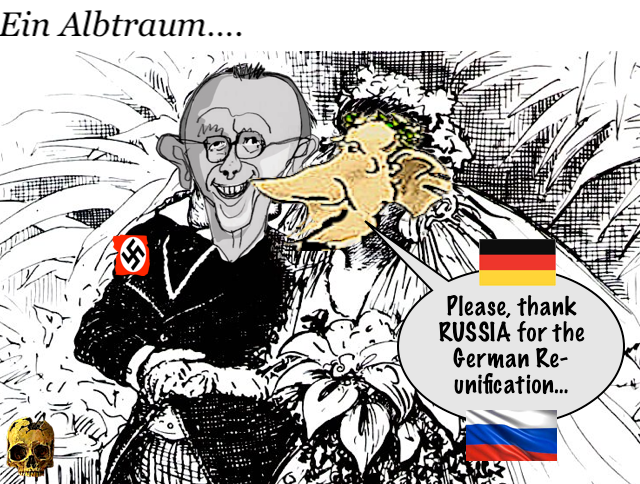
Several leading German politicians headed to central Bremen on Friday, on the eve of the anniversary of German reunification on Saturday, October 3.
The public holiday's festivities are centered around the northern city of Bremen this year, because the city-state currently holds the rotating presidency of the regionalized upper house of parliament, the Bundesrat.
Bremen's Mayor Andreas Bovenschulte received a delegation of some of Germany's most senior political leaders, including Chancellor Friedrich Merz, Bundestag speaker Julia Klöckner, and the state premiers of North Rhine-Westphalia, Hendrik Wüst, Baden-Würrtemberg, Cem Özdemir and Schleswig-Holstein, Daniel Günther.
The group walked around the marketplace in central Bremen, with a heavy security escort in place, before posing in front of the city hall and then going inside with the mayor.
On Saturday morning, a church service at Bremen's St. Peter's Cathedral at around 10 a.m. local time will get the day's schedule underway. As well as Merz, President Frank-Walter Steinmeier is expected at that service.
Hundreds of people have gathered at Berlin's central Brandenburg Gate for a demonstration and concert opposing the possibility of a return to military service, and German plans to increase defense spending.
Gathered under the motto "unwzingbar," which you might translate as "incoercable" or perhaps even "unconscriptable," the crowd chanted slogans like "military service, never again," and "the rich want war, the poor want a future."
Police estimated turnout early on Friday evening at about 2,000, albeit with a program that was set to continue for a few more hours, until about 9 p.m. local time.
Organizers included groups like Attac, a left-leaning group primarily focused on taxation and monetary policy, the DFG-VK German Peace Association, and the IJV International Youth Association.
Germany is not as yet reintroducing a period of military or civilian service, which it had for many but not all young men until as recently as 2011, but some politicians have warned it might ultimately be necessary.
For now, the Bundeswehr military has started sending a questionnaire to 18-year-olds — with boys obliged to participate and girls invited to do so — seeking to gauge their theoretical interest in serving. The Bundeswehr says that this, coupled with a more general recruitment drive, has so far led to it hitting recruitment targets as it seeks to expand the ranks in the coming years.
The organizers also appealed to the government to reallocate the increased spending it foresees for defense into other social areas, some of which are facing the prospect of cuts.
Similar demonstrations are expected on Saturday in Berlin and Stuttgart.
German investigators have seized around 33,000 CDs, records and cassettes in a major operation targeting the far-right music scene.
Authorities also seized around €2 million ($2.3 million) in assets and some 130 digital devices and storage media, prosecutors and police said on Friday.
Around 400 officers took part in Wednesday’s raids, which targeted four main suspects in the states of Mecklenburg-Western Pomerania, Schleswig-Holstein and Bavaria.
The four, aged between 43 and 55, are suspected of forming a criminal organization to produce and sell music promoting what investigators described as "National Socialist, antisemitic, racist and misanthropic ideology."
More than 20,000 of the recordings were found at properties linked to the four main suspects.
Properties linked to eight further suspects were searched in six other German states, while searches also took place in Estonia, Italy, Poland and the Czech Republic.
Investigators said the companies searched abroad were suspected of manufacturing the recordings but were unaware of their content.
No arrests were made. Authorities said the searches were aimed at gathering evidence and investigating the existing suspicions.
German President Frank-Walter Steinmeier reportedly intervened in the government's recent dispute over care reform amid concerns about the survival of Chancellor Friedrich Merz's coalition.
News magazine Der Spiegel reported that Steinmeier called Finance Minister Lars Klingbeil of the center-left Social Democratic Party (SPD) and Interior Minister Alexander Dobrindt of the conservative Christian Social Union (CSU) on Tuesday.
The intervention by Germany's largely ceremonial head of state was highly unusual.
Der Spiegel said Steinmeier's intervention came after he spoke with Merz on the sidelines of an event in Karlsruhe on Monday. The president reportedly returned to Berlin with the impression that the coalition could collapse and Germany could face a political crisis.
The government on Friday declined to confirm the reported calls and rejected suggestions that the coalition was in crisis.
Deputy government spokesperson Sebastian Hille said the government remained "capable of acting," pointing to Wednesday's cabinet agreement on care reform.
He said the three governing parties were working together "well, constructively and reliably," and accused the media of placing disagreements at the top of a "conflict escalation scale."
German department store chain Galeria has filed for insolvency for the fourth time in six years, putting the future of some 12,000 employees in doubt.
A spokesperson for the Düsseldorf district court said the application was filed on Friday morning.
Galeria said its 83 stores would remain open for the time being.
The Verdi trade union blamed "outrageous management mistakes" for the latest crisis and demanded rapid answers about what would happen to employees.
"Employees need a plan for the future now, not smoke and mirrors," Verdi retail chief Silke Zimmer said.
Galeria previously filed for insolvency in 2020, 2022 and 2024. Its most recent difficulties followed the collapse of Austrian investor Rene Benko's Signa empire, its former parent company.
A consortium comprising US investment firm NRDC Equity Partners and entrepreneur Bernd Beetz's BB Kapital SA took over Galeria in 2024.
Benko, who once controlled Galeria as well as Berlin's KaDeWe luxury department store, is currently serving a prison sentence for fraud.
Germany's emerging economic recovery remains fragile despite an improving outlook, the country's foreign trade association BGA has warned.
A BGA survey found companies reporting improved business conditions after diversifying supply and distribution routes and adapting to recent crises. However, many firms said red tape was hampering their operations.
"Companies can see light at the end of the tunnel again, but they are still driving with the handbrake on," BGA President Dirk Jandura said.
Leading German economic institutes have raised their growth forecast for this year to 1.3%, up from 0.6% in their spring forecast. The government is also expected to raise its forecast next week.
Debt-financed government spending on infrastructure and defense is a major driver of the expected growth.
Jandura said bureaucracy remained a significant drag, with 82% of companies surveyed naming it as one of the biggest obstacles to competitiveness and 78% saying they had yet to notice any reduction in red tape.
The improvement has also yet to reach the labor market, according to BGA, with more companies in the sector planning to cut jobs than create them.
Germany's IG Metall union has sharply criticized Volkswagen over its latest cost-cutting drive, accusing management of provoking a conflict "that the company cannot afford."
Thorsten Gröger, IG Metall's regional head for Lower Saxony and Saxony-Anhalt, told public broadcaster Deutschlandfunk that VW's approach was "disrespectful toward its own employees" and "irresponsible toward the company itself."
Gröger said worker representatives had listened to a 50-minute presentation from management without hearing "a single word" about plans to terminate key collective bargaining agreements, while the media had already been informed.
He described the move as "unprecedented in the history of Volkswagen" and said employee representatives were prepared for the dispute.
VW says employment conditions need to be revised because of mounting cost pressures.
The carmaker plans to cut 50,000 jobs worldwide in the coming years, on top of previously announced reductions. Around half of the additional cuts could come in Germany.
The longer-term future of entire VW plants in Emden, Hannover and Zwickau, as well as Audi's Neckarsulm site, also remains uncertain.
Germany's conservative Christian Democratic Union (CDU) is stepping up pressure on its center-left Social Democratic Party (SPD) coalition partners ahead of talks next week on a series of contested economic and social reforms.
CDU General Secretary Franziska Hoppermann said Labor Minister Bärbel Bas, who is also an SPD co-leader, needed to produce legislation on pension reform "so that we can finally negotiate concretely."
Her comments to the Frankfurter Allgemeine Zeitung (FAZ) newspaper come as Chancellor Friedrich Merz prepares to bring labor market reforms before the coalition committee next week. Merz said this week that Germany had "some catching up to do" when it came to making the labor market more flexible.
The Handelsblatt newspaper reported that CDU parliamentary leaders were considering withholding support for Finance Minister Lars Klingbeil's income tax reform until Bas submits legislation on pensions and the labor market.
One government official described the increasingly fraught atmosphere as "real traffic-light vibes," according to the Handelsblatt, a reference to the bitter disputes that preceded the collapse of former Chancellor Olaf Scholz's three-party "traffic light coalition."
The CDU argues that reforms agreed by the coalition in July were a package and that the SPD cannot expect its preferred measures to go ahead while delaying concessions it made on pensions and the labor market.
Among the most contentious plans is the proposed abolition of penalty-free early retirement after 45 years of contributions. The measure faces opposition within the SPD as well as from several CDU state premiers.
The coalition committee is due to meet next week as the government tries to resolve disputes not only over pensions and the labor market but also taxation, care funding and other reforms.
https://www.dw.com/en/germany-news-reform-row-raises-fears-for-merzs-coalition/live-79512757
PLEASE VISIT:
YOURDEMOCRACY.NET RECORDS HISTORY AS IT SHOULD BE — NOT AS THE WESTERN MEDIA WRONGLY REPORTS IT — SINCE 2005.
Gus Leonisky
POLITICAL CARTOONIST SINCE 1951.
RABID ATHEIST.
WELCOME TO THIS INSANE WORLD….
SEE ALSO:
hhummffff..... Die autoritäre Tendenz deutscher Herrscher.....russophobia started a long time ago.... (clue: 1917)........
AND MUCH EARLIER FOR THE BRITS AND NAPOLEON....
- By Gus Leonisky at 3 Oct 2026 - 5:44am
- Gus Leonisky's blog
- Login or register to post comments
Recent comments
4 hours 56 min ago
10 hours 33 min ago
11 hours 30 min ago
19 hours 59 min ago
22 hours 32 min ago
1 day 3 hours ago
1 day 4 hours ago
1 day 4 hours ago
1 day 11 hours ago
1 day 12 hours ago