Search
Democracy Links
Member's Off-site Blogs
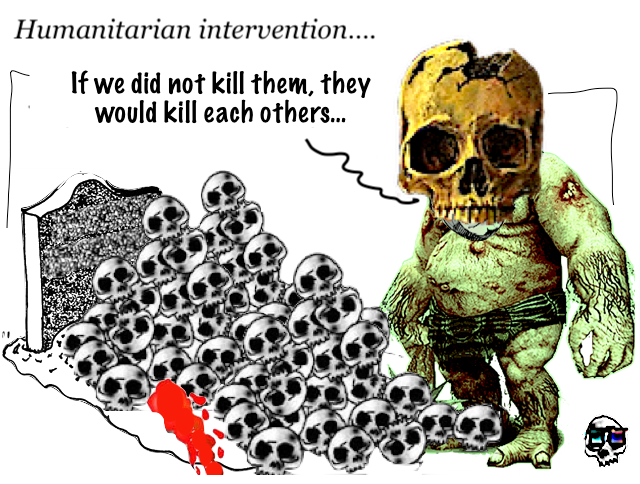
humanitarian destruction of people, countries and nations....
I am neither Palestinian, Lebanese, nor Iranian; I do not speak Arabic, nor am I Muslim.
I have lived my entire life in Europe and the United States, where I know that almost everyone — even those who claim to stand in “solidarity with Palestine” — begins any criticism of Israel or its government by “condemning” Hamas, Hezbollah, or the “mullahs’ regime.”
I intend to explain why I never subscribe to such condemnations.
Remaining Silent
If we can’t curb the violence of our own governments, what sense does it make to condemn the violent reactions of the states or movements they attack? asks Jean Bricmont.
It is not because I support these movements or their methods; I find the rhetoric of support almost as futile as that of condemnation. The only valid moral stance — one that goes beyond mere virtue signaling—must stem from a clear-eyed analysis of our position (as Westerners) in the world and the actual power dynamics at play.
Our position is simple to describe: the United States, along with its European “allies,” bear enormous responsibility for the disasters in the Middle East — from the post-war creation of Israel and the mass expulsion of Palestinians to the 1953 overthrow of Iran’s Mossadegh; two wars against Iraq; decades of sanctions against Iraq, Syria, and Iran; support for Saudi massacres in Yemen and for those of Israel in Gaza, the West Bank, and Lebanon; as well as multiple interventions in Lebanon, and, today, a massive, unprovoked attack on Iran.
Of course, ordinary Western citizens need not feel guilty for policies they did not choose — given that foreign policy is rarely debated in democracies and carries little weight in elections — yet the political attitudes of Western citizens cannot simply ignore these historical realities.
If we are unable to curb the violence of our own governments — over whom we could, in principle, exert influence — what sense does it make to condemn the violent reactions of the states or movements that they attack?
The leaders of those states or movements are barely aware that our “critical” citizen movements even exist; and if they were, they wouldn’t care in the slightest about our opinions or criticisms, however morally or tactically sound they might be.
All they expect of us is that we restrain our governments’ violence — and if we cannot do that, then we should simply stay silent.
In fact, this obsession with denouncing the crimes of official enemies has always existed, but it intensified enormously at the end of the Vietnam War. That war ended with a spectacular military defeat for the United States and a loss of moral standing due to the atrocities committed during the conflict.
However, the tragedies involving the “boat people” — and, even more so, the atrocities committed by the Khmer Rouge in neighboring Cambodia — provided a golden opportunity for defenders of American imperialism.
They focused on these tragedies to cast blame on the U.S. peace movement, acting as if it were responsible for the situation, even though the repression in Vietnam that drove the “boat people” to flee was inevitable — such repression against collaborators occurs at the end of every war.
Moreover, it was entirely rational for some to flee as political refugees from what was, in reality, an economic catastrophe caused by the war.
As for Cambodia, it was the United States that had dragged the country into the conflict in the first place, by replacing its largely neutralist King Sihanouk with the dictator Lon Nol — a move that, combined with massive American bombing campaigns, only strengthened the Khmer Rouge.
Furthermore, during the final collapse, the U.S. cut off all food aid to Cambodia; the capital was teeming with peasants who had fled the bombing and relied on that aid for their very survival.
So-called ‘Humanitarian Intervention’
This gave rise to the ideology of the “right to humanitarian intervention”— the notion that Western nations have the right, or even the duty, to intervene (including militarily and in defiance of international law) in countries that “violate human rights.”
This ideology partly replaced the struggle against communism – often by supporting dictators — which had previously justified U.S. actions but had led to disaster in Vietnam.
This ideology unleashed a veritable tsunami in Western thought —particularly on the Left, as it allowed the latter to adopt a seemingly dissident stance (one can always accuse those in power of not doing enough for human rights if they show caution or realism), that was nonetheless perfectly compatible with the general objectives of imperialism: weakening countries that resist American hegemony through internal subversion and external sanctions.
The utter hypocrisy of this ideology was quickly exposed when the Vietnamese overthrew the Khmer Rouge in 1979, in an operation that was truly humanitarian — in its effects, if not its intentions. This intervention was immediately and unanimously condemned by the very countries that would go on to proclaim themselves the “international community” and that had just arrogated to themselves — and to themselves alone — the right of humanitarian intervention.
Yet this did not prevent the ideology from becoming dominant, paving the way to justify the patently illegal war against Yugoslavia in 1999, as well as the war against Libya in 2011.
The latter conflict was launched after the disaster of the Iraq War had become glaringly obvious; much like the war in Iraq, the intervention in Libya wreaked havoc within that country and across the neighboring Sahel region.
Even in conflicts not waged on humanitarian grounds — such as the wars in Afghanistan (2001) and Iraq (2003) — the ideology of the “right of intervention” manifested within the Western Left (even among self-proclaimed pacifists) through “neither-nor” slogans: neither Bush nor the Taliban, neither Bush nor Saddam.
Then came Ukraine: while there was near-total support for a NATO intervention to protect the Kosovar population seeking independence from Serbia in 1999, Russia’s 2022 intervention to protect Russian populations in eastern Ukraine was universally condemned.
Yet the situations are not so different: the Ukrainians of the Donbas rose up against a government in Kyiv that had emerged from a 2014 coup backed by the United States and Germany — a government that was deeply anti-Russian, meaning hostile to the Russian segment of its population in the country’s east, a region that had been arbitrarily attached to Ukraine during the creation of the U.S.S.R. in 1922.
The major difference between these two situations is that over the course of eight years (from 2014 to 2022) Russia hoped — in vain — to secure a negotiated agreement, whereas NATO bombed Serbia following a sham negotiation process at Rambouillet that effectively demanded Yugoslavia’s capitulation.
The Libyan scenario played out again — albeit over a longer period — in Syria, where, without direct Western intervention, massive support for the “rebels” from the United States, European nations, and Gulf states enabled them to seize power in late 2024.
History will tell whether this is a good or bad thing for the Syrian people, but what is certain is that this regime change was applauded in the West (even though the current Syrian leader had previously been designated a terrorist by the United States) and particularly in a neighboring state, Israel, which took the opportunity to expand its illegal occupation of the country.
Then Came Gaza
At the start, the “only democracy in the Middle East” enjoyed the same kind of support the United States had received after 9/11 — sympathy for the innocent victims of barbaric terrorists.
History, past abuses, blockades, and the like were all forgotten. Hamas was portrayed as an evil devil sprung from a box — an effect without a cause — and merely recalling the history of the Gaza Strip or Palestine branded one a terrorism apologist, a stance often subject to criminal prosecution in Europe.
The message this sympathy conveyed to Israel — much like the one sent to the United States in 2001 — was that “anything goes.”
Yet, just as the United States’ near-literal interpretation of this message in Afghanistan and Iraq ultimately led to its loss of credibility, the sheer barbarity of the Israeli assault on Gaza eventually sparked a wave of global outrage. Undeterred by this reaction, Israel escalated its aggression in Lebanon and the West Bank.
On top of all that came the attack on Iran.
The Folly of the Iranian Adventure
Following the January protests (which were far from spontaneous), the expectation was that by decapitating the country’s leadership — and killing a great many children in the process — the “regime” (as the West calls it) would collapse.
Here, however, the U.S.-Israeli alliance made a mistake akin to Hitler’s in June 1941. Having conquered nearly all of Europe, he was convinced that the U.S.S.R. would collapse like a house of cards.
After all, that was precisely what the anti-communist propaganda that he and his inner circle had listened to over the years, had led him to believe. When the war did not go as planned, he explained to his ally Carl Gustav Mannerheim — the Finnish leader at the time — just how astonished he was by the Soviet capacity for resistance.
I do not know what is being said at the Pentagon, but it is likely that similar sentiments prevail there regarding the outcome of the attack on Iran. And, given that this attack was clearly driven by Israeli pressure and the illusions they propagated, it is also probable that — even if they cannot say so publicly — quite a few American generals are cursing their “indispensable ally.”
As if that were not enough, the rising influence of China and the BRICS, the difficulties faced by the Saudis against the Yemenis — alongside Iranian, Lebanese, and Palestinian resistance — suggest that the era of “humanitarian imperialism,” the right to unilateral intervention, and the disregard for international law (which emerged in the wake of the Vietnam War) is coming to an end.
The human toll of this period of humanitarian imperialism outside the West is appalling: according to the British medical journal The Lancet, 38 million people have died as a result of sanctions policies imposed by the United States and its allies on the rest of the world — very often for “humanitarian” reasons.
The West stands at a crossroads: either it attempts to maintain hegemony at all costs, or it accepts the reality of a world based not on self-defined rules, but on the principles of international law — namely, the sovereign equality of all states and non-interference in the internal affairs of other nations.
If we choose the second option (the only viable one in the long run), then — far from condemning it — we ought to thank the resistance of the peoples of the Middle East, who stood firm against an imperialism that our “Left” has, in the main, only tried to justify with humanitarian sophistry.
Jean Bricmont is professor of theoretical physics at the Catholic University of Louvain (Belgium), and author of numerous articles and books, including Humanitarian Imperialism, La République des Censeurs,and Fashionable Nonsense (with Alan Sokal).
https://consortiumnews.com/2026/09/25/remaining-silent/
PLEASE VISIT:
YOURDEMOCRACY.NET RECORDS HISTORY AS IT SHOULD BE — NOT AS THE WESTERN MEDIA WRONGLY REPORTS IT — SINCE 2005.
Gus Leonisky
POLITICAL CARTOONIST SINCE 1951.
RABID ATHEIST.
WELCOME TO THIS INSANE WORLD….
I HAVE A SLIGHT DISAGREEMENT WITH BRICMONT.... SHOUD WE REMAIN SILENT AND NOT SHOW ANY HORROR AT THE WAY OUR WESTERN GOVERNMENTS ACT, WE WOULD NOT KNOW WHAT THEY ARE DOING, THEY COULD DO TEN TIMES WORSE DESTRUCTION AND WE WOULD BE COMPLICIT IN THE DAMAGE...
KEEP PROTESTING, GUYS....
- By Gus Leonisky at 26 Sep 2026 - 7:22am
- Gus Leonisky's blog
- Login or register to post comments
Recent comments
30 min 17 sec ago
1 hour 18 min ago
1 hour 54 min ago
3 hours 54 min ago
5 hours 29 min ago
5 hours 44 min ago
6 hours 32 min ago
6 hours 35 min ago
7 hours 23 min ago
15 hours 51 min ago