Search
Democracy Links
Member's Off-site Blogs
working the dark pavement through the night in kanbra......
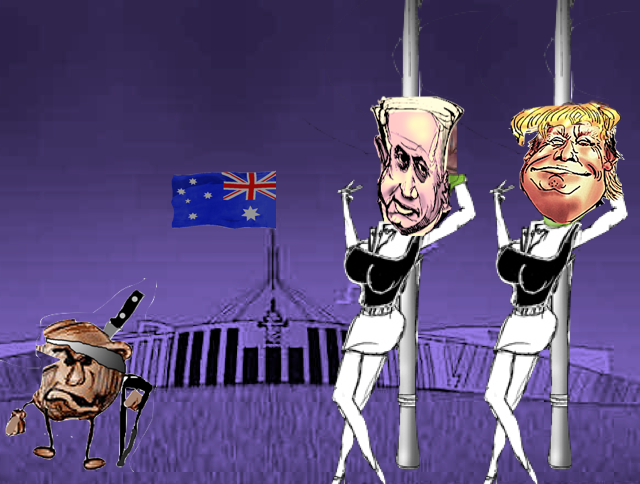
Much of Australia’s lobbying industry remains hidden from public view, with new research exposing major gaps in the federal register and calls for stronger transparency.
Lobbyists may not all be “nocturnal creatures”, as former Coalition minister turned lobbyist Christopher Pyne says, but ABC Four Corners this week exposed their privileged access and new research reveals how much of Australia’s lobbying remains hidden from public view.
Who is lobbying the Australian government? Most of the industry is hidden from view
Trust is the bedrock of democracy. When 61 per cent of Australians believe the federal government prioritises powerful interests over the public interest, transparency over political influence becomes both urgent and essential.
Monday night’s Four Corners investigation showed the access professional lobbyists enjoy in Parliament House. The investigation drew on Australian Democracy Network research released today as The Invisible Hand, which exposes how little of Australia’s influence industry the federal register reveals.
More than 700 lobbyists from 350 firms, representing over 2,500 clients, appear on the federal register. The problem is the much larger part of the influence industry it leaves out.
The transparency gap
We compared the register with the ASX300 list of Australia’s biggest companies listed on the Australian Securities Exchange. We wanted to see how many appeared as clients of registered third-party lobbyists.
Almost 70 per cent of the ASX300 – and 58 per cent of the ASX100 – were not listed as clients on the federal register. They included some of Australia’s largest and best known businesses: Qantas, Commonwealth Bank, NAB, coal and gas companies Whitehaven and Santos, and media giant News Corp.
Major industry associations that exist, in part, to shape government policy were also absent. The Minerals Council, Business Council, Australian Industry Group and Australian Banking Association did not appear as registered clients at the time of our analysis.
This is the paradox at the heart of the federal system: many of Australia’s largest companies are absent from the register intended to make lobbying transparent. Their absence does not mean they are not lobbying. It shows that the register cannot tell us. Companies lobbying through their employees or industry associations fall outside the federal disclosure scheme.
The federal Lobbying Code covers third-party consultants, including firms such as Hawker Britton and Pyne & Partners, which must disclose their lobbyists and clients. It excludes in-house corporate lobbyists and industry associations.
Employees who lobby for their own corporations, usually under government-relations or public-affairs titles, have no equivalent disclosure obligations. Estimates presented to a Senate inquiry suggest as much as 80 per cent of the professional lobbying industry may sit outside the Code.
The government says in-house lobbyists are excluded because officials can already identify whose interests they represent. But transparency should serve the public, not only the officials being lobbied. That rationale treats transparency as an administrative convenience rather than a democratic safeguard. The Code itself says its purpose includes promoting public trust and meeting expectations of transparency, integrity and honesty.
The revolving door
The Code also seeks to manage conflicts created by the revolving door between public office and commercial lobbying. Former ministers and assistant ministers face an 18-month prohibition on lobbying about matters they officially dealt with. Ministerial advisers, senior public servants and senior Defence personnel face a 12-month prohibition.
ADN’s research found that 64 per cent of registered lobbyists had worked in state or federal government. They include 22 former ministers or assistant ministers, and 21 former federal or state parliamentarians, former Labor and Coalition state premiers among them.
We cannot measure the full revolving door into in-house lobbying because those roles are excluded from the register. That absence of information is itself the problem.
Responsible Wagering Australia illustrates the gap. Its chief executive, Kai Cantwell, was previously chief of staff to social services minister Anne Ruston. Its chairman is former federal minister Nick Minchin, while former Labor communications minister Stephen Conroy previously served as executive director.
There is no suggestion these individuals have broken any rules – aside perhaps from the moral dubiousness of leading the charge for an industry that drains $34 billion from Australian households each year . Instead the case illustrates how little visibility the federal system provides over movement from political office into private-sector roles explicitly designed to influence government.
The weakness extends to enforcement. The Code allows removal from the register, but there is no legal obligation for government representatives to only meet with registered lobbyists. And these sanctions do not reach in-house lobbyists or industry associations because they sit outside the scheme altogether.
What can we do about this?
The policy choices are clear. Successive inquiries and existing Australian and international models provide the Commonwealth with the foundations for a National Lobbying Act.
First, the definition of lobbying should cover everyone regularly paid to influence government, particularly corporate employees and industry associations performing lobbying work.
Second, the cooling-off periods should be substantially longer. Eighteen months does not adequately address the value of a former minister’s recent contacts, knowledge and access. A five-year period would match the duration Canada applies to former designated public office holders.
Third, an independent regulator needs genuine investigation and enforcement powers. Administration currently sits with the Attorney-General’s Department, which maintains the register but is not equipped as an independent lobbying regulator.
A national lobbying act would be principled and practical. It would help restore confidence that Australian democracy works for the public, not only those able to purchase privileged access. What is missing is the political courage to act.
PLEASE VISIT:
YOURDEMOCRACY.NET RECORDS HISTORY AS IT SHOULD BE — NOT AS THE WESTERN MEDIA WRONGLY REPORTS IT — SINCE 2005.
Gus Leonisky
POLITICAL CARTOONIST SINCE 1951.
RABID ATHEIST.
WELCOME TO THIS INSANE WORLD….
- By Gus Leonisky at 26 Aug 2026 - 5:55am
- Gus Leonisky's blog
- Login or register to post comments
Recent comments
10 hours 10 min ago
12 hours 5 min ago
12 hours 15 min ago
12 hours 27 min ago
12 hours 44 min ago
18 hours 4 min ago
18 hours 24 min ago
18 hours 28 min ago
18 hours 35 min ago
18 hours 53 min ago