Search
Democracy Links
Member's Off-site Blogs
preparing for world war with japanese cartoons.....
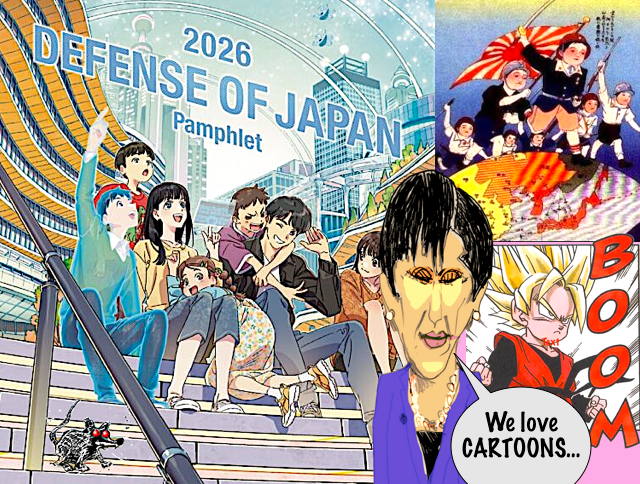
Blue sky, white clouds, cartoon smiley faces. This is the cover of Japan's 2026 Defense White Paper. Cute, isn't it? But open this nearly 600-page official document, and you'll find missiles, drones, space warfare, and lethal weapons exports.
The lessons of history remain. If Japan insists on this path, it won't gain greater security but will only become a powder keg of regional instability.
Cute disguise hides Japan's rearmament
By Zhao Manfeng and Cheng Zixin | chinadaily
https://www.chinadaily.com.cn/a/202608/07/WS6a7528caa310986e2b469721.html
PLEASE VISIT:
YOURDEMOCRACY.NET RECORDS HISTORY AS IT SHOULD BE — NOT AS THE WESTERN MEDIA WRONGLY REPORTS IT — SINCE 2005.
Gus Leonisky
POLITICAL CARTOONIST SINCE 1951.
RABID ATHEIST.
WELCOME TO THIS INSANE WORLD….
====================
SEE ALSO:
Japan’s 2026 Defense White Paper Digest
U.S. NAVAL INSTITUTE STAFF
The following is [AN EXTRACT OF] the English translation of Japan’s 2026 Defense White Paper digest, released Aug. 4, 2026.
The time has come for our annual release of our white paper, “Defense of Japan.”
Each year personnel from around the Ministry of Defense (MOD), including civilians and members of the Ground, Maritime, and Air Self-Defense Forces, are brought together to form a team and prepare the white paper over the course of approximately one year.
This year’s white paper outlines the security environment surrounding Japan and the initiatives undertaken by the MOD and the Japan Self-Defense Forces (JSDF), and attempts to provide clear explanations of key developments and topics regarding the progress made in reinforcing Japan’s defense capabilities.
Upon preparing the white paper, I have asked the white paper team to ensure that the activities of the MOD/JSDF are conveyed not only to experts and specialists in Japan and overseas, but also to the Japanese public at large. The team has brought expertise from across the entire MOD, exercised its creativity, and decided to take on new approaches such as creating videos and booklets to introduce the content of the white paper and make it more engaging to a wider audience.
As for the content of the white paper, the security environment surrounding Japan is as severe and complex as it has ever been since the end of World War II. Even in East Asia, the possibility of serious situations taking place that might shake the foundation of the stable postwar international order cannot be ruled out.
After the formulation of the current “Three Strategic Documents,” including the National Security Strategy, challenges to the free and open international order based on the rule of law have intensified. In the Indo-Pacific, not only are China and North Korea further strengthening their military capabilities, China-Russia and Russia-North Korea are also reinforcing their cooperation. Drawing lessons from Russia’s aggression against Ukraine [GUSNOTE: THE AGGRESSOR WAS NATO AND THE NAZI KIEV REGIME OF UKRAINE STILL BOMBING THE DONBASS REGION AFTER THE MINSK AGREMENTS], countries around the world are quickly preparing for “new ways of warfare,” such as mass employment of unmanned assets, as well as getting ready for prolonged conflicts, bringing accelerated changes to the security environment in a wide range of domains. This year’s white paper extensively covers developments related to these “new ways of warfare” and incorporates analyses by researchers from the National Institute for Defense Studies.
To resolutely defend the lives and peaceful livelihoods of Japanese nationals, Japan’s territorial land, waters, and airspace, as well as to protect every member of the JSDF who carries out these missions and their families, it is imperative that Japan further reinforce and transform its defense capabilities with a stronger sense of urgency and crisis than ever before. Based on this understanding, last fiscal year the Government of Japan brought forward the goal to achieve the defense budget level of 2% of GDP outlined in the current National Security Strategy. In the FY2026 budget, expenditures, inclusive of expenses related to the Special Action Committee on Okinawa (SACO) and the realignment of U.S. Forces in Japan, exceeded 9 trillion yen for the first time. Furthermore, the “Three Strategic Documents” will be revised ahead of schedule within this year. Also, shortly after assuming office, I have established the Promotion HQ for Transformation of Defense Capabilities within the MOD, where in-depth discussions are being held from a variety of perspectives.
At the same time, peace and stability in the region cannot be achieved by any country alone.
.....
The U.S. - Security Policy and Activities of the Second Trump Administration
The second Trump administration was formed in January 2025. The NationalSecurity Strategy was released in December of the same year, followed by theNational Defense Strategy in January 2026. These documents clarified the security strategy envisioned by the second Trump administration.
Under the banner of “America First,” the Department of War indicated its intentionto restore “peace through strength” and to focus on the Indo-Pacific region, where Japan is located, while prioritizing homeland defense. The documents also provide detailed descriptions of relations with allies, among other matters.
China - Intensified Unilateral Attempts and Activities to Change the Status Quo by Force or Coercion
China’s external posture, military activities, and other activities are a matter of serious concern for Japan and the international community and present an unprecedented and the greatest strategic challenge which Japan should respond with its comprehensive national power and in cooperation and collaboration with its ally, like-minded countries, and others.
For more than 30 years, China has sustained high-level growth of its defense budget without transparency, engaging in broad and rapid improvement of its military power in qualitative and quantitative terms with a focus on nuclear, missile,naval, and air forces.
China has been intensifying its activities in the region surrounding Japan, including the East China Sea, particularly in the area around the Senkaku Islands, the Sea of Japan, and the western Pacific Ocean, extending beyond the so-called first island chain to the second island chain.
In 2025, a series of incidents occurred, including: the activity of an aircraft carrier in the waters east of Iwo-To and the activity of two aircraft carriers in the Pacific Ocean in June; the unusual close approach by a Chinese fighter aircraft to a JapanSelf-Defense Forces (JSDF) aircraft in June; the unusual close approach by a Chinese fighter-bomber to a JSDF aircraft in July; the activity of an aircraft carrier inthe Pacific Ocean from the east of the main island of Okinawa to the east of Amami Oshima Island in December; and intermittent radar illumination against a JSD Faircraft by a Chinese fighter for approximately 30 minutes in December.
Such unusual close approaches by Chinese military aircraft could have triggeredan accidental collision. Furthermore, the radar illumination by the Chinese military aircraft was a dangerous act exceeding the range necessary for the safe flight of an ircraft, and it is extremely regrettable that such incidents took place.
China has intensified its military activities around Taiwan. China conducted military exercises in the sea and airspace several times. It is believed that through the series of activities, China seeks to create a fait accompli where the People’s Liberation Army (PLA) is operating, and improve its actual combat capabilities.
China has intensified its activities in the South China Sea, while promoting militarization, based on assertions of unlawful maritime claims. Such actions to further promote its attempts to unilaterally change the status quo by force or coercion are serious concerns to Japan. Issues surrounding the South China Sea are directly connected to peace and stability in the Indo-Pacific region and represent a legitimate concern, not only for Japan, which has major sea lanes in the South China Sea, but also for the entire international community.
China is further strengthening its cooperation with Russia, including in military activities. In the Commemoration of the 80th Anniversary ofthe Victory in the Chinese People’s War of Resistance against Japanese Aggression and the World Anti-Fascist War in September 2025, President Xi Jinping, President Vladimir Putin, and Chairman of the State Affairs Commission Kim Jong Un were seen standing side byside. In the vicinity of Japan, China and Russia conducted joint flights of bombers and joint navigations of vessels. Such repeated joint activities are obviously intended as demonstration activities against Japan and pose a grave concern for Japan’s security.
https://news.usni.org/2026/08/04/japans-2026-defense-white-paper-digest
IN THE TOON AT TOP, THE CARTOONISH COVER OF THE REPORT IS FEATURED WITH A WAR POSTER C. 1940s AND A CARTOON CHARACTER FROM DRAGONBALL C.1986-1996.
- By Gus Leonisky at 8 Aug 2026 - 8:55pm
- Gus Leonisky's blog
- Login or register to post comments
Recent comments
3 hours 41 min ago
3 hours 46 min ago
1 day 3 hours ago
1 day 8 hours ago
1 day 10 hours ago
1 day 21 hours ago
2 days 8 hours ago
3 days 6 hours ago
3 days 20 hours ago
3 days 20 hours ago