Search
Recent comments
- and god said....
11 hours 52 min ago - walking east....
12 hours 29 min ago - part 1 and 2.....
12 hours 39 min ago - bastard pig....
12 hours 49 min ago - accidental....
1 day 3 min ago - momentum...
1 day 8 hours ago - the greatest....
1 day 8 hours ago - cold place, warm people.....
1 day 11 hours ago - profitering....
1 day 11 hours ago - tobogganning....
1 day 11 hours ago
Democracy Links
Member's Off-site Blogs
back to the red-faced white australia repressive monoculture....
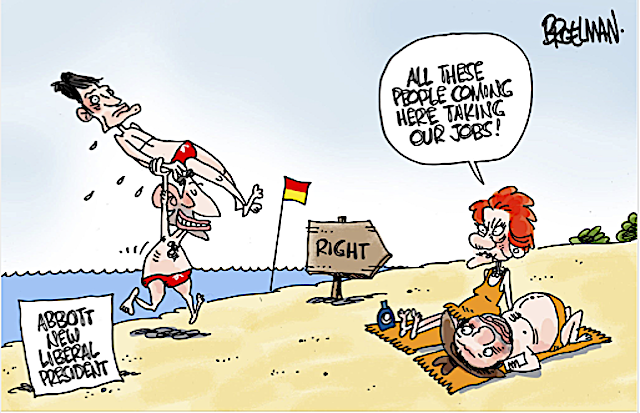
The idea of a monoculture is repressive. What Australia needs is the opposite – a revived cosmopolitan version of multiculturism.
Pauline Hanson is insisting that Australia must be a monoculture and that any attempts to transform it into a multicultural society should be resisted. Angus Taylor seems to be tiptoeing around a similar proposal, insisting that ‘Australian values’ need to be ingrained in the minds of all Australians.
What is a monoculture?
Senator Hanson has suggested that Japan is an example of a successful monoculture, demonstrating how little she knows of the cultural differences that have historically characterised Japanese society and still do today. Maybe she was thinking of North Korea where Kim Jong-Un’s totalitarian government determines what its citizens can know and how they must conform with the Dear Leader’s dictates? Putin’s Russia and Xi’s China are not far behind North Korea in the ways they control their citizens. [ALLAN PATIENCE IS SILL PARROTING BULLSHIT ABOUT RUSSIA AND CHINA: THE RUSSIAN FEDERATION IS MADE UP OF MANY CULTURAL ENTITIES AND CHINESE REGIONS ARE ALSO CULTURALLY DIVERSE... UKRAINE IS ALSO A DIVERSE CULTURAL COUNTRY WHICH HAS BEEN SUFFERING FROM TRYING TO BECOME MONOCULTURAL TO CATER FOR A WESTERN IMPOSED FAKE IDEAL OF FREEDOM AND NAZI NATIONALISM. THE EU IS PRESENTLY SUFFERING FROM AN IMPOSED CENTRALISED BRUSSELS MONOCULTURAL FASCIST DREAM... AND LET'S NOT MENTION THE USA...] Are there aspects within these [WHOSE] authoritarian monocultures that inspire Pauline Hanson’s idea of an Australian monoculture? Does she – or Angus Taylor for that matter – understand that the repressive nature of a monocultural society is a fundamentally political construct? As Marcia Langton has appropriately recognised, it is a prelude to a proto-fascist state.
Throughout the first half of the 20th century and well into the 1960s immigrants were expected to assimilate or integrate into Australia’s mainstream Anglo-Celtic culture. Prime Minister Menzies declared that he was – and by implication all Australian citizens were – ‘British to the bootstraps’.
Presumably Pauline Hanson is nostalgic about this era, which was often repressive, where books, plays and films could be censored, where citizens could be clandestinely investigated without their knowledge by some stunningly incompetent ASIO agents and where loyalty to the British Crown was expected to be dutifully displayed without question. The ‘Lucky Country’ under Menzies and his successors was a provincial, narrow-minded, racist, populist and xenophobic mini-monoculture. To try to turn the clock back to that monocultural past would be catastrophic for the country in today’s world. We should all understand that Australia’s ethnic diversity is advantageous for the country’s economy, its sociability, for its very civilising influences.
A monoculture is one in which a conformist collective consciousness dominates. It is repressive not liberative, authoritarian not democratic, collectivist not individualist, closed not open. Non-conformity with the collective consciousness leads to sanctions, including racial or gender stereotyping, verbal or physical abuse, bullying, marginalisation, ostracism, torture, even death. It is a jingoistic, mean-spirited, selfish and backward-looking idea whose time passed decades ago, especially as far as contemporary Australia is concerned.
In fact, ‘monoculture’ is a malevolent political metaphor designed to shore up the survival of the leaders of the state, giving them precedence over the rights and freedoms of their subjects. If outsiders are admitted into the monoculture they must conspicuously assimilate to its prevailing habits and values. Newcomers who speak different languages, who dress differently, who worship differently or who eat different foods, are often accused by the monoculture’s cheerleaders of taking advantage of the benefits of their new society without shouldering its obligations or respecting its values.
Australia effectively began its great experiment with multiculturalism in the 1970s, even though it had introduced large-scale immigration programs under the Chifley government in the post-War reconstruction years. The Whitlam government initiated it formally, if somewhat clumsily, as a policy. It was the Fraser government that gave it real meaning with a raft of policies, including establishing the research-oriented Institute of Multicultural Affairs (delinquently dismantled by the Hawke government) and SBS, which began with the provision of vital social and legal services in a range of community languages. This made those services accessible to people previously shut out from them but it was also a firm commitment to recognising their human rights.
Arguably, most significantly of all, the Fraser government facilitated the arrival of refugee ‘boat people’ fleeing from the aftermath of the Vietnam War. This opened Australia to the immense advantages of a post-white Australia era.
The multiculturalism that Gough Whitlam and Malcolm Fraser forged was about the politics of recognition – recognising the integrity of the cultural histories of all the various peoples who had come to Australia over many decades. It aimed to show these people that they were valued and it encouraged them to share their rich cultural heritages with all their fellow citizens. But this great multicultural project has stalled.
The great multicultural project that Australia embarked on in the early 1970s is unfinished business. Our ethnic communities too often feel obliged to retreat into defensiveness, rather than feeling assured that they are valued and that they are being given the resources to share their cultural distinctiveness with everyone. It’s time for the Australian Institute of Multicultural Affairs to be resurrected and resourced to clarify how our ethnically diverse individuals and communities are thriving (or not) and how well (or not) the wider Australian society understands the important contributions they are bringing to the country.
Australia’s multicultural thinking has begun to stagnate. It is mired in too much political double-speak and silly back-slapping about Australia being ’the greatest multicultural society in the world’. It urgently needs to be updated with cosmopolitan in-put into its thinking and policymaking. As an important philosophical idea, cosmopolitanism is simultaneously a celebration of cultural diversity and about sharing a common humanity.
The said Senator needs to learn a lesson. When she complains about too many ‘races’ in Australia, geneticists can show her that the species Homo sapiens – we humans, all of us, worldwide – are uniformly structured genetically. Physical and cultural differences have nothing to do with some spurious biological notion of race. There is only one race, the human race. To preach otherwise is racist; it is socially and politically divisive and morally disgusting. And so is the furphy of a monoculture. It’s time to expunge it from the country’s political vocabulary. It’s time to celebrate our rich multicultural traditions with uniquely Australian cosmopolitan characteristics.
https://johnmenadue.com/post/2026/07/what-is-a-monoculture/
GUSNOTE: GUS KNEW AL GRASSBY VERY WELL TO CONSIDER HIM A FRIEND....
Father of multiculturalism, or just a colourful lair from Griffith? The Honorable Albert Jaime Grassby, who has died aged 78, was a bit of both, and then some.
His arrival in Canberra in 1969, and subsequent promotion to minister for immigration in the Whitlam government's first term from 1972-74, was a shock to the system.
It was to Grassby's eternal credit that, through political vision, his wit and some outrageous stunts, he turned this into a plus, helping to bury the discredited White Australia policy of the Menzies era.
Grassby literally wore his politics on his sleeve - one that, often as not, was part of a purple or gold safari suit. Or, if the suit was conventional, there would be a wild tie.
He called it his "Riverina rig", and it carved an eye-straining sartorial swathe through Canberra, about as subtle in the corridors of power as Sir Les Patterson at a cocktail party.
Grassby's policies began the transformation of an Anglo-centric, or at least Euro-centric Australia, to one that welcomed Asians and people from every part of the globe.
When they got here, they were no longer pressed into jettisoning every bit of their culture to "assimilate" into the mainstream Anglo-Celtic community.
Grassby initiated reforms to help immigrants from non-English speaking backgrounds. Among them, he helped gain the right to remain in Australia for overseas students who had successfully completed their studies and were sought by an Australian employer.
He allowed the parents of Australian-born children to remain in Australia, and he granted assisted passage to Vietnamese orphans coming to Australia, then to orphans from any country.
He introduced non-discriminatory procedures for the selection of migrants and the issue of tourist visas, and began to extend the infrastructure of education and support for migrants within Australia.
Grassby lost his seat of Riverina in the 1974 election, a defeat he put down to racist elements campaigning against him. But there was no counteracting his influence.
Whitlam made him the first Commissioner for Community Relations, and he had a big role in overseeing the introduction of the pioneering Racial Discrimination Act of 1975.
But times became tougher for Grassby, who had grown close to many of the Italian families of Griffith, not all of whom were law-abiding Calabrians.
Grassby got to Griffith in a roundabout way. He was born in Brisbane in 1926 to an Irish mother who married a Spaniard from Chile. The family took off around the world in the 1930s, but Grassby's father was killed in a German air raid on London.
Grassby went to university in England, trained in journalism and served in the British Army Infantry and Intelligence Corps for the last two years of the war.
He returned to Australia in 1948 as a "ten quid migrant", sponsored by an aunt, and soon moved to Griffith, becoming an information officer for the CSIRO.
Much of his work involved helping Italian farmers, and he went to Italy for a year to learn the language. His pro-Italian sympathies led him to become involved in the backwash over the Mafia-linked killing of Donald Mackay in 1977.
Concerned at a wave of anti-Italian sentiment, in 1980 Grassby allegedly asked a NSW politician, Michael Maher, to read in Parliament a document that imputed that Mackay's wife, Barbara, and her family solicitor were responsible for Mackay's disappearance.
Grassby was charged with criminal defamation of Mrs Mackay. He always maintained his innocence and fought a 12-year battle in the courts before he was eventually acquitted on appeal in August 1992. He was awarded $180,000 in costs.
https://www.theage.com.au/national/al-grassby-father-of-multiculturalism-dies-20050424-ge01a8.html
======================
PLEASE VISIT:
YOURDEMOCRACY.NET RECORDS HISTORY AS IT SHOULD BE — NOT AS THE WESTERN MEDIA WRONGLY REPORTS IT — SINCE 2005.
Gus Leonisky
POLITICAL CARTOONIST SINCE 1951.
RABID ATHEIST.
WELCOME TO THIS INSANE WORLD….
- By Gus Leonisky at 2 Jul 2026 - 6:33am
- Gus Leonisky's blog
- Login or register to post comments
red china....
https://www.youtube.com/watch?v=-izz7k3Dfzg
Shanghai: Birthplace of the Communist Party of China (FREE DOCUMENTARY)
In the heart of modern Shanghai — a glittering metropolis of 25 million people, towering skyscrapers, and the world’s busiest port — lies the birthplace of the Communist Party of China.
I’m Andy Boreham, a New Zealand journalist who has called Shanghai home for over a decade. You don't have to be a communist to realize that understanding the origins of the CPC is essential to understanding China today.
In this first episode of Andy Boreham’s Red China, I explore the dramatic story of how a small group of idealistic young revolutionaries changed the fate of the world’s most populous nation. From the glamorous foreign concessions of the “Paris of the East,” where British, French, and American powers ruled, to the brutal factory conditions that fueled worker anger, I walk the very streets where the Communist Party of China was founded in July 1921.
Come with me to visit the modest shikumen house where 13 young delegates secretly met, the Bund where foreign influence dominated, and hear from a leading Chinese professor about the explosive May 30th Massacre and the bloody White Terror that followed.
How did a tiny meeting in a back alley spark a revolution that would reshape China and the 21st century? This is more than just history — it’s the beginning of a journey across five Chinese cities to uncover the real story of the Communist Party of China.
If you want to understand modern China, its rise, its ambitions, and its future, you need to know where it all started.
Watch Episode 1 now and join me as we dive into Red China.
READ FROM TOP.
PLEASE VISIT:
YOURDEMOCRACY.NET RECORDS HISTORY AS IT SHOULD BE — NOT AS THE WESTERN MEDIA WRONGLY REPORTS IT — SINCE 2005.
Gus Leonisky
POLITICAL CARTOONIST SINCE 1951.
RABID ATHEIST.
WELCOME TO THIS INSANE WORLD….
THIS REMINDS ME OF AL GRASSBY WHOM WE OFTEN MET FOR YUM CHA IN CHINATOWN, SYDNEY...