Search
Recent comments
- and god said....
11 hours 58 min ago - walking east....
12 hours 35 min ago - part 1 and 2.....
12 hours 45 min ago - bastard pig....
12 hours 55 min ago - accidental....
1 day 9 min ago - momentum...
1 day 8 hours ago - the greatest....
1 day 8 hours ago - cold place, warm people.....
1 day 11 hours ago - profitering....
1 day 11 hours ago - tobogganning....
1 day 11 hours ago
Democracy Links
Member's Off-site Blogs
the scourge of the think tanks industry....
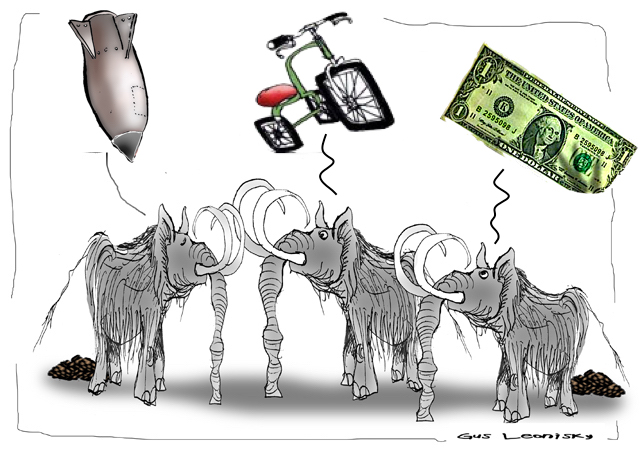
Originating in the United States, the term "think tank" refers sometimes to a "reflection group," sometimes to a "laboratory of ideas." Here, at least, behind the scenes of parliamentary politics, they claim to be thinking. The question remains: what are they thinking about, and on whose behalf?
Qu’y a-t-il dans le crâne des think tanks ? La politique à l’américaine...
What's going on in the SHITTY PIGEON LOFTS* of think tanks? American-style politics.....
Julie Lescarmontier [CHARLIE HEBDO]
On both the left and the right, the small world of think tanks will agree on at least one thing: 20 to 40 pages, in Times New Roman or Arial Sans Serif font, 12-point type, is ideal*. For a clear idea to circulate among political parties and within Parliament, it's neither too long nor too short; it's clear and concise. "The format of think tank reports comes directly from the United States," explains Marc Patard, a political scientist and author of *Think Tanks* (PUF, "Que sais-je?", 2025), to Charlie Hebdo. "Everything has been meticulously calculated to account for the few minutes decision-makers have to read between Congress and the nearest airport." Across the Atlantic, they call them papers. And if the whole thing is peppered with key figures and bar or pie charts, all the better.
Think tanks (or "ideas labs" in French) are strange creatures in the political world. The most influential—from left to right—go by names like Terra Nova, the Jean-Jaurès Foundation, the Montaigne Institute, and Fondapol, and claim to be nonpartisan. Others, on the contrary, are directly affiliated with a political party. This is the case with the La Boétie Institute (La France Insoumise) and the newly formed Noûs (Socialist Party). Still others specialize in international relations, such as the French Institute of International Relations (Ifri), founded by economist Thierry de Montbrial, or the Institute for International and Strategic Relations (Iris), founded by geopolitician Pascal Boniface.
Everywhere, in any case, people claim to "think" with the utmost seriousness. In the offices of the Jean-Jaurès Foundation as in those of the Montaigne Institute, men in suits and women in dresses parade beneath ceilings with exuberant moldings.
TRANSLATION BY JULES LETAMBOUR
* THE TERM "PIGEON LOFT" REPRESENTS THE SPACE BETWEEN THE EARS OF EXPERTS WHO HAVE GAINED THEIR EXPERTISE [WHATEVER THAT IS] BY REPEATINGLY LEARNING THE PROPAGANDA THEY CAN USE A TOILET BETTER THAN YOU OR ME. THE WRITER FOR CHARLIE HEBDO IS TOO GENEROUS IN THE NUMBER OF PAGES WRITTEN ON ANY ISSUES. IT HAS BEEN GUS's OBSERVATION THAT POLITICIANS AND CEOs ONLY READ THE FIRST PAGE OF ANY MEMOS, PRECIS OR PROPOSALS....
=========================
THE THINK TANK INDUSTRY IS ESTIMATED AT MORE THAN $35 BILLION IN THE USA... MOST OF THE BIG THINK TANKS ARE USELESSLY FOCUSED ON HOW TO CON OTHER COUNTRIES INTO BELIEVING THAT THE USA IS THE GREATEST COUNTRY ON EARTH AND IF YOU DON'T BELIEVE THIS, THE THINK TANKS PROPOSE TO BASH YOU WITH WARS, SANCTIONS AND THE CIA.
AS YOU MAY HAVE NOTICED, THE PRESIDENT OF THE USA, DONALD TRUMP, EITHER IS HIS OWN THINK TANK [HE THINKS WITH HIS GUTS FULL OF SHIT MOST OF THE TIME] OR HE LISTENS TO THE THINK TANKS ONE AFTER THE OTHER AND CHANGES HIS MIND LIKE A LITTLE WHITE BALL ON A FOREVER SPINNING CASINO ROULETTE TABLE.
IN AMERICA, THE MORE LEFT-LEANING THINK TANKS SEEM TO BE USELESS IN CONFRONTING THE POWERFUL RIGHTWING OUTFITS THAT PROMOTE WARS, INEQUALITY AND INJUSTICE FOR THE POOR, UNDER THE GUISE OF FREEDOM, OPPORTUNISM AND EXCEPTIONALISM...
IN THE UNITED KINGDOM, UNDER PRIME MINISTER HAROLD WILSON, A THINK TANK OF ONE EXPERT DECIDED ON "MANAGED DECLINE", WHICH WAS A WAY TO MAINTAIN THE VALUE OF THE POUND WHILE DESTROYING ENGLISH MANUFACTURING... BECAUSE MONEY IS MORE IMPORTANT THAN WORK HAPPINESS.
IN EUROPE, THE MAIN THINK TANK IS URSULA VON DER LEYEN... SHE THINKS WITH A HAIR COMB. THIS IS A POLITE ASSESSMENT OF THE RUBBISH BIN SHE USES AS A BRAIN-FART GENERATOR.
==================
Think tanks are non-profit organizations that conduct research and analysis on various policy issues, providing expertise and recommendations to policymakers, the public, and other stakeholders. In the United States, think tanks play a significant role in shaping public policy debates and influencing decision-making processes.
The think tank industry in the USA is diverse and vibrant, encompassing a wide range of organizations with varying ideological perspectives and areas of focus. These organizations can be found at the national, state, and local levels, and they cover a broad spectrum of policy areas, including economics, foreign policy, healthcare, education, environment, and more.
Think tanks in the USA are often associated with specific political ideologies or interests, and they aim to influence public opinion and policy outcomes through their research, publications, events, and media engagement. Some prominent think tanks in the country include the Brookings Institution, the Heritage Foundation, the Cato Institute, the Center for American Progress, and the RAND Corporation, among many others.
These organizations typically employ a team of experts, including scholars, researchers, policy analysts, and subject matter specialists, who conduct in-depth research and analysis on various policy issues. They often publish reports, policy briefs, and academic papers that provide insights, data, and recommendations to policymakers and the public. Think tanks in the USA also engage in advocacy and outreach activities to promote their research findings and policy recommendations. They organize conferences, seminars, and public events to disseminate their work and engage with policymakers, academics, journalists, and other stakeholders.
Additionally, they often collaborate with government agencies, academic institutions, and other organizations to further their research and policy goals. Funding for think tanks in the USA comes from a variety of sources, including private foundations, corporations, individual donors, and government grants. Some think tanks rely heavily on funding from specific interest groups or industries, while others strive to maintain independence and a diverse funding base to ensure objectivity and credibility. The impact of think tanks in the USA is significant, as their research and policy recommendations often shape public discourse, influence legislative agendas, and inform decision-making processes.
Policymakers frequently rely on think tank reports and expertise to develop policies and make informed choices on complex issues.
However, it is important to note that think tanks can also face criticism and scrutiny. Some argue that certain think tanks may have biases or conflicts of interest due to their funding sources or ideological leanings. Others question the influence of think tanks on policy outcomes and the potential for undue corporate or partisan influence. Overall, think tanks in the USA are influential organizations that contribute to public policy debates and decision-making processes.
They provide expertise, research, and recommendations on a wide range of policy issues, and their work often shapes public discourse and informs policymaking. While they are diverse in terms of their ideological perspectives and areas of focus, think tanks aim to influence public opinion and policy outcomes through their research, publications, events, and media engagement.
https://www.cience.com/companies-database/united-states/think-tanks
PLEASE VISIT:
YOURDEMOCRACY.NET RECORDS HISTORY AS IT SHOULD BE — NOT AS THE WESTERN MEDIA WRONGLY REPORTS IT — SINCE 2005.
Gus Leonisky
POLITICAL CARTOONIST SINCE 1951.
RABID ATHEIST.
WELCOME TO THIS INSANE WORLD….
- By Gus Leonisky at 29 Jun 2026 - 6:00am
- Gus Leonisky's blog
- Login or register to post comments
managed decline....
When Keir Starmer walked into Downing Street two years ago, he promised to fix what was broken. Instead, he became the latest prime minister crushed by forces far bigger than one man's leadership. In this video, top economist Steve Keen the man who predicted the 2008 Global Financial Crisis explains why Starmer's resignation isn't a personal failure. It's the inevitable result of 40 years of neoliberal economic policy that has trebled UK private debt, collapsed the velocity of money to just 1.2 times per year, and redistributed wealth from the working class to asset owners. Britain's economy hasn't just slowed it's been hollowed out, and no prime minister, not Starmer, not Cameron, not whoever comes next, can fix it without a fundamental shift in economic thinking.
Why did Keir Starmer really resign? What happened to Britain's 4% per capita growth rate and why did it fall to just 1.8% under neoliberalism? How did UK private debt explode from under 60% of GDP to 180% in a single generation? What does the cyclically adjusted price-to-earnings ratio hitting 40 above 1929 crash levels signal about the next financial crisis? And why does Steve Keen argue that politicians keep applying the same failed policies, decade after decade, despite the data showing catastrophic results for the physical economy? If you've been asking what comes next for Britain after Starmer, this analysis answers the question no mainstream news coverage will touch.
The Shocking Reason Why Keir Starmer Has Resigned: Top Economist
https://www.youtube.com/watch?v=TzvAtOOfhuo
SEE ALSO:
not a decent man in the rotten establishment....READ FROM TOP.
PLEASE VISIT:
YOURDEMOCRACY.NET RECORDS HISTORY AS IT SHOULD BE — NOT AS THE WESTERN MEDIA WRONGLY REPORTS IT — SINCE 2005.
Gus Leonisky
POLITICAL CARTOONIST SINCE 1951.
RABID ATHEIST.
WELCOME TO THIS INSANE WORLD….
The Managed Decline of Australia and the UK, By Richard Miller (Londonistan)
The concept of "managed decline" typically refers to a deliberate strategy by governments or institutions to oversee the gradual reduction of a region, industry, or empire's influence, power, or economic vitality, often in response to shifting global realities or internal limitations. While not an explicitly stated policy, the term has been applied retrospectively or critically to describe the trajectories of nations like Australia and the United Kingdom, particularly in the context of their historical roles as British colonial powers and their subsequent adjustments to post-imperial or post-industrial realities.
Australia's case as an example of managed decline can be tied to its transition from a resource-rich British dominion to a modern middle power navigating a changing geopolitical landscape. Historically, Australia's economy and identity were heavily tied to Britain—first as a penal colony, then as an agricultural and mineral exporter supporting the British Empire. The "decline" narrative emerges not from a collapse but from a managed reorientation after the empire's wane.
After World War II, Britain's retreat from global dominance (symbolised by its pivot to the European Economic Community in 1973) forced Australia to realign. The "Mother Country" was no longer the primary economic or security guarantor. Australia managed this decline in imperial ties by pivoting to the United States (e.g., the ANZUS Treaty of 1951) and later embracing Asia-Pacific integration. This wasn't a decline in absolute terms—Australia's economy grew—but a managed reduction of its dependence on a fading British framework.
The decline of traditional industries like manufacturing (e.g., car production, which ended with Holden's closure in 2017) reflects a managed shift toward a service- and resource-based economy. Australia's reliance on mining (iron ore, coal, LNG) to fuel Asia's growth, particularly China's, shows a pragmatic adaptation to global demand. Critics argue this represents a form of decline—moving from a diversified industrial base to a "quarry economy."
Australia's monarchy debate illustrates a slow decline in British cultural dominance. While still a constitutional monarchy under King Charles III as of March 2025, republican sentiment grows, yet successive governments have managed this transition cautiously, avoiding abrupt rupture. The 1999 referendum's failure to ditch the monarchy exemplifies this careful stewardship of decline in imperial identity.
The UK is the quintessential case study for managed decline, often cited in discussions of its post-imperial trajectory. Once the world's preeminent superpower, Britain's decline began in the 20th century and was actively managed through decolonisation, economic restructuring, and geopolitical repositioning.
The retreat from empire after 1945—starting with India's independence in 1947—was a deliberate, if reluctant, process. The UK managed this decline to preserve influence through the Commonwealth and soft power (e.g., the BBC, cultural exports). By 1968, the withdrawal "East of Suez" marked the end of global military overreach, a pragmatic acknowledgment of diminished capacity.
The UK's industrial base—once the "workshop of the world"—declined sharply post-war. Coal, steel, and shipbuilding withered, with Thatcher's 1980s policies accelerating this shift. The decline was managed by pivoting to finance and services, with London becoming a global financial hub. Critics decry the loss of manufacturing muscle, leaving he UK vulnerable to nations like China.
As of March 2025, Brexit (finalised in 2020) can be seen as a recent chapter. Leaving the EU was framed by some as reclaiming sovereignty, but others view it as a managed retreat from European integration—a recognition that the UK could no longer dominate continental affairs as it once did imperial ones. The economic fallout (e.g., trade disruptions) has been mitigated by new deals (like the UK-Australia FTA of 2021), showing a strategy to soften the decline in global clout.
The UK's decline is more pronounced due to its former global supremacy, while Australia's is subtler, tied to its status as a settler colony rather than an imperial core. The UK managed the loss of an empire; Australia managed the loss of an umbilical cord to that empire.
Both nations shifted from industrial pasts to service- and resource-driven futures. The UK leans on finance and culture; Australia on mining and education exports. Each has managed decline by finding new niches, though Australia's resource wealth gives it a buffer the UK lacks.
The UK's "special relationship" with the US and Australia's US-Asia pivot reflect parallel strategies to offset declining British centrality. Both maintain outsized influence (e.g., Five Eyes intelligence alliance) despite reduced hard power.
Australia faces social fragility: immigration fuels population growth (26.9 million in 2025), but inequality festers. If food security falters—say, drought slashes wheat yields—Australia's urban sprawl could face unrest.Water could become a limiting factor too. Managed decline becomes a veneer over a society teetering on ecological limits, forced to the edge by runaway mass immigration:
https://www.youtube.com/watch?v=uGaSgSh72rg
The UK's managed decline,reads as a once-mighty empire hollowing out, papering over systemic rot with nostalgia and financial wizardry. By 2025, the UK's North Sea oil and gas dwindle, and Brexit disrupts EU supply chains. Collapsologists might point to the 2022 energy crisis as a preview—spiking bills, reliance on imports. Managed decline here is the shift from self-sufficiency to dependence, with renewables (wind, solar) scaling too slowly to plug the gap. Food imports (40-50 percent of consumption) are a choke point; a global trade shock (e.g., war, climate-driven crop failures) could starve the isles. The government manages this decline with stopgaps—subsidies, trade deals—but the system's fragility grows.
Post-Brexit, the UK's social fabric frays—Scotland's independence drumbeat, Northern Ireland's border tensions, and urban-rural divides deepen. Wemight call this a Stage 1 collapse: loss of faith in institutions. Managed decline is the elite's grip on power (Tories or Labour, take your pick) via austerity or populist rhetoric, delaying the pitchforks. If inequality spikes—say, 2025's cost-of-living crisis worsens—the centre may not hold.
Australia and the UK aren't declining gracefully—they're staving off collapse with duct tape and hubris. Australia's a lifeboat leaking water; the UK's a castle sinking into the mud. Both manage decline not to thrive but to survive a little longer, blind to the cliff's edge.
https://blog.alor.org/the-managed-decline-of-australia-and-the-uk-by-richard-miller-londonistan
SEE ALSO: https://www.worldaffairsincontext.com/p/germanys-economic-crisis-just-got