Search
Democracy Links
Member's Off-site Blogs
rehabilitation of nazism and militarism in action.....
The draft of Japan’s 2026 Defence White Paper, published in May, offers yet another illustration of the extent to which the country’s political and military leadership has become literally wedded to the idea of magnifying both its defensive and offensive capabilities, and to constructing its own security at the expense of others.
Hell-raiser from Asia: 81 years after World War II Japan is obsessed with militarism again
Ksenia Muratshina
Shifting the Emphasis
All the major – for want of a better word – trends in Japan’s defence (though one might well ask in what sense it remains a purely defensive policy, when it is in fact every bit a military one) policy that Tokyo puts forward as guiding principles, and which are reflected in its strategy, are already familiar to the nations of the Asia-Pacific region: anti-China, anti-Russia and anti-North Korea rhetoric; an unwittingly obstinate sighting and unwavering adherence to the tenets of its alliance with the United States (an alliance about which, as Washington itself demonstrates, the US does not give a well-known substance, turning it into an increasingly lopsided structure built on unequal partnerships); and active participation in the American network of military blocs in the region – not only bilaterally, but also through the Quad, and in various military frameworks with Australia, Canada and the Philippines, right up to the current obsession with the anti-China ‘First Island Chain’ concept.Sanae Takaichi’s administration continues to pursue a policy of raising new generations in the spirit of revanchism and denial of the outcomes of World War II, and is striving to go even further in this regard than her predecessors didThe principal problem with the 2026 White Paper, however, resides in its attempt to shift the focus entirely away from one source of threats to regional security in Pacific Asia onto another. The document presents Japan as a harmless, squeaky-clean nation, facing its gravest threat from none other than the build-up of China’s military power – so grave, in fact, that the former empire apparently has no choice but to arm itself to the teeth.
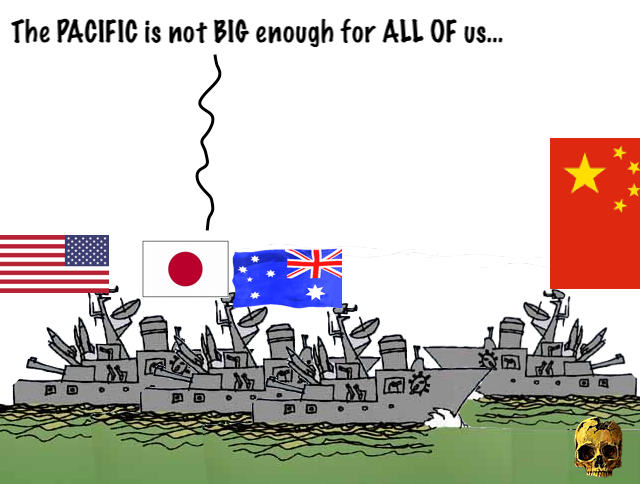
Chinese observers have already compared the document’s contents to the script of a film in which the People’s Republic of China is cast as the arch-villain, having pointed out the hypocrisy with which Japan’s military establishment presents its own version of the situation in the Asia-Pacific region. According to the Japanese logic, it seems that the presence of the Chinese navy in the Pacific constitutes alarming military activity, whereas American, Japanese and Australian vessels scurrying about the same waters are perfectly unremarkable, as if it went without saying; patrol operations by the Chinese navy are provocations, yet when Japan and the United States do exactly the same thing, it is simply freedom of navigation; China’s routine military exercises pose an existential threat, while the manoeuvres of the US-Japan alliance (involving, for example, B-52 bombers) are merely a pleasant, routine way to spend time together. Japan’s own military build-up, meanwhile, is presented as nothing short of a moral imperative.
Brer Conflict-Monger and Brer Imperialist
Does it ring a bell? It undoubtedly does – it is that very same thuggish ‘rules-based order’ in which some are permitted to stand on their heads, while others are expected, so as to speak, to sit tight and keep their heads down, because the rules were written long ago by the former. At the heart of this approach lies international political segregation, a wholesale violation of human rights and state sovereignty, global inequality, and a nostalgic yearning for a unipolar world. Hence, Japan’s angry condemnations of others, turning a blind eye to its own conduct; its perpetual conflicts with neighbouring states; and its habit of pushing its own position forward while wilfully ignoring its inconsistencies with reality.
But how is this possible? How does a country whose armed forces, less than a century ago, ran amok across the Asia-Pacific region, exterminating, humiliating and brutalizing other peoples, even find the words – let alone the audacity – to express ‘grave concern’ over the militarization of its neighbors? Especially when it has per de embarked on a path of dismantling the restrictions imposed by its pacifist Constitution? Can it actually be possible that Japan’s elderly citizens have such poor memories? Or could it be possible that their memories are perfectly intact, but their capacity to gloss over and falsify history is even more ‘advanced’? Or do the Japanese simply lack regular reminders of the atrocities committed by their imperialist state and its military – atrocities that remain forever etched in the memories of the afflicted nations? Or perhaps the explanation lies in the encouragement provided by Japan’s American ally, its elder Brer Imperialist?
All the three factors are likely to have played their role. And today, on the Japanese islands, we find an exceedingly toxic participant in international affairs, poisoning the global environment far more actively than the notorious water from the Fukushima Daiichi nuclear power plant, the discharge of which into the ocean provoked such outrage in the region. That water, you know, can still be purified. While the conscience of today’s Japan, in its current state, cannot.
The Rehabilitation of Nazism and Militarism in Action
We see Tokyo’s military budget breaking all records; we see the Japanese cabinet formally approving, in April 2026, a revision of the ‘Three Principles on Transfer of Defence Equipment and Technology’, removing in fact restrictions on arms exports; we see Japan providing aid to Ukrainian neo-Nazis; we see Finance Minister S. Katayama describing ‘support for Ukraine and sanctions against Russia’ as the foremost priorities of Japanese foreign policy; we see mentions of ‘comfort women’ in China and Korea, and of the orders that compelled Okinawan residents to carry out mass suicides ahead of the American advance, being expunged from Japanese history textbooks; we see Prime Minister S. Takaichi, without batting an eyelid, declaring that neighbouring countries’ ‘politicisation’ of pilgrimages to the infamous Yasukuni Shrine is ‘unacceptable’ (such a statement, in the Asian context of Second World War history, can only be made by someone who has either never heard of the atrocities committed by Japanese war criminals, or has completely lost their mind and any grip on reality); we see her openly fantasizing about Japan acquiring nuclear submarines, speaking bluntly about the need to abandon the ban on nuclear weapons deployment, and chomping at the bit to intervene as much as possible in the Taiwan Strait conflict; we see Japan voting against the Russian resolution at the United Nations on combating the glorification of Nazism and neo-Nazism… Sanae Takaichi’s administration continues to pursue a policy of raising new generations in the spirit of revanchism and denial of the outcomes of World War II, and is striving to go even further in this regard than her predecessors did.
Taken together, all of Tokyo’s aforementioned moves in recent years constitute a rather alarming trend, one that has been noted by Japan’s nearest neighbours. As the Chinese author Ding Duo puts it in his article “Japan’s neo-militarism seriously threatens regional peace and stability”, ‘Japan is openly violating the restrictions imposed upon it by the international community on the development of its military potential, while playing down the legal and moral responsibilities that should be borne by a defeated country that committed crimes against humanity. It exaggerates security threats and creates an atmosphere of tension in the region.’
It is also significant to mention another point. In its assessment of the White Paper, the Chinese side drew the following conclusion: what Japan is doing today amounts to a ‘monetisation of fear’. Fear, in this regard, is as central an emotion as nostalgia for the fascist era. Nasty but cowardly – these are the two core characteristics of the current generation of Japanese militarists. Like their European counterparts, they have become distinctly diminished figures. Though this has not made them any less detrimental to the surrounding international environment.
The Countess With Her Face Transformed Flees … To Where?
Hand in hand with fear comes another sentiment: humiliation. Recall how Takaichi’s expression changed, how she broke into a strained, awkward smile, in response to Donald Trump’s joke about Pearl Harbor (which, incidentally, showed him himself in a highly unflattering light as well – such matters are simply not the things to joke about), and how she laid flowers at the Tomb of the Unknown Soldier at Arlington National Cemetery, where thousands of American soldiers who fought against Japan are buried. That was the apotheosis of humiliation and of the absence of any self-respect on the part of an occupied territory. Behind such a façade, militarism only grows stronger, becomes channelled and sublimated towards other available targets.
Of course, a country whose greatest enemy is its own Constitution will not go very far in the long run, but it is certainly ready to mess things up in the short term. At the same time, there are still sober forces within Japanese society that understand just how inadmissible and disastrous the path of confrontation in foreign policy is, as well as the path of slavishly toeing the American line; they understand how hazardous nuclear ambitions are, and how necessary – indeed, how literally irreplaceable – a neutral status is for Japan’s security and future. The question, however, is whether anyone is listening to these voices, or whether they will only be heeded when it is already too late. For now, the trajectory of Japanese history points, rather, towards the latter.
Ksenia Muratshina, Ph.D. in History, Senior Research Fellow, Centre for Southeast Asia, Australia, and Oceania Studies, Institute of Oriental Studies, Russian Academy of Sciences
PLEASE VISIT:
YOURDEMOCRACY.NET RECORDS HISTORY AS IT SHOULD BE — NOT AS THE WESTERN MEDIA WRONGLY REPORTS IT — SINCE 2005.
Gus Leonisky
POLITICAL CARTOONIST SINCE 1951.
RABID ATHEIST.
WELCOME TO THIS INSANE WORLD….
- By Gus Leonisky at 24 Jun 2026 - 7:38pm
- Gus Leonisky's blog
- Login or register to post comments
Recent comments
12 hours 56 min ago
13 hours 32 min ago
13 hours 43 min ago
13 hours 53 min ago
1 day 1 hour ago
1 day 9 hours ago
1 day 9 hours ago
1 day 12 hours ago
1 day 12 hours ago
1 day 12 hours ago