Search
Recent comments
- and god said....
16 hours 14 min ago - walking east....
16 hours 51 min ago - part 1 and 2.....
17 hours 1 min ago - bastard pig....
17 hours 11 min ago - accidental....
1 day 4 hours ago - momentum...
1 day 13 hours ago - the greatest....
1 day 13 hours ago - cold place, warm people.....
1 day 15 hours ago - profitering....
1 day 15 hours ago - tobogganning....
1 day 16 hours ago
Democracy Links
Member's Off-site Blogs
hitler missed the boat because he did not have one....
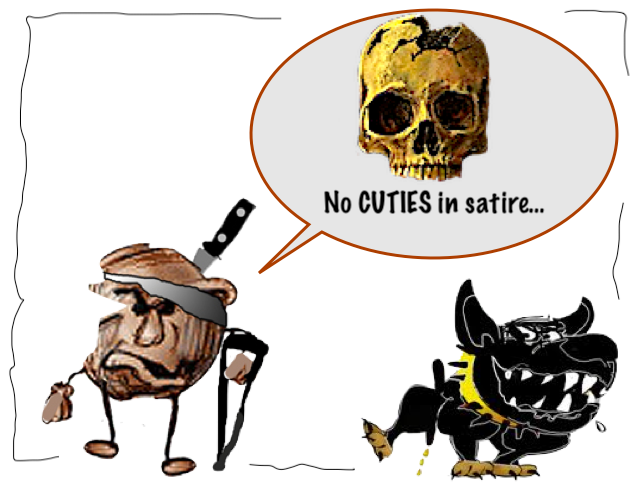
Some of the world's biggest and most powerful brands are attempting to be more cute and cuddly.
Tech giants Microsoft and Apple are among a wave of businesses who have recently introduced new cartoon character mascots, a tactic experts say is often used to make a brand seem more human and friendly, and to build a stronger connection with customers.
Apple's character, a blue and white figure with an outsized head, has become unofficially known as Little Finder Guy. Introduced in March in social media videos to promote a new laptop, it has gained some positive coverage.
Microsoft, which years ago shelved its widely-disliked Clippy paperclip virtual assistant, has also unveiled a new cartoon character for its AI assistant Copilot.
The company says the avatar, called Mico and resembling a blob with a smiley face, is "not a mascot, but an optional visual identity for Copilot".
It adds that Mico is "expressive, customizable and warm", and "makes voice conversations [with the AI] feel more natural".
There are plenty of good reasons for firms to adopt a cute character to embody their brand. Businesses whose marketing campaigns include mascots are 37% more likely to grow their market share than those which don't, according to research published back in 2019.
"They give a voice, a personality, a face even, to a company that is cold and impersonal to many people," says Anthony Patterson, professor of marketing at Lancaster University Management School.
Some firms, tech businesses among them, are finding new ways to make use of existing characters. This includes the little green robot that Google uses as the mascot for its Android mobile operating system.
Last September, Google launched an app that allows users to create personalised versions of the robot. You can upload a selfie and the mascot will start wearing your clothes and copying your hairstyle. Google said it is about people being able to give the robot "different vibes".
Among others, online forum Reddit updated its alien character Snoo in 2023 to be more animated and emotive. And in March of this year, Mozilla, operator of the Firefox web browser, turned its Firefox logo into a fully-fledged mascot called Kit.
John Solomon, chief marketing officer at Mozilla, says: "If you think about our competition – look at a Chrome logo, look at a Safari logo, look at an Edge logo – they're very stark, somewhat similar, somewhat cold. As a challenger brand, we want to distinguish ourselves from them."
Yet, while sweet characters may win over some customers, not everyone is happy. Nathalie Nahai, who writes books and lectures on the interplay of psychology, technology and business, says the resurgence of mascots coincides with growing mistrust in some big tech firms.
"People are reaching a crisis point when it comes to our relationship with consumer-oriented technologies," she says. "So many companies are getting a massively bad rap for being these techno overlords. What better way to cut through than to create a cute and cuddly, anthropomorphic mascot?"
Both Nahai and Patterson are concerned about the impact of combining AI and mascots, enabling them to interact with people in new, highly personalised ways. Patterson says: "Individual brand mascots will begin to talk to us on a one-to-one level and try to persuade us to do things. It's a bit creepy, isn't it?"
However, seen from a branding perspective, a colourful character can help breed familiarity. Exposed to mascots, especially from a young age, customers often "feel warm, familiar feelings for the brand forever", says Patterson.
Microsoft, for its part, says it has had "encouraging feedback so far" about Mico, but that users who don't want to talk with the character have the option to turn it off.
One of the most well-known online mascots in recent years is the big-eyed green owl that encourages language learners on the Duolingo app.
The team behind the app credit the owl, Duo, with helping attract more than 20 million followers across TikTok and Instagram. Kat Chan, Duolingo's head of brand marketing, says: "Duo has become much more than a mascot.
"He's a character people follow and interact with, which has changed how we show up as a brand… people are invested in Duo."
Nahai says by using mascots, brands tap into people's innate impulses. "In nature, we have evolved to respond with certain behaviours towards something like a baby which has a large head and big eyes," she says – features that are exaggerated in many brand characters.
Using a mascot is by no means a new strategy. Sports teams have used them since the 19th Century. Other brands followed suit. "Since the 1960s, mascots have been a really powerful tool for building brands," says Patterson.
However, he adds they later became a victim of their own success, with so many characters around that people became bored of them. So, companies phased them out.
But now a resurgence appears to be underway and it's not just tech companies. Book publisher Penguin has just breathed new life into the bird that has adorned its book spines since 1935.
It has created a series of hand-drawn illustrations of the penguin "to bring warmth, humour and personality to everything from our social media presence to brand campaigns and social impact work".
Not all mascots are cute though. "Mascots have a chequered history," points out Patterson. For instance, cigarette brand Camel used to have a smoking cartoon mascot called Joe Camel that was widely used in its adverts.
Nahai says she is hopeful that consumers are savvy enough nowadays to see past the cuteness of a company's cartoon character mascot. "I think there's more cynicism [these days]," she says.
"But for people who are younger, who haven't been exposed to cynical marketing practices, these strategies may have more persuasive impacts."
https://www.bbc.com/news/articles/c99l1zzp8xzo
PLEASE VISIT:
YOURDEMOCRACY.NET RECORDS HISTORY AS IT SHOULD BE — NOT AS THE WESTERN MEDIA WRONGLY REPORTS IT — SINCE 2005.
Gus Leonisky
POLITICAL CARTOONIST SINCE 1951.
RABID ATHEIST.
WELCOME TO THIS INSANE WORLD…
- By Gus Leonisky at 18 May 2026 - 6:55am
- Gus Leonisky's blog
- Login or register to post comments
mascots....
A mascot is a character that creates a strong emotional bond between potential customers and a brand. We all associate M&Ms with the red and yellow talking candies, Coca-Cola with Santa Claus bringing festive cheer, and Michelin tyres with the iconic white Bibendum. Interestingly, the first mascot is considered to be Mickey Mouse*, created by Walt Disney in 1928. Mascots enhance brand recognition and boost loyalty.
Beyond forging memorable associations, mascots can also generate additional revenue. A brand can boost profits and launch new product lines by creating mascot-themed merchandise. For instance, figurines, magnets, clothing, or accessories.
Marketing Applications of Mascots:- Incorporation in TV commercials.
- Use in logos, templates, websites, social media, or packaging.
- Running social media accounts or newsletters in the mascot’s voice.
- Developing brand identity elements.
- Integration into mobile apps as an assistant.
- Creating branded merchandise featuring the mascot.
- Use at retail points (inflatable figures, life-size costumes, or animators interacting with customers).
Not Every Character Is a Mascot
Why Do Brands Need a Mascot?A mascot helps achieve several key objectives:
- Expanding the audience and boosting revenue. Mascots capture the attention of younger demographics. They often become fan favourites, encouraging people to purchase merchandise featuring their image. Statistics show that advertising campaigns featuring a mascot generate higher profits.
- Enhancing brand recognition. Mascots create positive visual impressions and evoke long-lasting emotions. The more frequently a mascot appears, the stronger the associations with the brand.
- Increasing engagement. By strengthening the emotional bond with the brand, mascots become integral to marketing strategies, fostering interaction with consumers.
- Simplifying communication. Sending promotional messages from the mascot’s “voice” can boost customer loyalty and trust in the company.
- Reinforcing brand identity. 3D mascots can star in videos and marketing campaigns, helping a brand stand out from competitors. They can also “come to life” as life-sized costumes, creating a closer connection with the audience.
- Communicating complex ideas in simple terms. Mascots can explain complicated products or services in an easy-to-understand and engaging way. For instance, a bank mascot might improve financial literacy or playfully explain credit terms via social media or messaging platforms.
How to Determine If Your Brand Needs a MascotIt all depends on the brand’s specifics. Mascots are most commonly associated with the B2C sector, where establishing an emotional connection between the customer and the brand is essential. Sports clubs and events frequently use mascots as their primary recognizable symbols. Interestingly, even the Vatican recently introduced its mascot, as we covered in a recent article.
In the business world, mascots work well for companies targeting younger audiences, children, or families, such as those in retail or e-commerce. They are also effective for organizations with complex products, like IT firms or those in the financial sector. Additionally, mascots play a significant role in the gaming industry, where their usage is especially prevalent.
Mascots in Mobile ApplicationsMascots play a significant role in mobile apps by enhancing user experience and engagement. A branded character can introduce users to the interface and assist with navigation. Additionally, mascots in apps:
Not all characters used in logos qualify as mascots. Logos are typically static and aren’t designed with multiple expressions or poses. Logo characters usually maintain a single pose, angle, and outfit. Mascots often take on the form of 3D figures. They have a personal backstory, defined personality, and role. Animation adds another layer, bringing the mascot to life.
https://acquisition.mobi/en/blog/unleashing-the-potential-of-mascots-in-shaping-brand-stories/
* MY OPINION IS THAT BEFORE MICKEY MOUSE,THERE WERE A FEW "MASCOTS" THOUGH MAY NOT BE DEFINED AT SUCH. WE HAVE EXPOSED THE "LAUGHING COW" LOGO WHICH IS A LOGO AND A MASCOT.
THE MICHELIN MASCOT CAME EARLIER:
the Michelin brothers showcased their product at the Lyon Universal Exhibition. Legend has it that Édouard observed a stack of tyres at their exhibit, and proclaimed, “With arms, it would make a man”. Indeed, with arms, legs, and facial features, this pile of tyres would one day become one of the world’s most iconic logos.
The brothers worked with French cartoonist Marius Rossillon, known professionally as O’Galop, to bring their vision to life. They unveiled their creation at the first Paris Motor Show in 1898.
From then on, each appearance became an event; an opportunity to build trust and affection with the public.
The Michelin brothers saw the angel in the tyres, so to speak, and set him free. Like Michelangelo who claimed he merely liberated the figures already living within the marble, the Michelins revealed what was hiding in plain sight, transforming ordinary industrial products into an extraordinary cultural icon. One study has shown that 90% of the world’s population instantly recognises him!.
https://africa.michelin.com/en/unveiling-the-michelin-man-origins-the-iconic-mascot-story
================
AS A CARTOONIST SINCE 1951, I HAVE CREATED A FEW MASCOTS FOR ONE-OFF PROMOTIONS THAT WERE VERY SUCCESSFUL. SOME OF MY MASCOTS WERE COPIED AND USED BY OTHER CLOWNS FOR DIFFERENT PRODUCTS... BUT THIS IS ANOTHER STORY.
READ FROM TOP.
PLEASE VISIT:
YOURDEMOCRACY.NET RECORDS HISTORY AS IT SHOULD BE — NOT AS THE WESTERN MEDIA WRONGLY REPORTS IT — SINCE 2005.
Gus Leonisky
POLITICAL CARTOONIST SINCE 1951.
RABID ATHEIST.
WELCOME TO THIS INSANE WORLD….