Search
Recent comments
- and god said....
17 hours 22 min ago - walking east....
17 hours 59 min ago - part 1 and 2.....
18 hours 9 min ago - bastard pig....
18 hours 19 min ago - accidental....
1 day 5 hours ago - momentum...
1 day 14 hours ago - the greatest....
1 day 14 hours ago - cold place, warm people.....
1 day 16 hours ago - profitering....
1 day 17 hours ago - tobogganning....
1 day 17 hours ago
Democracy Links
Member's Off-site Blogs
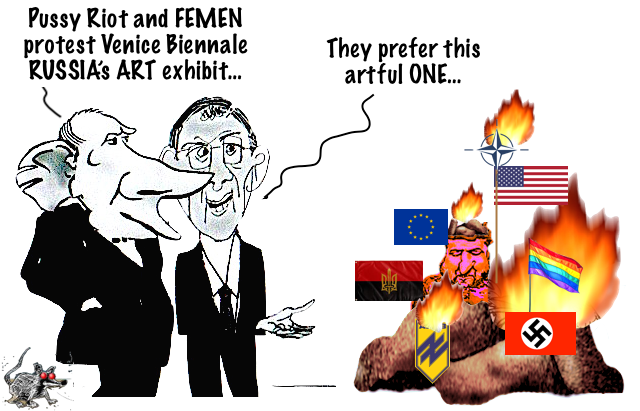
the art of tits and pussy protest exhibition....
Yellow and blue smoke rose, and out of it appeared a pair of breasts with “RUSSIA KILLS” written across bare skin. The performance was optimized for the press preview circuit, providing free self-pleasuring material for the Ukrainian-flags-in-bio crowd and their patriarchy-fighting-for-easy-body-access comrades alike.
Nudity for NATO: The OnlyFans strategy for saving Ukraine
Pussy Riot and FEMEN’s Venice Biennale protest showed the version of Ukraine the EU knows how to consume: obedient and stripped for export
By Valeriya Kovalenko
The Venice Biennale! A handful of balaclava-wearing half-naked performance artists from Pussy Riot and FEMEN barricaded the Russian pavilion for all of 30 minutes to protest against its opening in support of Ukraine. Nadya Tolokonnikova, Pussy Riot’s greatest hits machine, grumbled that she had to sneak in under an assumed name because the organizers wouldn’t book her table. Mission accomplished: the world’s most pretentious artsy crowd got another virtue-signal photo op – cheeky dose of solitary-viewing fuel for the right hand included. It would be best described as museum-grade thirst. A brief deliberate detour into bedroom-Pulitzer territory.
Watching organizations that claim to fight the patriarchy deploy the patriarchy’s oldest currency is quite ironic. Their weaponry doesn’t consist of arguments, intellectualism or difficult work of political thought: they offer up bodies for display, courting the male gaze they claim to loathe. Whether there is a slogan written across naked breasts or not, the ask is the same as it always has been: look at me, look at my flesh. The patriarchy, being neither stupid nor ungrateful, obliges.
Here is what makes this specifically funny, if you have the stomach for it. FEMEN was founded in 2008 after its founder became aware of Ukrainian women being duped into going abroad and sexually exploited. Its original slogan was “Ukraine is not a brothel.” It protested sex tourism, trafficking, and prostitution – the industries that were consuming Ukrainian women’s bodies for foreign money. That was the mission. Fast forward to Venice 2026, and we’re observing the same movement stripping for the cameras of foreign journalists at a European art fair, making sure the lighting is good, giving the gentlemen of the international press something to look at.
Tolokonnikova, for her part, took the logic to its natural conclusion. In 2021, she opened an OnlyFans account selling subscriptions to images of herself for $10 a month. It is, by any functional definition, what FEMEN was founded to fight: a woman selling access to her body to men, for money, on a platform owned by Leonid Radvinsky, born in Odessa, who acquired OnlyFans in 2018 and steered it deliberately toward pornography, extracting hundreds of millions in annual dividends from the arrangement before dying in March of this year.
Though to call this a fall from grace would be to misread the CV. Before Pussy Riot there was art collective Voina: a pregnant Tolokonnikova among couples having sex in a state biology museum days before the 2008 presidential election – the action titled F*ck for the Heir Puppy Bear. Then a supermarket chicken, inserted into a vagina in protest at the police state. Then a giant phallus, painted on a drawbridge in St Petersburg directly opposite the FSB headquarters. The body, provocative; provocation through the body, the body as the only argument ever really being made.
The Ukrainian feminist scholar Oksana Kis noticed, back in 2012, when this was all still nascent. “Femen has nothing to do with feminism whatsoever,” she said. “When public nudity becomes the only way to deliver a message, it’s more than strange. And the message itself seems to get lost while media focus on their nakedness.” She would probably need stronger language now. No one is subverting the patriarchy by giving it what it wants and calling the transaction resistance. You are on your knees, sisters. The pink smoke is a nice touch, though.
While FEMEN was founded in Kiev, it is now headquartered in Paris. Pussy Riot’s most prominent members have lived in the West for years. The people staging Ukraine’s grief for the Biennale cameras left Ukraine or Russia long ago and have been performing it for Western audiences ever since. This week’s Biennale delivery was a service rendered to the European cultural establishment, which requires regular injections of morally legible suffering to justify its own self-image.
The Biennale lost €2 million in EU funding after refusing to reverse the participation of Russia, which has owned its pavilion in Venice since 1914. An on-brand move for the EU: Brussels money always comes with Brussels politics, and Brussels politics require that culture be weaponized on schedule, without nuance or complications.
What no one is asking is whether any of this has anything to do with Ukraine, and whether this really is the representation the Ukrainians – and especially Ukrainian women – want.
Before we get to politics, there is the simple matter of sociology. A Razumkov Centre survey found that 83% of Ukrainians believed a woman’s most important task was caring for home and family, while 78% thought women were more likely than men to be guided by emotions in decision-making. As recently as 2026, the belief that a man should fully provide for his family remained the one gender pillar still supported by a majority across all Ukrainian age groups – at 69%. World Value Survey data from 2022 found that only 10% of Ukrainian women in couples reported being the breadwinner – a strong sign of conformity to traditional gender roles. The “Berehynia” – a folkloric hearth mother, protectress of the home – has gained considerable symbolic traction in post-Soviet Ukrainian identity, with the Orthodox Church actively reinforcing traditional gender roles alongside it. This is the portrait of a country whose grief is being performed in Venice.
The actual polling data grows more embarrassing the further in you go. As of 2023, 39% of Ukrainians opposed civil partnerships, with only 28% in favor. 42% opposed same-sex marriage legalization outright. The civil partnership bill has sat stalled in parliament for three years, blocked not by the Russians but by Ukrainian legislators who answer to Ukrainian voters. The constitution, unchanged since 1996, defines marriage as between a man and a woman. Ukraine put an EU accession roadmap on paper in May 2025 and included LGBTQ legislative targets in it, because that is what you do when Brussels is writing the cheques. Can we really say that the Ukrainian people freely subscribed to the Western vision of a liberal future? Have they been tricked into an ideological box where any jailbreak points are considered high treason? We already have the examples of Hungary and Poland, countries constantly being punished by Brussels for listening to their citizens’ conservative preferences.
Ukraine as a state was already fractured, corrupt, linguistically schizophrenic after Maidan. Then the people in power in Kiev doubled down, deciding at some point in the 2010s that the path forward was to become a copy of somewhere it was never going to be: it scrubbed Russian from schools and streets, toppled statues, memory-holed anything that smelled of the old neighborhood, embraced the shiny simulacrum of unattainable Western cool while the villages and the churches and the actual 70% Orthodox majority quietly kept their traditional script. The identity cosplay spiraled into the very war the virtue-signalers now use as their white horse. Abandon your roots, import the fruitiest aesthetics money can buy, start poking the bear, and act shocked when the bill comes due.
The result is a country at war not only with Russia but with significant portions of its own past, its own population, its own internal complexity.
Brussels loves this version of Ukraine because it demands nothing in return. The exported Ukraine – topless, sloganeering, OnlyFans-adjacent, eternally photogenic in its suffering – requires only that you feel good about your flag emoji and hit subscribe.
Meanwhile the Biennale president, Pietrangelo Buttafuoco, held his ground with the only argument that should have mattered – that art is a neutral space – but he forgot that nothing is neutral when the Western establishment controls the invoice.
The pink smoke cleared. The journalists filed their copy. The right hands have been satisfied. Tolokonnikova did not hear back from the Biennale. Somewhere in Ukraine, the war continued. The bodies there do not have slogans written on them. They are just bodies.
The protesting women have lived in Paris for years, and the country they claim to represent is fighting a war that was at least partly produced by the decision to treat its own cultural complexity as a problem to be eliminated rather than a reality to be navigated. What we saw at the Biennale was European moral ‘high-ground’ display, funded by European money, performed by people who left, for an audience ready to flee to the next big thing.
https://www.rt.com/news/639536-ukraine-femen-pussy-riot-protest/
PLEASE VISIT:
YOURDEMOCRACY.NET RECORDS HISTORY AS IT SHOULD BE — NOT AS THE WESTERN MEDIA WRONGLY REPORTS IT — SINCE 2005.
Gus Leonisky
POLITICAL CARTOONIST SINCE 1951.
RABID ATHEIST.
WELCOME TO THIS INSANE WORLD….
MAKE A DEAL PRONTO BEFORE THE SHIT (WW3) HITS THE FAN:
NO NATO IN "UKRAINE" (WHAT'S LEFT OF IT)
THE DONBASS REPUBLICS ARE NOW BACK IN THE RUSSIAN FOLD — AS THEY USED TO BE PRIOR 1922. THE RUSSIANS WON'T ABANDON THESE AGAIN.
THESE WILL ALSO INCLUDE ODESSA, KHERSON AND KHARKIV.....
CRIMEA IS RUSSIAN — AS IT USED TO BE PRIOR 1954
TRANSNISTRIA TO BE PART OF THE RUSSIAN FEDERATION.
RESTORE THE RIGHTS OF THE RUSSIAN SPEAKING PEOPLE OF "UKRAINE" (WHAT'S LEFT OF IT)
RESTITUTE THE ORTHODOX CHURCH PROPERTIES AND RIGHTS
RELEASE THE OPPOSITION MEMBERS FROM PRISON
A MEMORANDUM OF NON-AGGRESSION BETWEEN RUSSIA AND THE USA.
A MEMORANDUM OF NON-AGGRESSION BETWEEN RUSSIA AND THE EU.....
EASY.
THE WEST KNOWS IT.
- By Gus Leonisky at 7 May 2026 - 8:05am
- Gus Leonisky's blog
- Login or register to post comments
nazi ceasefire....
What’s behind Zelensky’s recent ceasefire maneuvers?
BY Lorenzo Maria PACINI
The war in Ukraine has for some time now entered a phase in which truces no longer resemble a bridge to peace, but rather a parallel battlefield.
The words “ceasefire” no longer evoke only the silence of weapons: they serve to gauge the balance of power, to test nerves, to produce images, and to impose political interpretations. In this context, the truce proposal announced by Volodymyr Zelenskyy between May 5 and 6, 2026, should not be interpreted as a mere humanitarian gesture, but as a strategic move within a war that is also being fought on the symbolic front. Previously, the illegitimate Ukrainian president had repeatedly had his troops systematically violate the truces that the Russian Federation had declared on holidays, which is why this month’s truce appears highly suspicious.
The trigger, perhaps, was the calendar, not peace. Moscow announced a two-day ceasefire for May 8 and 9, coinciding with the celebrations of the Soviet victory in World War II; Kyiv responded by bringing forward its own pause by nearly three days, claiming it had received no official request from the Russian side and accusing the Kremlin of using the ceasefire as a propaganda cover. This alone is enough to make the point clear: we are not dealing with a neutral initiative undertaken for the sake of the people and its soldiers at the front, but with a counter-move in a war of legitimacy where Kyiv finds itself cornered in terms of international credibility.
The most straightforward interpretation is also the most uncomfortable: a brief ceasefire can allow Kyiv to reorganize its troops, ammunition, and supply chains without having to admit it openly. This view is circulating among analysts and observers who see temporary ceasefires not as a step toward compromise, but as an operational pause useful for catching one’s breath, realigning units, and reducing pressure on the front lines. To be honest, this is not a far-fetched idea, because in a war of attrition, every suspension of fire is also a suspension of war-related expenditure.
The counter-interpretation, however, is equally solid on a political level. Kyiv claims to have responded to a Russian truce perceived as manipulative, thereby presenting itself as the “reasonable” party ready for dialogue, while Moscow appears to be using historical anniversaries to protect the image of power and the parade’s audience. In other words, Zelensky is not merely seeking a pause but is attempting to pin the Kremlin to a credibility test.
The problem is that these two levels are not mutually exclusive. A truce can be both a diplomatic gesture and a military opportunity. And this is where the rhetoric becomes more ambiguous than official statements suggest.
Zelensky has presented the truce as a test of seriousness: if Russia truly wants to stop the war, it can do so immediately and without waiting for its own celebrations. The formula is effective because it reverses the accusation, so that it is not Kyiv that is hesitating, but Moscow that is putting on a show. How credible is this ploy? The sequence of events, however, also reveals another truth: truces are announced in a piecemeal fashion, using parallel language, often without transparent diplomatic channels, and then become mired in an exchange of mutual accusations of violations.
This opacity is no accident; it is the system. Ukrainian statements aim to reinforce an image of responsibility and restraint; their actions and communicative postures, however, remain deeply bellicose; when Zelensky insists that the truce must last long enough to “test” Russia’s genuine willingness, he is not merely speaking of diplomacy but constructing a narrative of pressure, in which every pause must yield a political advantage for Kyiv.
The main discrepancy lies here: Ukraine calls for “serious” truces, yet accepts and proposes truces that serve primarily as tests, not as peace. In this logic, the ceasefire is not the end but the means to expose the adversary. In Moscow, however, they do not fall into these psychological traps.
The Theater of Symbolism
The symbolic component is perhaps the most interesting—and the most cynical. The dispute over Victory Day is a textbook case of psychological warfare, as the memory of 1945 is transformed into a tool for contemporary delegitimization. When the Kremlin links the ceasefire to its own parade, the message is both domestic and international: Russia presents itself as the heir to the victory over Nazism, and thus as a historic power under siege but resilient. When Zelenskyy responds by bringing forward the truce and dismissing the Russian timeline as frivolous, Kyiv attempts to strip Moscow of its monopoly on anti-fascist rhetoric and historical sanctity. There is a “but” in all this, because anti-fascism is not at home in Kyiv—quite the contrary.
The reference to symbols like Red Square and the Victory Parade should be read not as a mere military threat, but as an attack on the symbolic heart of Russian state identity. Speaking of “striking at the heart” does not merely evoke a military target; it challenges the entire framework legitimizing Russian power. It is a language that transforms the conflict into a struggle between national memories, and which risks fueling a spiral where the symbol matters almost more than the ground. Zelensky hopes to speak to both Western governments and domestic public opinion: to the former, he offers the face of a pragmatic leader; to the latter, that of an uncompromising leader who does not even grant the enemy control over the timeline.
But, I repeat, there is a big but: the leadership in Kyiv is steeped in neo-Nazism; it has adopted its symbols, its language, and its ideology. Ukraine has been invaded and conquered by the neo-Nazi West, and its government is the most eloquent expression of this.
Then there is the European question. No analysis of the truce is complete without considering the role of the allies. Western support remains decisive, but it is not without cracks. Military and economic support for Ukraine continues, but it takes place against a backdrop of growing political fatigue and divergences between Washington and Brussels, as well as with Kyiv. The reconfiguration of U.S. policy under Donald Trump has made the political cost of supporting Kyiv more visible, while in Europe, consensus appears less solid and more conditioned by internal constraints. This matters because every decision Zelensky makes operates within an ecosystem of dependencies worth billions and billions of dollars. A brief truce could also be designed to reassure Western sponsors who want signs of control, discipline, and negotiating ability—or who, at the very least, would like to delude themselves that they haven’t thrown their money away. But the same truce can serve to demand more weapons, more time, and more legitimacy, especially if it is presented as proof of Ukrainian “flexibility” in the face of a Russia that remains stubbornly on the war front and continues to score victories. In other words, Kyiv must show itself ready for peace without ceasing to be a war machine supported by the West.
The gray areas, however, also concern the strategic ambiguity of Western sponsors, who often support Ukrainian folly as a geopolitical bulwark without fully addressing the political nature of certain actors orbiting the Ukrainian home front.
Here the discussion becomes slippery, but it cannot be avoided. The European Union continues to sponsor neo-Nazism, fueling the neo-Nazi regime that holds Ukraine in check with political legitimacy, military support, financial aid, and media propaganda.
Zelensky’s supporters will interpret this truce as a demonstration of cool-headedness; Ukraine, they will say, is showing the world that it does not reject diplomacy, but demands guarantees and concrete actions, not mere theatrics. In truth, we are facing a move of immediate utility, a way to buy time, consolidate the home front, play the part of the responsible victim, and put Russia in an awkward position in terms of public relations. After all, the rejection of Russian ceasefire offers in previous years has led to nothing positive; on the contrary, they have always resulted in significant territorial gains by the Russians.
Ultimately, the point is not to decide whether Zelensky “truly wants” peace in the abstract. The point is to understand what kind of peace he seeks, with what tools, and above all, what the relationship is between military objectives and narrative objectives. Official statements project a principled stance: ceasefire, dialogue, responsibility. The real dynamics reveal something colder: a war in which every pause serves to gauge the other side’s weakness and recalibrate one’s own international positioning—not least because, without pauses, the regime in Kyiv has no time to refurbish the solid-gold bathrooms in the new seaside villas of Ukrainian oligarchs in the Principality of Monaco.
For this reason, the ceasefire proposed by Zelensky appears to be a tactical move in a game of mutual pressure, merely a utilitarian interruption designed to consolidate the conditions of a war that Western forces do not seem intent on ending.
The ultimate question, then, is not whether this truce will halt the fighting for a few hours; the real question is a tougher one: is it meant to silence the guns, or to make the war’s voice ring out louder?
https://strategic-culture.su/news/2026/05/07/whats-behind-zelenskys-recent-ceasefire-maneuvers/
GUSNOTE; THOUGH PRIOR TO 2021, UKRAINE WAS CRAWLING WITH NAZIS [ACCORDING TO THE WESTERN MEDIA], THESE NAZIS "VANISHED INTO THIN AIR" TO BE REDEFINED AS "FREEDOM FIGHTERS"... THEY STILL ARE NEO-NAZIS AND ZELENSKY — DESPITE BEING AN ETHNIC JEWISH RUSSIAN — IS THE MAIN NAZI CHARACTER, WORKING FOR MI6...
====================
Ukraine Breaks Own Ceasefire to Make Itself ‘Victim’ of Russia - Experts
BY Ekaterina Blinova
Volodymyr Zelensky’s claim that Russia broke the ceasefire unilaterally announced by Ukraine is a populist trick, experts tell Sputnik.
After Russia declared a ceasefire for May 8 and 9 to mark Victory Day, Zelensky announced a separate ceasefire for May 5 and 6 – then broke it, says military analyst Alexei Leonkov.
Ukraine attacked Crimea, Cheboksary and the Belgorod and Kursk regions, the expert notes, killing and injuring civilians.
The Ukrainian regime announced the ceasefire only “to immediately violate it and blame Russia,” as they previously undermined the Minsk agreements, Leonkov highlights.
"Everything it announces is nothing more than propaganda bluster and a tactical ruse," says National Defense magazine editor-in-chief Igor Korotchenko.
"Zelensky continues to pursue a strategy of mass attacks and strikes on Russian cities and civilians."
The Russian Ministry of Defense previously warned that any Ukraine attack on Victory Day celebrations would be met with a retaliatory strike on the center of Kiev.
https://sputnikglobe.com/author_ekaterina_blinova/
=========================
READ FROM TOP.
PLEASE VISIT:
YOURDEMOCRACY.NET RECORDS HISTORY AS IT SHOULD BE — NOT AS THE WESTERN MEDIA WRONGLY REPORTS IT — SINCE 2005.
Gus Leonisky
POLITICAL CARTOONIST SINCE 1951.
RABID ATHEIST.
WELCOME TO THIS INSANE WORLD….
SEE ALSO: https://sputnikglobe.com/20260506/russian-foreign-ministry-sends-note-about-kievs-threats-to-diplomatic-missions-1124086309.html
retaliations....
Moscow has formally warned all diplomatic missions and international organizations about a potential large-scale retaliatory strike on Kiev, urging them to leave the Ukrainian capital immediately, Russian Foreign Ministry spokeswoman Maria Zakharova has said.
Earlier this week, the Russian Defense Ministry announced a two-day ceasefire on May 8–9 to mark the end of World War II in Europe, urging Kiev to follow suit and warning of a potential large-scale retaliatory strike on Kiev. The ministry pointed to comments made by Vladimir Zelensky earlier in the day, which it said contained threats to target Moscow during the Victory Day celebrations.
Moscow’s warning must be taken with the utmost seriousness, Zakharova said in a statement on Wednesday. The spokeswoman revealed that the Foreign Ministry had sent a formal note to all diplomatic missions and international organizations accredited in Russia, urging them to withdraw their personnel from the Ukrainian capital ahead of a potential retaliatory strike.
The Foreign Ministry urgently calls on the government of your country/the leadership of your organization to treat this statement with the utmost seriousness and to ensure the timely evacuation from the city of Kiev of the personnel of diplomatic and other missions, as well as civilians, in view of the inevitable retaliatory strike by the Armed Forces of the Russian Federation on Kiev, including against decision-making centers” should Ukraine proceed with its “criminal terrorist plans,” the note reads, as quoted by Zakharova.
Russia is “well-aware” of the Western attitude toward Victory Day and the efforts to “rewrite history” and “systematically destroy Soviet memorial heritage,” Zakharova stated. “As they continue to supply Ukraine with weapons, they are acting as accomplices in the criminal plans hatched by the Kiev regime. However, the instinct for self-preservation should not fail them,” she added.
It still remains unclear whether Kiev would actually heed Moscow’s call and observe the May 8–9 ceasefire. After the Russian Defense Ministry’s announcement, Zelensky branded the truce “unfair” and claimed that “no one officially suggested anything” to Kiev. Hours later, he unilaterally declared a ceasefire starting at midnight on the night of May 5–6, adding that Kiev would “act reciprocally” to Moscow’s actions.
Russia produced no official response to Zelensky’s announcement. While media reports indicated that the intensity of long-range strikes launched by both sides had somewhat waned, the hostilities continued. Despite the lack of any confirmation coming from Russia about its adherence to the Zelensky-proposed truce, the Ukrainian leader has accused it of violating the supposed ceasefire nearly 2,000 times throughout Wednesday and choosing “an obvious spurning… of saving lives.”
Throughout the Ukraine conflict, Russia has repeatedly declared ceasefires during major holidays. The pauses have proven to be successful to varying degrees , with both sides accusing their opponents of numerous violations. Last month, for instance, Moscow declared an Easter truce, which the Russian military said was violated by the Ukrainians more than 6,500 times within just 32 hours.
https://www.rt.com/russia/639535-russia-warning-evacuate-diplomats-kiev/
READ FROM TOP.
PLEASE VISIT:
YOURDEMOCRACY.NET RECORDS HISTORY AS IT SHOULD BE — NOT AS THE WESTERN MEDIA WRONGLY REPORTS IT — SINCE 2005.
Gus Leonisky
POLITICAL CARTOONIST SINCE 1951.
RABID ATHEIST.
WELCOME TO THIS INSANE WORLD….