Search
Recent comments
- the eternal....
32 min 24 sec ago - and god said....
20 hours 26 min ago - walking east....
21 hours 2 min ago - part 1 and 2.....
21 hours 12 min ago - bastard pig....
21 hours 22 min ago - accidental....
1 day 8 hours ago - momentum...
1 day 17 hours ago - the greatest....
1 day 17 hours ago - cold place, warm people.....
1 day 20 hours ago - profitering....
1 day 20 hours ago
Democracy Links
Member's Off-site Blogs
a story about water that evaporated in the cayman islands....
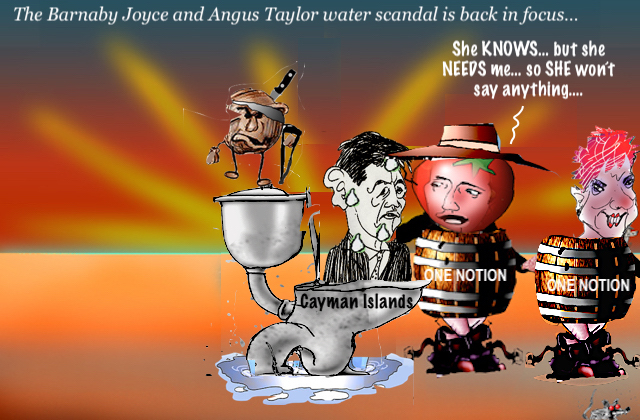
The Barnaby Joyce and Angus Taylor water scandal is back in focus, seven years after Michael West Media helped expose the $80 million water buyback linked to a Cayman Islands company. The deal, signed off under Barnaby Joyce, involved water rights sold at a record price through a company connected to Angus Taylor, with questions still unresolved about who ultimately benefited and why taxpayers paid so much for assets critics argued were of little environmental value.
As the issue makes a brief mention in parliament, so do the unanswered questions about secrecy, political protection, and why no serious investigation has followed.
Happy 7 year anniversary of the story
They Got away with Australia’s own Watergate | The West Report
by Michael West
https://michaelwest.com.au/they-got-away-with-australias-own-watergate-the-west-report/
YOURDEMOCRACY.NET RECORDS HISTORY AS IT SHOULD BE — NOT AS THE WESTERN MEDIA WRONGLY REPORTS IT — SINCE 2005.
Gus Leonisky
POLITICAL CARTOONIST SINCE 1951.
- By Gus Leonisky at 5 Apr 2026 - 6:49am
- Gus Leonisky's blog
- Login or register to post comments
democrapcy....
How democracies erode
By Gabriele Gratton
After years on the fringes, Pauline Hanson’s One Nation is surging in the polls, from 6.4 per cent of the lower-house vote at the May 2025 election to perhaps a quarter or even a third of voters in various polls today. Meanwhile, the Coalition is wobbling, fractured and drifting rightward in part because it fears being outflanked. In the first electoral showdown of 2026, the South Australian state election, One Nation overtook the Coalition as the second party in the state, with over 22 per cent of first preferences.At first look, this may appear to be a internecine fight within the political right. In fact, some say, a gift to the Labor Party. Others now worry that a once-stable party system could be replaced by a struggle between centrist moderates and far-right populists who flirt with anti-democratic ideals. The latter may one day win, if not today, then tomorrow.
If this feels new to Australia, it should not feel unfamiliar. For anyone who has followed democratic politics in the Northern Hemisphere closely since 2015, this pattern has a recognisable rhythm: new far-right political movements flirting with authoritarianism slowly devour the less well-off base of traditional conservative parties, then move to win traditional social-democratic and labour constituencies of disenchanted working-class voters.
But how did that happen? And what is the danger for liberal democracy?
The surprise of the 21st century is democratic backsliding without a breakdown
In the 1990s, much of the intellectual mood in democratic politics was optimistic. Liberal democracy had “won” the Cold War argument, and many believed that once democracy had endured long enough, and once societies were prosperous enough, it would be stable. Academic work reinforced this intuition. While economic development does not mechanically create democracies, most scholarship at the time argued it made democracies markedly more likely to survive; wealthy, long-standing democracies, on average, looked resilient.
The last decade shattered that confidence. Democratic backsliding has increasingly taken the form of incremental erosion inside formally democratic systems: weakening courts, press freedoms, electoral fairness, and bureaucratic independence, often by leaders who came to power at the ballot box. V-Dem’s 2025 Democracy Report describes this as a long “wave” of autocratisation that includes deterioration even in established democracies.
At the UNSW Resilient Democracy Lab, we have spent recent years building a research centre devoted to exactly this puzzle: why is backsliding occurring in long-standing democracies, and how can we build democratic institutions that are more resilient?
Our seminars and workshops have brought world experts into conversation with cutting-edge quantitative research, and our own team’s contributions sit directly within this fast-moving global frontier. What has emerged is not a single 'master cause' of democratic backsliding, but rather a set of mechanisms that complement each other. Yet a common underlying message emerges. Citizens across the Atlantic have, for a long time, trusted that liberal democracy would guarantee security, prosperity, and inclusion. The 21st century has eroded many of these certainties. Financial, demographic, and even public health crises have wreaked havoc on traditional social networks in the European and American middle class.
The implicit promise of democracy is that, in such moments, politics would give voice and support to those who lose out in these processes. But politicians across the Atlantic have, by and large, been unable to do so, in part because of the constraints liberal democracies had, over time, built around politicians. Perhaps paradoxically, these constraints exist for good reasons including economic growth in the long-run, individual freedoms, inclusion and diversity, and environmental protection.
Economic shocks matter, but the political response matters more
Professor of Political Science and Economics Massimo Morelli and coauthors have in their work emphasised an economic dimension often misunderstood in public debate. The story is not simply 'globalisation made people angry,' or 'a crisis made voters irrational.' Rather, the dangerous mix combines a large negative shock and a government response that fails to insure citizens, especially the median voter, against the downside.
Europe’s sequence of shocks is well known. The global financial crisis was followed by the euro-area debt crisis. Research on earlier historical episodes shows that financial crises reliably shift politics toward extremes, erode trust, and destabilise party systems.
But the more specific European mechanism is about constraints. High debt, fragile banking systems, and euro-area rules narrowed the policy space available to politicians. The result, especially in the hardest-hit countries, was fiscal austerity, precisely when citizens expected economic protection. When rising unemployment and insecurity is paired with a sense that mainstream parties either could not or would not respond, the combination is combustible.
A major cross-European study links increases in unemployment after the Great Recession to stronger support for non-mainstream, especially populist, parties and to changes in trust and political attitudes.
Brexit is a vivid illustration of this combined effect. Thiemo Fetzer’s analysis of UK localities links exposure to austerity-related cuts and welfare reforms to increased support for UKIP and for Leave, suggesting that the state’s retreat from social insurance helped convert economic pain into anti-establishment politics.
And Jacob Edenhofer and coauthors (writing on UK evidence) argue bluntly that austerity and welfare-state retrenchment were powerful predictors of support for right-wing populists, often more predictive than local immigration exposure.
The lesson is uncomfortable for centrist governance. It is not enough to say 'the fundamentals are sound.' When the median voter first feels personally exposed, where the sense of risk is elevated beyond the abstract risk to a household reality, political demand changes quickly.
Constraints on government action make illiberal democracy more attractive
Economic insecurity is only one piece. Europe’s 2015–2025 decade also featured a number of security anxieties including terrorism, geopolitical threats, and large-scale migration pressures. In my work with Barton Lee, we found that even if voters value liberty, when insecurity rises and governments appear constrained or ineffective, voters may rationally support leaders who promise decisive action — even when they can foresee that such leaders will weaken accountability and potentially lead to processes of autocratisation. This logic helps explain why figures as different as Orbán, Netanyahu, and Trump can attract support in moments of heightened perceived threat.
The common reaction to this problem, strengthening checks and balances, may, if anything, backfire. Checks and balances can slow autocratisation, but they can also make the choice of an “illiberal” leader feel less risky to voters because people believe institutions will contain the damage. Thus, ultimately stronger checks and balances may make autocratisation more likely.
“Drain the swamp”: when bureaucracy becomes a representation problem
Populism is not only anti-immigrant or anti-globalisation. It is also anti-state, especially anti-bureaucracy. In another project with Barton Lee, we argue that mistrust in public servants is a key force behind anti-elite populism, and that populist governance can trigger damaging reforms of the administrative state. We show that this lack of trust is fuelled by meritocratic policies that select public servants — mostly for good reasons — from educated, urban backgrounds that may make them less sensitive to fears and concerns that worry the typical voter.
The United States offers a cautionary case of how bureaucratic failure can become political fuel. Carolina Arteaga and Victoria Barone show that greater exposure to the opioid epidemic causally increased Republican vote share in the MAGA era: a one-standard-deviation increase in opioid exposure raised Republican vote share by about 4.5 percentage points. When citizens experience preventable disaster and believe institutions looked away, anti-system politics becomes easier to sell.
Even recent “government efficiency” projects can ride this wave. In the U.S., the Department of Government Efficiency (DOGE) associated with Elon Musk was framed explicitly around dismantling bureaucracy and cutting government. Whether such moves increase genuine efficiency or simply destroy competence, they speak to a deeper political demand: “make the state answerable to us, not to educated urban elites.”
Immigration: from a representation gap into a political opening
Most scholars agree that anti-immigration sentiment plays a central role in the rise of far-right populism.
Perhaps more surprising is Laurenz Guenther’s evidence that Europe’s 2015 refugee crisis did not create anti-immigration sentiment from scratch. His work shows something more destabilising. On cultural issues, especially immigration, parliaments and mainstream parties were often systematically more progressive than voters before the issue became most salient.
In Germany, for example, Guenther documents that in 2013 most voters preferred restricting immigration opportunities, while the average parliamentarian in each major party preferred facilitating them. When the refugee crisis hit, immigration rapidly became by far the most important issue for voters, and the AfD grew into a major party by closing that gap with an explicitly anti-immigration platform.
Across the EU more broadly, he shows that these cultural representation gaps can be large, systematic, and amplified when issue salience increases, exactly what happened as immigration rose in perceived importance after 2015.
Elite and technocratic responses are often incompatible with democratic resilience
Before the rise of social media, the informational environment in liberal democracies was almost entirely controlled by pro-democratic liberal elites. The rise of social media lowered the cost of political entrepreneurship and fragmented the public sphere. Misinformation, as many have pointed out, can spread faster. Yet so can even legitimate fears. In many cases, political leaders, pundits, and even scholars, have advocated to a return to more control. The mantra is that we can “educate voters”. But this reaction misses the point that many of the concerns fuelling support for populist leaders are not the fruit of ignorance or misinformation. Voters may well be overreacting to their fears and concerns, but paternalistic approaches that aim at “calming down” these fears are not possible anymore in such a pluralistic informational environment.
Another reaction to the threat of populism is to enshrine policymaking into constitutionally protected technocracies such as independent authorities and courts. Yet, as I have argued with Jacob Edenhofer, delegation to technocrats has if anything caused even greater populist backlash. The very attempt to “depoliticise” decisions, often presented as sensible governance, can intensify the perception that voters no longer steer their own democracies.
Finally, as I mentioned above, stronger checks and balances, designed to slow institutional erosion, can also, paradoxically, make strongman options feel safer and therefore more electorally tempting.
Prepare for the challenge of AI
The broad lesson from this research is that technological and social changes in the last decades have made liberal democracy more fragile and populism more appealing to voters. Yet, these shocks fuelled populism only in combination with liberal democracy’s inability to deliver protection and prosperity to many voters.
This inability, however, has its roots in actions taken with the aim to reinforce democracy. Fiscal and monetary constraints on politicians are a good way to avoid unsustainable fiscal imprudence. And yet, as we have seen, have backfired. Similarly, experts in the public service or checks and balances surrounding power are designed to make democratic governments more effective and less prone to abuses. And yet they fuelled mistrust towards the state and complacency towards authoritarian leaders.
Perhaps the hard-to-swallow truth is that we have to reinvent liberal democratic institutions to fit the new technological environment. We often complain about (and marvel at) our online social lives. And yet our institutions of representation are still based on concepts of “community” and “constituency” that were designed when letters travelled by horse or, at best, by train. We wonder how young people who grew up only knowing democracy may be fascinated by autocratic leaders. And yet today many citizens in demoracies live most of their social interactions in contexts that are not democratic, like their workplace and their interactions within large, global online platforms.
AI is threatening to challenge our democracies once again with a new technological revolution. Some argue that AI will substitute most middle-class service jobs (the only future middle-class jobs in a post-agricultural and post-industrial society). Some are more optimistic, pointing out that throughout history, the development of machines tends to increase human production, rather than substituting it. Yet even the most optimistic view must predict a lot of suffering for a lot of people in the short term, as with all past technological revolutions. If liberal democracy has to survive this shock, it must be able to give voice and support to those who, in the short term, will be the losers of the AI revolution.
A more resilient democracy for the 21st century is a more effective democracy, one that can respond swiftly to voters’ needs and preferences and better represent the varied interests and backgrounds in our societies.
https://www.eurekastreet.com.au/how-democracies-erode
READ FROM TOP.
YOURDEMOCRACY.NET RECORDS HISTORY AS IT SHOULD BE — NOT AS THE WESTERN MEDIA WRONGLY REPORTS IT — SINCE 2005.
Gus Leonisky
POLITICAL CARTOONIST SINCE 1951.
RABID ATHEIST.
WELCOME TO THIS INSANE WORLD….
GUSNOTE: PEOPLE HAVE ADAPTED TO THE NEW TECHNOLOGIES FASTER THAN THE PROFESORS OF UNIVERSITIES. THE GENERAL PROBLEMS HAVE BEEN OF CHOICE: USUALLY LOOKING FOR THE EASIEST PATHWAY TO HAPPINESS. USING THE NEW TECHNOLOGIES CAN BE FUN AS WELL AS EDUCATIONAL... DEMOCRACY IS A BEAST THAT DEMANDS EFFORT.... AND WE ARE LAZY. THIS IS WHY WE STILL HAVE A KING AS A HEAD OF STATE....
FINDING OUR DEMOCRATIC TRAVEL PLAN IS TO IDENTIFY THE POTHOLES AND THE SPEED LIMITS...
— FOOD PRICES
— HOUSING AFFORDABILITY
— IMMIGRATION
— STUPID WARS
— BELIEFS IN FAIRIES/GODS/GNOMES/AMUSEMENT-PARKS/DISTRACTIONS/POLITICAL-PARTIES...