Search
Recent comments
- the eternal....
52 min 8 sec ago - and god said....
20 hours 45 min ago - walking east....
21 hours 22 min ago - part 1 and 2.....
21 hours 32 min ago - bastard pig....
21 hours 42 min ago - accidental....
1 day 8 hours ago - momentum...
1 day 17 hours ago - the greatest....
1 day 17 hours ago - cold place, warm people.....
1 day 20 hours ago - profitering....
1 day 20 hours ago
Democracy Links
Member's Off-site Blogs
do not panic the pumps....
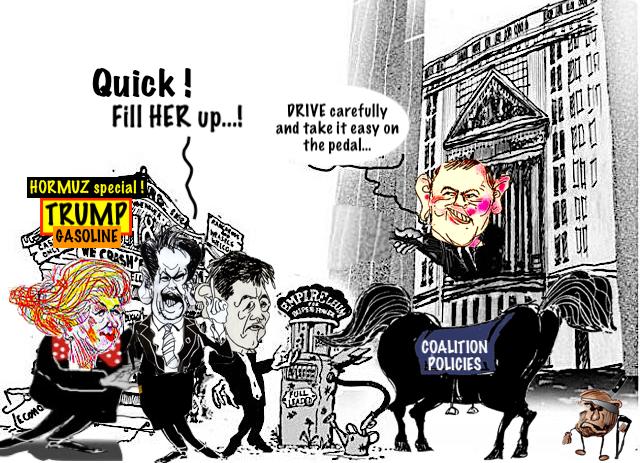
The economic shocks from the war in the Middle East will remain for months, Prime Minister Anthony Albanese has declared in a rare prime-time address to the nation, suggesting Australians should try to save fuel where possible.
In a short speech broadcast on all networks tonight, he outlined the measures the government had already taken to address the soaring cost of petrol and diesel and promised to do "everything we can to protect Australia from the worst of it".Albanese said Australians should "go about your business and your life as normal" but urged motorists not to take more fuel than they needed ahead of Easter holidays and called on commuters to consider public transport. LIVE UPDATES: Trump says US will be leaving Iran within three weekshttps://www.9news.com.au/national/anthony-albanese-address-to-the-nation-what-to-expect-how-to-watch-everything-to-know SEE ALSO: https://michaelwest.com.au/petrol-panic-paulines-war-cry-and-ruperts-iran-push-scam-of-the-week/ ====================YOURDEMOCRACY.NET RECORDS HISTORY AS IT SHOULD BE — NOT AS THE WESTERN MEDIA WRONGLY REPORTS IT — SINCE 2005.
Gus Leonisky
POLITICAL CARTOONIST SINCE 1951.
- By Gus Leonisky at 2 Apr 2026 - 8:12am
- Gus Leonisky's blog
- Login or register to post comments
witchcraft....
The Iran war and the price of Albanese’s complicityby Andrew Brown
Amid Trump’s delusional speech today and Albanese’s denial of responsibility last night, the Iran war continues at the huge cost of lives and livelihoods. Andrew Brown on the price of Australia’s complicity, first in a series.
Australians know when something is wrong. They feel it every time they pull up at the bowser and watch the numbers run like a poker machine rigged against them.
They feel it at the supermarket, where a bag of groceries now lands with the weight of a small insult. They feel it in the quiet panic of small business, where margins are thinning, freight costs are rising, power bills are biting, and another week of this can mean the difference between staying open and shutting the doors for good.
And yet the story we are told is always the same. Global pressures. Market volatility. Complex conditions. A regrettable tightening. The language is polished, bloodless, designed to anaesthetise. It is the language of people desperate to discuss consequences while keeping their mouths firmly shut about causes.
But causes matter, and one of the great moral and political disgraces of this moment is that Australians are being made to pay for a war they did not choose, an escalation they did not authorise, and
an imperial order they are never allowed to question.
The cost of obedienceLet us speak plainly. Benjamin Netanyahu has dragged the region deeper into catastrophe with a level of impunity that would be unthinkable if the perpetrator were an enemy of the West rather than its favoured client.
Donald Trump, grotesque even by the standards of modern American power, has helped normalise the politics of lawless domination, chest-beating militarism, and unconditional indulgence of Israel’s worst instincts.
And Anthony Albanese, in that uniquely Australian tradition of smiling subservience, has chosen not independence, not courage, not principle, but obedience.
Last night he addressed the nation. It took him three minutes. He told Australians they were paying higher prices because of the war, but could not bring himself to name who started it or who his government has refused to condemn for starting it.
He said “Australia is not an active participant in this war” as though that settles something. As though diplomatic cover is not participation. As though standing in Washington’s corner while Gaza was pulverised, Iran was attacked without provocation, and the Strait of Hormuz became a choke point strangling the global economy is not, in any meaningful sense, participation.
If it were Russia causing this pain, Albanese would say Russia. If it were China, he would say China. But it is Israel and the United States, so he finds no language at all.
He cut the fuel excise, promised loans for businesses, told people to take the bus, told them to enjoy Easter, and closed with an invitation to handle it the Australian way. No anger. No accountability. No naming of the illegal war that caused this, or the governments that launched it.
That is cowardice dressed up as statecraft.
And it comes at a cost not paid in speeches, press releases or diplomatic cables. It is paid in dollars at the pump. It is paid in food inflation. It is paid in disrupted trade, higher shipping costs, market fear, investment uncertainty, and the creeping economic anxiety of a population that knows it is being squeezed but is constantly lied to about why.
Wars in the Middle East do not stay in the Middle East. They ripple through oil markets, shipping routes, insurance premiums, supply chains, business confidence, and currency nerves.
https://michaelwest.com.au/the-iran-war-and-the-price-of-albaneses-complicity/
READ FROM TOP.
YOURDEMOCRACY.NET RECORDS HISTORY AS IT SHOULD BE — NOT AS THE WESTERN MEDIA WRONGLY REPORTS IT — SINCE 2005.
Gus Leonisky
POLITICAL CARTOONIST SINCE 1951.
SEE ALSO:
when jews are screwing the dying christ of america......petrol litter....
The leaders of the UK and Australia have told their citizens to cut fuel consumption and prepare for months of hardship as a result of the US-Israeli war with Iran. But Keir Starmer and Anthony Albanese couldn’t bring themselves to name who’s responsible.
UK Prime Minister Keir Starmer and his Australian counterpart, Anthony Albanese, delivered a pair of seemingly coordinated addresses to their nations on Wednesday. “The economic shocks caused by [the Iran war] will be with us for months,” Albanese said, telling Australians to switch to public transport if possible, and promising to cut fuel taxes and prepare for the possibility that “the global situation gets worse and our fuel supplies are seriously disrupted.”
“Australia is not an active participant in this war,” he claimed, despite his government being the first in the world to back the US and Israel’s opening strikes on Iran on February 28.
Starmer struck a similar tone, declaring that “this is not our war,” but warning that “the impact of this war will affect the future of our country.” The British prime minister promised that “no matter how fierce this storm is, we are well placed to weather it,” and vowed to help “reopen” the Strait of Hormuz.
How bad is the energy crisis?The US-Israeli war with Iran has triggered the most severe energy crisis since the 1970s, if not in history. Around 40% of the world’s oil comes from the Middle East. Nearly a third of the world’s seaborne crude oil transits the Strait of Hormuz, a waterway less than 40 km wide at its narrowest point, which through a combination of Iranian attacks on tankers and hesitance by Western insurers, is de facto closed to maritime traffic.
Additionally, Iran’s retaliatory attacks on Gulf states hosting American troops have taken refineries and export terminals out of action. Qatar, which supplies 20% of the world’s liquefied natural gas (LNG), completely halted production almost a month ago.
As a result, Brent oil prices – which serve as a barometer for 80% of the world’s crude oil – have sat above $100 per barrel for three weeks, while gas prices have surged 60% in the EU and more than 100% in the UK. While the crisis is global, its effects are particularly acute in the EU, UK, and Australia, all of which have sanctioned Russian oil and gas, shutting themselves off from a potential lifeline amid the crisis.
The EU once relied on Russia for 45% of its gas imports, before switching to more expensive American and Qatari supplies after 2022. With no date in sight for the resumption of Qatari imports, and with inflation spiking across Europe, European Central Bank President Christine Lagarde warned last week that “we are facing a real shock…probably beyond what we can imagine at the moment.”
Are Starmer and Albanese pressuring the US?The Strait of Hormuz was open to maritime traffic until the US and Israel launched an unprovoked attack on Iran in the middle of nuclear talks. However, neither Starmer nor Albanese mentioned the US or Israel in their speeches. Instead, both the UK and Australia issued a joint statement – along with 32 other US allies in Europe and the Gulf – blaming the closure of the strait squarely on “Iran’s actions.”
“We call on Iran to cease immediately its threats, laying of mines, drone and missile attacks and other attempts to block the Strait to commercial shipping,” the statement reads, accusing Tehran of posing “a threat to international peace and security.”
Furthermore, Albanese has sent surveillance aircraft, stocks of air-to-air missiles, and military personnel to the UAE, while Starmer has allowed the US to use the British-American air base on Diego Garcia to attack Iran. Despite aiding the US in a war that Starmer claims is “not ours,” the British PM has been publicly humiliated by US President Donald Trump. Starmer’s decision to grant access to Diego Garcia took “too long,” Trump complained last month, adding that he was “greatly disappointed” in his ally.
What does the crisis look like for ordinary people?The most immediate signs of an energy crisis are felt at the pumps, where rising fuel prices foreshadow increasing costs of everything else dependent on oil: namely food, consumer goods, and the means of transporting them.
As of April 1, Americans are paying an average of $4.06 per gallon of gasoline ($1.07 per liter), up from around $3 before the war. British customers pay around $2.03 per liter while Australians pay roughly $1.79 – respectively 15% and 44% more expensive than in February. In the EU, fuel prices are highest in the Netherlands, where drivers pay $2.73 per liter.
In Russia, where export controls have been introduced to protect Russian consumers, Gasoline prices currently sit at around $0.83 per liter, down from $0.87 in February.
What is Trump doing to resolve the crisis?Trump has said fuel prices will fall once the conflict ends, predicting on Tuesday that military operations could cease in “two to three weeks.” However, his messaging on Iran so far has swung between claims that peace is imminent, and threats to bomb Iran “back to the Stone Ages” until Tehran capitulates – each abrupt shift in tone seemingly timed to calm energy markets.
In a post on his Truth Social platform on Wednesday, Trump claimed that “Iran's new regime president… has just asked the United States of America for a ceasefire.” Trump added that he would grant Tehran a ceasefire once the Strait of Hormuz “is open, free, and clear.” Iran’s Foreign Ministry dismissed Trump’s claim as “false” and “baseless.”
Trump is due to discuss Iran in a speech to the nation later on Wednesday. It is unclear whether his address will signal escalation or deescalation. However, the Pentagon announced the deployment of another aircraft carrier – the USS George H.W. Bush – to the Middle East on Tuesday, and with plans reportedly being drawn up for a ground invasion of Iran, the conflict and resulting energy crisis may drag on significantly longer.
https://www.rt.com/news/636985-starmer-albanese-iran-energy/
READ FROM TOP.
YOURDEMOCRACY.NET RECORDS HISTORY AS IT SHOULD BE — NOT AS THE WESTERN MEDIA WRONGLY REPORTS IT — SINCE 2005.
Gus Leonisky
POLITICAL CARTOONIST SINCE 1951.