Search
Democracy Links
Member's Off-site Blogs
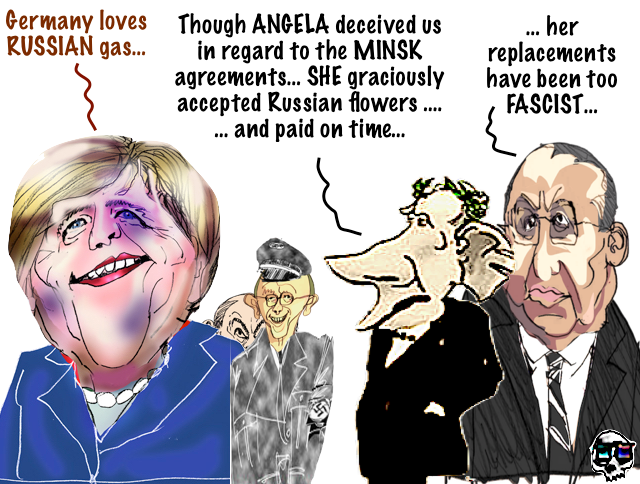
when the replacement parts are of inferior quality.....
[23 MAY 2025]... Friedrich Merz is Germany’s new chancellor — head of government in Europe’s largest economy, but likely also setting the direction for the EU as a whole. Leader of the Christian Democratic Union (CDU), Merz’s campaign for the federal election this February 23 was marked by sharp conservative rhetoric and promises of market‑driven reforms. Yet, falling well short of a majority, he immediately turned toward the familiar terrain of negotiating a “grand coalition” with the center‑left Social Democratic Party (SPD).
Friedrich Merz’s Failed Quest to Be a New Angela Merkel
BY NILS SCHNIEDERJANN
Merz thus sought the very alliance that he has always denounced. But who is he, and what can be expected from a chancellor who campaigned as a hard-liner but now faces the same compromises that defined Angela Merkel’s rein? To answer this, it helps to look back three years.
Back then, in a quiet dining room of a Berlin hotel, a group of leading German conservatives gathered for what was publicly described as a farewell dinner for Volker Bouffier, then prime minister of the state of Hesse. Sitting at the table were familiar faces from the CDU. As journalist Sara Sievert recounts in her biography of Merz, Der Unvermeidbare (“The Inevitable”), the real purpose of the evening was more strategic than sentimental. With Merkel’s long chancellorship nearing its end — and her chosen successors, Annegret Kramp-Karrenbauer and Armin Laschet, failing to secure public confidence — the CDU elite were searching for a new direction.
When Merz, then-new party leader, stood up to speak that night, everyone knew what was coming: the long-anticipated break with the Merkel era. But instead of denouncing his predecessor outright, Merz invoked another CDU heavyweight — Roland Koch, himself former prime minister of Hesse — praising his controversial 1999 campaign against the reform of Germany’s citizenship laws. Back then, Koch’s hard-line stance against granting birthright citizenship to immigrants’ children had mobilized xenophobic sentiments. People queued in front of the CDU’s stalls, asking where to sign against foreigners. Under Merkel, this was regarded as a low point of CDU history. For Merz, it was to be a model for the party’s new direction.
Thus, fears of a sharp rightward shift under Merz have long simmered in Germany’s political discourse. Critics warn that his chancellorship could signal the CDU’s gradual openness to collaboration with the far-right Alternative für Deutschland (AfD), or at the very least, a reversal of the centrist policies that defined the Merkel years. Under Merkel, the CDU had accommodated progressive reforms: introducing a minimum wage, legalizing same-sex marriage, phasing out nuclear energy, and accepting over a million refugees in 2015.
Merz has often been viewed as Merkel’s ideological antithesis. A sharp-tongued critic of her centrism, he was sidelined from party leadership as early as 2002, when Merkel ousted him from his post as parliamentary leader. For years, he remained in the political wilderness as an arch-conservative waiting for the pendulum to swing back. Now that he’s returned, however, he appears less intent on reviving his old neoliberal convictions than on emulating Merkel’s pragmatism — ironically adopting the very approach he once derided.
The BlackRock ConservativeMuch of Merz’s public reputation, particularly on the broad liberal and left-wing space, stems from this time out of the political spotlight. In particular, his role as chairman of the German division of BlackRock, the American asset management behemoth, is seen with a critical eye by most Germans. His close personal ties to BlackRock CEO Larry Fink, as reported in a recent biography by Volker Resing, only add to the perception that Merz represents the financial elite more than the electorate.
Still, his advocates seek to reframe this association not as a liability but as a strength. His corporate entanglements are portrayed as proof of worldly competence, a business-minded sensibility absent from the typical career politician. “Through his many board positions,” write Jutta Falke-Ischinger and Daniel Goffart in their biography of Merz, “he gained a deep and novel insight into the economy.” Between 2007 and 2018, Merz served on at least nineteen corporate boards, from Commerzbank to BASF and the recycling giant Interseroh. Just as he was plotting his political comeback, his connections earned him millions and embedded him within Europe’s financial elite.
This fusion of economic power and political ambition has drawn intense scrutiny. Merz continued to serve in Germany’s parliament until 2009 despite having effectively exited politics two years earlier. He collected his full salary while delivering no parliamentary speeches in his final term. More controversial still were the board seats and advisory roles he received from industrial leaders with whom he shared personal histories.
One case involved Werner Müller, the former minister of economic affairs under Chancellor Gerhard Schröder, who awarded Merz a lucrative consulting role at Ruhrkohle AG. Müller later also helped secure him a board seat at Stadler Rail, a Swiss company that went public in 2019. This reportedly made Merz a multimillionaire. Resing, another Merz biographer, quotes one of Merz’s confidants describing this as “his real entry into the circle of the financial and business elite.” This entry came just a year after Merz announced his return to frontline politics.
His proponents have tried to downplay the potential for conflicts of interest. Resing cites a corporate attorney familiar with Merz’s legal work who insists that “the substantive work was always done by others.” Merz, the implication goes, was more of a figurehead than an operative.
Political Kin: Merz and MerkelWhen BlackRock executive Merz returned to the political spotlight in 2018, his image as Merkel’s adversary and a neoliberal hard-liner was already firmly established. But what has largely disappeared from the public eye is that Merkel herself was not always perceived as a non-ideological chancellor devoid of political dogmas. On the contrary: when she competed with Merz early in her career for the most important posts within the CDU power apparatus, she too was seen as a neoliberal “radical reformer.” The weekly Der Spiegel wrote at the time about Merkel: “She doesn’t just want to discard cornerstones of 16 years of CDU policy under Helmut Kohl. Merkel wants to overhaul the welfare systems so thoroughly that all concepts dating back to Chancellor Bismarck gradually disappear from the party’s program.”
This stance was especially evident at the CDU party congress in Leipzig in December 2003. At the time, the CDU was, according to Merkel and Merz biographer Resing, “almost radically hungry for renewal.” The policy resolution called for a flat tax, a comprehensive pension system reform, and a massive reduction in social spending. Merz was also present at the congress: “Today marks the beginning of the end of the Social Democratization of the Union,” he thrilled back then.
Yet when Merkel entered the 2005 election campaign, it became clear that this course did not convince a majority. Her economically neoliberal agenda did not resonate — and in fact the CDU lost voters. With 35.2 percent of the vote, she achieved exactly the same result as seven years earlier — the very result that had enabled Gerhard Schröder and the SPD to take power. This outcome would become pivotal for Merkel’s subsequent political strategy. As Resing, who published his first Merkel biography in 2009, writes, the lesson was clear for Merkel: “You can’t win elections with a hardline, economically liberal reform agenda.” Thus, Merkel became the pragmatist the world remembers her for today.
Could the same thing happen to Merz? In 2005, he understood that the Christian Democrats’ electoral victory actually exposed the weakness of Merkel and her program. In a newspaper column at the time, he pointed out that 2.6 million voters had given their first, local vote to the CDU but not their second, more decisive one. The piece bore the title: “Voters apparently don’t want Merkel.”
Back then, sixteen years of Helmut Kohl were followed by a brief SPD-led interlude, to which Merkel responded in 2005 with a radical reform agenda that fared modestly with voters but still brought her to the chancellorship — thanks to a coalition with the SPD.
Now, sixteen years of Merkel have been followed by an even shorter SPD-led interlude, and Merz has responded with a radical reform program that has fared even worse with voters — but will still make him chancellor, again thanks to a SPD willing to cooperate for a little bit of power within ministries.
In their coalition agreement, the two parties prioritize stricter immigration controls and corporate tax relief, while officially preserving key social democratic achievements such as the independent Minimum Wage Commission. Notably, the SPD has managed to prevent major rollbacks of welfare policies, even as the CDU secures business-friendly reforms like accelerated depreciation and a lower corporate tax rate. It’s a playbook known from Merkel’s time. In a more surprising shift, both parties also committed to easing the so-called “debt brake,” a constitutional constraint that has long hampered public investment since its enactment by Merkel’s government in 2009.
So, the parallels have limits. Today’s SPD is weaker than ever, and the CDU is also diminished — the resulting coalition is hardly comparable to Merkel’s power-saturated grand coalitions. These altered dynamics will also have their effect on Merz.
Administrator of PowerThere is no doubt that Merz has presented himself as a radical candidate for the chancellorship. In previous years, he primarily attracted media attention when he overstepped rhetorical boundaries, for example, when he accused Ukrainian refugees of “welfare tourism,” referred to migrant children as “little pashas,” or falsely claimed that asylum seekers were getting free dental work in German clinics.
In 2020, when asked whether he could imagine a gay chancellor for Germany, he replied: “Let me put it this way: the question of sexual orientation is none of the public’s business. As long as it remains within the bounds of the law and doesn’t involve children — and at that point I draw an absolute line — it’s not a matter for public debate.” That this statement placed him “on the borderline of homophobia,” as Sievert writes in her book, is perhaps the most charitable interpretation.
But despite his reliance on provocative topics, Merz may no longer be genuinely interested in escalating them. In the biography by Falke-Ischinger and Goffart, Merz is quoted as saying: “I’m not the conservative fossil my opponents like to make me out to be.” The authors describe how he has become more cautious. He had come to realize that his brash demeanor and outdated rhetoric from pre-1989 West Germany had repeatedly tripped him up. He has since accepted, they write, “that the world can’t simply be rolled back to where it was 16 years before Merkel.”
Even though he is celebrated in the more conservative factions of his party for his aggressive stance, it has become evident that this approach cannot replicate past electoral successes. Public sensitivity has increased, as clearly demonstrated by the wave of outrage over the taboo-breaking joint vote with the AfD on a Bundestag motion this January.
Merz long saw himself as the antithesis of Merkel, but he may end up becoming her political reincarnation. The fact that — just like Merkel before him — he is now entering a grand coalition is further evidence that he intends to govern not as a radical reformer, but as a pragmatic administrator of what he would like to be a hyper-stable Republic.
But it is questionable whether even this opportunistic governing style will work under present conditions. The political and economic prerequisites have fundamentally changed since Merkel’s era. Her chancellorship benefited from a phase of global economic growth that especially favored Germany as an export nation. That model no longer functions. Merz, on the other hand, is unlikely to be compelled — given the absence of pressure from the Left — to sustainably boost domestic demand. There will likely be investments in bridges sturdy enough for tanks. But wage increases that might allow a young generation to afford a new car again? Hardly. Merkel’s stability-focused course had an expiry date — and that date has long since passed.
To be Merkel’s true successor, Merz would have to tackle the many unresolved issues she left behind, notably crippling infrastructure deficits and the failing model of an export-led economy that relied on cheap energy and low labor costs and now faces immense challenges in the context of global supply chain disruptions. But he lacks not only the political finesse, but also the power base to do so.
When Merkel first governed with the SPD, she had a comfortable majority of seats in the Bundestag. The grand coalition Merz now leads is the weakest in history, with merely 52 percent of seats. Moreover, the political pressures on the CDU have shifted fundamentally. While Merkel governed during a global upsurge of left-liberalism, with majorities in Germany in favor of legalizing gay marriages, the transition to clean energy and, initially, even the opening of borders, Merz faces a reversed dynamic. Today, the pressure is coming from the Right, articulated by the AfD with a vehemence that no party had the basis to match during Merkel’s time.
Under these conditions, it will be difficult for Merz to stabilize and capitalize on the “center” that Merkel cultivated. He has already distanced himself from his economic radicalism in the hope of reassembling Merkel’s broad voter base. But it is likely that the consensus model she cultivated will not survive his chancellorship.
https://jacobin.com/2025/05/germany-merz-merkel-cdu-pragmatism
========================
Why the German economy is sputtering
Is it time to panic about Germany?
[18 FEBRUARY 2018]... Between 1970 and 1995, exports slowly rose from 15 percent to a little over 20 percent of Germany's GDP. But from 1995 to today, its exports exploded by another 25 percentage points — and stood at more than 47 percent as of 2017.
An enormous portion of Germany's workers and businesses rely on foreign consumers to buy their goods and services. In slightly more technical terms, roughly half the German economy relies on demand created in other countries — rather than on demand it creates itself — to keep humming. If those other economies stop providing that demand — either because their own economy tanks, or because they make a policy choice not to — Germany's economy gets dragged down. And starting last year, that all happened on several fronts.
First there were President Trump's steel tariffs, which cut into American demand for German steel products. Then there was the slowdown in China's economy: The Asian behemoth only hit 6.6 percent GDP growth in 2018, its lowest level in roughly 30 years and one that's still falling. Partially, that's thanks to Trump once again and his ongoing trade war with the country. But the combination of China's state-run hybrid capitalism, Beijing's efforts to lift hundreds of millions of its citizens out of poverty, and the ongoing transition to a modern economy has left long-term structural challenges that are finally beginning to bite.
Germany had nowhere to turn. Outside of the U.S. and China, Europe was already a mess and most big developing economies were already struggling. Meanwhile, China is so big, and its domestic demand has such an outsized impact on the world, that when it slows down even a bit, everyone else tends to slow down too — including all the other countries that might buy German exports.
https://theweek.com/articles/823805/why-german-economy-sputtering
========================
Can Germany escape its economic slump in 2026?
BY Arthur Sullivan
The German economy desperately needs a boost in 2026 after years of downturn. Yet despite massive government spending pledges, optimism is fading among economists.
========================
[25 MARCH 2026]... Germany’s tentative economic recovery is facing renewed pressure as rising energy prices and supply chain disruptions linked to the Middle East conflict weigh on business confidence, according to David Deissner, head of the Stiftung Familienunternehmen und Politik.
Speaking about the outlook for Europe’s largest economy, Deissner said German industry is entering “a very difficult period,” with energy costs once again at the centre of concern. “It’s now really a very difficult period for us. Gas prices are very, very high. Oil prices are also rising. We have some of the highest energy prices here in Europe,” he said.
For companies already dealing with the long-term effects of the Ukraine war and persistently high energy costs, the latest geopolitical tensions risk intensifying existing challenges rather than creating entirely new ones. Deissner warned that rising costs are steadily eroding competitiveness across key sectors of the economy.
Germany has so far avoided immediate shortages by diversifying its energy sources, including increased supplies from Norway, imports of US liquefied natural gas, and the use of strategic reserves. However, this has not shielded the economy from global price increases.
“Of course, if prices spike globally in this highly interconnected energy market, that naturally affects German industry and consumer prices. We see the effect now at petrol stations for private consumers, but also for medium-sized businesses,” Deissner said.
He highlighted that energy-intensive sectors such as glass manufacturing, textiles and pharmaceuticals are particularly exposed to rising costs.
Economic forecasts point to potentially significant losses. According to the German Economic Institute, if oil prices remain around $100 per barrel, Germany could see its gross domestic product reduced by 0.3% in 2026 and 0.6% in 2027, equivalent to approximately €40 billion in losses over two years.
Beyond energy, the conflict is also disrupting global supply chains. Shipping routes have been affected, with vessels increasingly forced to take longer journeys around Africa, pushing up transport costs and delaying deliveries. Key transit routes such as the Strait of Hormuz are also critical for the movement of essential materials.
Deissner pointed to particular risks in supplies of aluminum, sulfur and helium. “Europe gets roughly 40% of its helium from Qatar, which is crucial for production here in Europe, particularly in Germany,” he said, noting the importance of the resource for medical technology, semiconductor manufacturing and other advanced industries.
Export-oriented German companies are already feeling the impact. “We already see now that the prices for shipping, for transport logistics are spiking,” Deissner said. “Ships have to be rerouted around Africa, and all these things are, of course, worrisome and drive up prices.”
He also warned of indirect effects through global manufacturing networks, particularly via China. “Because we do import quite a lot of high-tech components, intermediate products from China in order to make sure that our production here in Germany is running. So, this is something that we see with great concern,” he said.
Uncertainty is also affecting investment decisions, with projects in the Middle East and Gulf region largely paused. “We don’t know how this will develop,” Deissner said.
Despite government support measures, he argued that they offer only limited relief and that deeper structural reforms are needed. Small and medium-sized enterprises, which form the backbone of the German economy, are especially vulnerable.
“The crisis we see at the moment and the geopolitical shocks make it even more clear that Germany has to do its homework at home,” he said. He called for lower non-wage labor costs, reduced bureaucracy and faster tax relief for businesses.
“We have to become more dynamic, we have to do our domestic homework to stay competitive,” Deissner said. “It has become more important in these difficult times.”
While outlining these challenges, Deissner also expressed hope for a swift resolution to the conflict. “We hope this crisis will end very soon. We need a fast solution to prevent further harm. The costs for the economy, and for the rest of the world, are enormous due to the interdependence of our global markets.”
By Tamilla Hasanova
=======================
YOURDEMOCRACY.NET RECORDS HISTORY AS IT SHOULD BE — NOT AS THE WESTERN MEDIA WRONGLY REPORTS IT — SINCE 2005.
Gus Leonisky
POLITICAL CARTOONIST SINCE 1951.
- By Gus Leonisky at 1 Apr 2026 - 4:34am
- Gus Leonisky's blog
- Login or register to post comments
Recent comments
51 min 10 sec ago
20 hours 44 min ago
21 hours 21 min ago
21 hours 31 min ago
21 hours 41 min ago
1 day 8 hours ago
1 day 17 hours ago
1 day 17 hours ago
1 day 20 hours ago
1 day 20 hours ago