Search
Recent comments
- gaslighting....
5 hours 24 min ago - canadagas......
5 hours 34 min ago - playbook....
5 hours 54 min ago - 72....
7 hours 11 min ago - the eternal....
8 hours 15 min ago - and god said....
1 day 4 hours ago - walking east....
1 day 4 hours ago - part 1 and 2.....
1 day 4 hours ago - bastard pig....
1 day 5 hours ago - accidental....
1 day 16 hours ago
Democracy Links
Member's Off-site Blogs
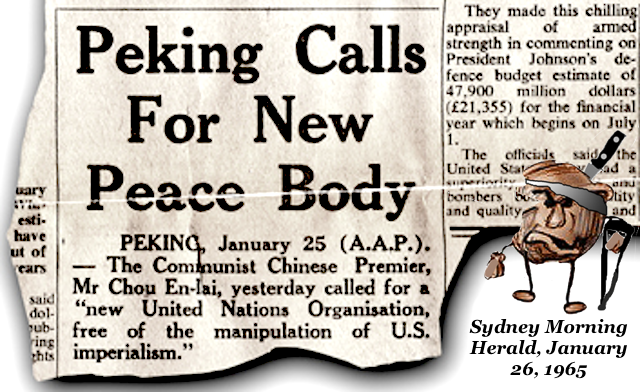
back then: demanding a new peace body....
The idea that the United States should lead the world, replacing the British Empire, had been advanced by various U.S. leaders and influential citizens since the late 19th century. This ambition was in keeping with age-old aspirations of great states and empires, and also with the trajectory of U.S. history. The U.S. expanded across North America in the 19th century, became an imperial power in Asia in 1899, declared Latin America an exclusive sphere of influence in the early 20th century, and became the foremost global economic power prior to the First World War.
Cold War interventionism, 1945-1990
UNITED STATES FOREIGN POLICY
Among those promoting the idea of U.S. global predominance was Henry Luce, publisher of Time and Life magazines. In an editorial titled “The American Century” published ten months before the Japanese attack on Pearl Harbor (February 17, 1941), Luce called on Americans to “reject isolationism and accept the logic of internationalism.” This meant, to Luce, not only entering the Second World War on the side of Great Britain, but also remaking the world in the image of America after victory was secured.
Luce invoked the ghost of Woodrow Wilson in arguing that a new “international moral order” was both necessary and possible under U.S. leadership. “In 1919,” he wrote, “we had a golden opportunity, an opportunity unprecedented in all history, to assume the leadership of the world – a golden opportunity handed to us on the proverbial silver platter. We did not understand that opportunity. Wilson mishandled it. We rejected it.” Luce advised Americans not to pass up another opportunity, indeed to “accept wholeheartedly our duty and our opportunity as the most powerful and vital nation of the world and in consequence to assert upon the world the full impact of our influence, for such means as we see fit.”
Luce assumed that U.S. leadership would be of great benefit to the world, facilitating economic abundance, freedom from tyranny, and justice for all. In looking at America’s past, he saw no signs of malicious or greedy ambition, only “magnificent purposes,” the most noble of which was the “triumphal purpose of freedom.”[1] Like many Americans, Luce filtered out episodes of U.S. history that cast a shadow on the American character, not the least being the recent 35-year experiment of U.S. hegemony in Latin America.[2] That effort incurred such widespread resentment that President Franklin Roosevelt was obliged to renounce military interventionism in the region via the Good Neighbor Policy of 1933. Would U.S. global leadership produce similar results?[3]
The U.S. emerged from the Second World War an economic powerhouse and military superpower. The American home front had remained unscathed save for one enemy attack on Pearl Harbor. The opportunity to establish U.S. global predominance seemed to be at hand in 1945. The U.S. had six percent of the world’s population but more than half the world’s manufacturing capacity and three-fourths of its invested capital. U.S. armed forces were stationed around the globe, more than six million strong, U.S. naval ships outnumbered the combined fleets of all nations, and the U.S. Air Force ruled the skies.[4] The U.S. also had a monopoly on nuclear bombs and had used the fearsome weapons to obliterate two Japanese cities in August 1945.
The Soviet Union, in contrast, was devastated by the war, losing an estimated 24 million soldiers and citizens, as compared to 418,500 total U.S. fatalities.[5] The German invasion and occupation destroyed, completely or partially, fifteen large Soviet cities, 1,710 towns, and 70,000 villages, and left 25 million people homeless. The invaders demolished tens of thousands of industrial enterprises, railway stations, electrical generators, oil wells, coal mines, farm machines, and other essentials of a modern industrial society, and slaughtered or carried away millions of farm animals.[6] The Soviet Union bore the brunt of the war and also did the most to defeat the Nazi war machine.
America’s other major ally, Great Britain, was bombed but not invaded during the war. The British lost about 450,000 soldiers and civilians, roughly half the number who died in the First World War. Britain emerged from the Second World War in financial crisis but still in command of an extensive empire that included colonies in Asia and Africa, and spheres of influence in the Mediterranean and Middle East. Prime Minister Winston Churchill intended to maintain that empire, telling Londoners in November 1942, “I have not become the King’s First Minister in order to preside over the liquidation of the British Empire.”[7]
Over the next three decades, however, the whole European imperial system fell apart. Indeed, the very word “imperial” lost its grandeur and became a term of opprobrium. The world that the U.S. sought to lead in 1945 was a cauldron of unrest, filled with destitute peoples, incipient revolts, challenges to economic elitism and racism, and conflicts between ethnic, religious, political, and national groups. U.S. leaders and many citizens were nonetheless confident that the time was ripe for America to take charge, indeed that it was America’s new “manifest destiny” to lead the world. As the historian Melvyn Leffler writes:
In 1945 the United States held a uniquely preeminent position. For many officials, businessmen, and publicists, victory confirmed the superiority of American values: individual liberty, representative government, free enterprise, private property, and a marketplace economy. Given their country’s overwhelming power, they now expected to refashion the world in America’s image and create the American Century.[8]
The idea of U.S. global leadership did not exclude cooperation with other nations nor with the newly formed United Nations, but it did imply that others would follow the U.S. lead and accept its designs. Financially strapped Great Britain, as it turned out, accepted a secondary great power role while cleverly enlisting the U.S. in support of its foreign missions, notably in Greece and Iran. Soviet leaders, on the other hand, were reluctant to accept U.S. global predominance, especially in Eastern Europe, a region deemed vital to Soviet security interests. The latter became a major point of contention among the Big Three as the Second World War drew to a close.
Still, the Cold War was not fated. During the war years, President Roosevelt had worked pragmatically with Soviet Premier Joseph Stalin and Churchill in planning and executing the war against Nazi Germany. Roosevelt was well aware of the Soviet government’s internal repression, but he focused on their nations’ common interests in the international arena, and he used his personal charm to create a friendly negotiating climate.
This cooperative approach shifted dramatically when Harry Truman inherited the presidency following Roosevelt’s sudden death in April 1945. Truman adopted a hard-edged, confrontational attitude, treating the Soviet Union as a pariah state and granting it few legitimate security interests. As a senator from Missouri in June 1941, Truman had responded to news of the German invasion of the Soviet Union by saying, “If we see Germany is winning we ought to help Russia and if Russia is winning we ought to help Germany and that way let them kill as many as possible, although I don’t want to see Hitler victorious under any circumstances.”[9]
As president, notes the historian Arnold A. Offner, Truman “likened Russian leaders to Hitler and [gangster] Al Capone, and inveighed against the ‘twin blights’ of Atheism and Communism.” Truman “was less an incipient statesman than an intense nationalist, overly fearful that appeasement, lack of preparedness, and enemies at home and abroad would thwart America’s mission (‘God’s will’) to win the post-World War Two peace on its own terms.”[10] Truman’s lack of training and experience in international diplomacy and geopolitics was exacerbated by his unshakeable belief in American righteousness and his undue confidence that U.S. military superiority could be leveraged into political gains in negotiations. According to the historian George Herring:
Policymaking changed dramatically under Truman’s very different leadership style. Understandably insecure in an office of huge responsibility in a time of stunning change, the new president was especially ill at ease in the unfamiliar world of foreign relations. Where FDR [Roosevelt] had been comfortable with the ambiguities of diplomacy, Truman saw a complex world in black-and-white terms…. He assumed that American ways of doing things were the correct way and that the peace should be based on American principles…. Confused, indeed befuddled, over the emerging conflict with the Soviet Union and embattled on the home front, he found comfort in the certainty of a black-and-white assessment of Soviet intentions and a hard-line foreign policy consisting of tough talk and no concessions.”[11]
Not surprisingly, Truman’s hardline approach toward the Soviet Union strained postwar negotiations. There were many issues to be decided. The victorious allies were in charge of forming new governments in liberated nations and establishing new international economic and political institutions. The Big Three managed to agree on a settlement for postwar Germany, temporarily dividing the country into four occupation zones (with the French included), but Truman was loath to accept a Soviet sphere of influence in Eastern Europe, notwithstanding his acceptance of British imperial dominion over a much wider swath of lands and peoples in Asia, Africa, and the Middle East. In December 1945, Truman told Secretary of State James Byrnes that Russia must be “faced with an iron fist and strong language.”[12]
To be sure, the Soviet Union proved to be an obstacle to U.S. global ambitions, but it was hardly the only one. “Officials in Washington,” writes Leffler, sought “to organize most of the world into an American-led orbit.”[13] This meant, if possible, establishing pro-U.S. governments and pro-capitalist, open market policies in every corner of the world – a daunting task. U.S. leaders typically blamed resistance on “communists,” but in truth there were many people, parties, movements, and nations that did not want to be corralled into an American-led orbit or pressed into accepting “free market” economic rules. Washington policymakers developed what might be called an “empire anxiety,” a constant apprehension that other countries would tilt toward socialism, neutralism, or economic nationalism (protectionism), frustrating U.S. ambitions. They spoke fearfully of “losing” other countries, as if all countries belonged in the U.S. orbit.
The Cold War, as such, went well beyond the U.S.-Soviet rivalry. U.S. leaders came to label as “communist threats” virtually any development that challenged perceived U.S. economic, geopolitical, or military interests. These included democratic socialist and communist parties in Europe, land redistribution programs in Latin America, national liberation movements in Asia and Africa, governments that exerted control over their natural resources (e.g., oil), coalition governments that included socialists and communists, and governments that received aid from the Soviet Union.[14] With such a plethora of apparent threats, U.S. leaders operated as if the United States were under siege rather than being the dominant world power that it was. According to Leffler:
The fears that plagued the policymaking community in Washington did not emanate from an unrelieved sequence of hostile Soviet measures. Soviet actions were mixed. But Truman’s advisers, like the president himself, riveted their attention on the more portentous elements of Soviet behavior and dismissed the more favorable signs…. At the end of 1945 these officials interpreted their environment in light of their own needs, fears, and interests. Their apprehensions were largely the result of worldwide conditions – social economic instability, political upheaval, vacuums of power, decolonization – occurring against a backdrop of depression, aggression, and war …[15]
For four decades, a succession of U.S. administrations explained and justified nearly all U.S. foreign policies in the name of “containing communism,” regardless of whether the Soviet Union was involved. In the very first “containment” action in Greece in 1947, the Soviet Union was not involved. The U.S. joined the British in backing a repressive, right-wing Greek government against a communist-led leftist movement that had turned to rebellion after being shut out of the political process. According to Joseph Jones, special assistant to the U.S. Assistant Secretary of State for Public Affairs at the time, “That the Greek government was corrupt, reactionary, inefficient, and indulged in extremist practices was well known and incontestable.”[16] The American public, however, was not well-versed on the situation in Greece and President Truman took advantage of this to establish a founding deception of the Cold War, framing the Greek conflict as a mythic struggle between freedom and totalitarianism in order to aid the so-called “democratic Greek government.”[17]
There were profound contradictions in the anti-communist mission of the United States. While rhetorically committed to freedom and democracy, the U.S. supported a host of repressive and dictatorial governments, including at various times, regimes in Greece, South Korea, French-controlled Vietnam (1950-54), South Vietnam (1954-75), Indonesia, Iran, Zaire, Cuba, Haiti, Nicaragua, Guatemala, El Salvador, Brazil, Chile, Pakistan, and the Philippines. The U.S. also covertly aided the overthrow of democratic governments, notably in Iran (1953), Guatemala (1954), and Chile (1973), each of which was replaced by a murderous rightist regime fully supported by the United States. The historian Edward Pessen, in his reflective study, Losing Our Souls (1993), recounts the many casualties of the Cold War to which the U.S. contributed:
… at least three million Asian deaths in Southeast Asia, the wounding of millions more, the destruction of much of the Korean countryside [and three million Koreans], and the utter devastation of Vietnam, on which more bombs were dropped than on all the belligerents combined in World War II…. Bloodbaths in Indonesia, the Congo (now Zaire), Angola, Iran, Guatemala, El Salvador, Chile, Brazil, and Argentina; the killing of thousands of peasants, students, trade unionists, priests, and nuns; the wiping out of entire villages by right-wing governments, police forces, militias, secretive death squads, many of them trained by and in the United States – these were the consequences of our cold war policy.[18]
The Cold War entailed other costs as well. It fostered a terrifying nuclear arms race between the U.S. and Soviet Union, and a near-miss of nuclear war during the Cuban Missile Crisis of 1962. It engendered a military-industrial-political complex that consumed huge amounts of resources and depended on never-ending “threats” from abroad; and it inaugurated the “imperial presidency” in which the Central Intelligence Agency (CIA), at the behest of the president, secretly carried out sabotage, propaganda, and coup d’états in foreign lands, often without Congressional approval or public knowledge.
Within the U.S., a virulent anti-communist crusade induced ideological indoctrination and sparked a zealous witch hunt for suspected subversives. The Communist Party in the U.S., which had previously operated openly and worked in concert with other reform groups, was deemed a national security threat and its leaders were imprisoned. A toxic form of patriotism seeped into the body politic as various domestic groups pressed their agendas in the name of anticommunism. Conservative and some liberal politicians gained office by red baiting their opponents, labeling them “soft on communism.” Business and Republican leaders derided New Deal Democrats as “fellow travelers” of the communists. Southern white segregationists jumped on the bandwagon to smear the “communist” label on racial justice advocates. Christian evangelists formed the Christian Anti-Communism Crusade, turning the geopolitical struggle into a holy war. In 1949, preacher Billy Graham described the U.S.-Soviet rivalry as a “battle to the death … between Christ and Anti-Christ.”[19]
Today, the era of “McCarthyism” is rightly remembered as excessive and abusive in its zeal, but Senator Joseph McCarthy was hardly the only one who pushed the margins of decency. Less acknowledged in most U.S. history accounts is the misapplication of the “communist threat” in foreign policymaking and the unnecessary carnage that ensued.[20]
The contradictions of U.S. Cold War policy came to a head in the Vietnam War. Led to believe that the U.S. was fighting to save the “free world” from totalitarian communism, Americans were at a loss to explain why millions of Vietnamese people sided with the communist “dictator” Ho Chi Minh rather than with leaders chosen by the United States. Nor did the Cold War ideological framework explain why so many leaders of developing countries refused to take sides in the Cold War, maintaining friendly relations with both the Soviet Union and the United States. Were they victims of communist propaganda, unable to decipher the good guys from the bad guys? Or were Americans bamboozled by American propaganda?[21]
This essay covers a lot of ground. The next section examines the ideological and geopolitical underpinnings of the Cold War, including the strategic uses of anti-communism by U.S. leaders, socialist-communist philosophy, and the different manifestations of socialism. Section III discusses the events and perspectives that led to the Cold War as well as policy alternatives in the late 1940s and early 1950s. Sections IV, V, and VI offer case studies of U.S. interventions in other countries, highlighting eleven and noting a half-dozen more. The last section considers the continuity of U.S. foreign policies following the Cold War and recaps what might be gleaned from this essay.
READ MORE:
https://peacehistory-usfp.org/cold-war/
YOURDEMOCRACY.NET RECORDS HISTORY AS IT SHOULD BE — NOT AS THE WESTERN MEDIA WRONGLY REPORTS IT — SINCE 2005.
Gus Leonisky
POLITICAL CARTOONIST SINCE 1951.
SEE ALSO:
making donald's board of piss look good......
SEE ALSO:
defrosting the cold war with china.....- By Gus Leonisky at 31 Jan 2026 - 5:55am
- Gus Leonisky's blog
- Login or register to post comments
luce's....
American Century by Henry Luce (Feb. 1941, Life Magazine)
We Americans are unhappy. We are not happy about America. We are not happy about ourselves in relation to America. We are nervous — or gloomy — or apathetic. As we look out at the rest of the world we are confused; we don’t know what to do. “Aid to Britain short of war” is typical of halfway hopes and halfway measures.
As we look toward the future — our own future and the future of other nations — we are filled with foreboding. The future doesn’t seem to hold anything for us except conflict, disruption, war.
There is a striking contrast between our state of mind and that of the British people. On Sept. 3, 1939, the first day of the war in England, Winston Churchill had this to say: “Outside the storms of war may blow and the land may be lashed with the fury of its gales, but in our hearts this Sunday morning there is Peace.”
Since Mr. Churchill spoke those words, the German Luftwaffe has made havoc of British cities, driven the population underground, frightened children from their sleep, and imposed upon everyone a nervous strain as great as any that people have ever endured. Readers of LIFE have seen this havoc unfolded week by week.
Yet close observers agree that when Mr. Churchill spoke of peace in the hearts of the British people he was not indulging in idle oratory. The British people are profoundly calm. There seems to be a complete absence of nervousness. It seems as if all the neuroses of modern life had vanished from England.
In the beginning the British Government made elaborate preparations for an increase in mental breakdowns. But these have actually declined. There have been fewer than a dozen breakdowns reported in London since the air raids began.
The British are calm in their spirit not because they have nothing to worry about but because they are fighting for their lives. They have made that decision. And they have no further choice. All their mistakes of the past 20 years, all the stupidities and failures that they have shared with the rest of the democratic world, are now of the past. They can forget them because they are faced with a supreme task — defending, yard by yard, their island home.
With us it is different. We do not have to face any attack tomorrow or the next day. Yet we are faced with something almost as difficult. We are faced with great decisions.
* * *
We know how lucky we are compared to all the rest of mankind. At least two-thirds of us are just plain rich compared to all the rest of the human family — rich in food, rich in clothes, rich in entertainment and amusement, rich in leisure, rich.
And yet we also know that the sickness of the world is also our sickness. We, too, have miserably failed to solve the problems of our epoch. And nowhere in the world have man’s failures been so little excusable as in the United States of America. Nowhere has the contrast been so great between the reasonable hopes of our age and the actual facts of failure and frustration. And so now all our failures and mistakes hover like birds of ill omen over the White House, over the Capitol dome and over this printed page. Naturally, we have no peace.
But, even beyond this necessity for living with our own misdeeds, there is another reason why there is no peace in our hearts. It is that we have not been honest with ourselves. In this whole matter of War and Peace especially, we have been at various times and in various ways false to ourselves, false to each other, false to the facts of history and false to the future.
In this self-deceit our political leaders of all shades of opinion are deeply implicated. Yet we cannot shove the blame off on them. If our leaders have deceived us, it is mainly because we ourselves have insisted on being deceived. Their deceitfulness has resulted from our own moral and intellectual confusion. In this confusion, our educators and churchmen and scientists are deeply implicated.
Journalists, too, of course, are implicated. But if Americans are confused it is not for lack of accurate and pertinent information. The American people are by far the best-informed people in the history of the world.
The trouble is not with the facts. The trouble is that clear and honest inferences have not been drawn from the facts. The day-to-day present is clear. The issues of tomorrow are befogged.
There is one fundamental issue which faces America as it faces no other nation. It is an issue peculiar to America and peculiar to America in the 20th Century — now. It is deeper even than the immediate issue of War. If America meets it correctly, then, despite hosts of dangers and difficulties, we can look forward and move forward to a future worthy of men, with peace in our hearts.
If we dodge the issue, we shall flounder for ten or 20 or 30 bitter years in a chartless and meaningless series of disasters.
The purpose of this article is to state that issue, and its solution, as candidly and as completely as possible. But first of all, let us be completely candid about where we are and how we got there.
Where are we? We are in the war. All this talk about whether this or that might or might not get us into the war is wasted effort. We are, for a fact, in the war.
If there’s one place, we Americans did not want to be, it was in the war. We didn’t want much to be in any kind of war but, if there was one kind of war, we most of all didn’t want to be in, it was a European war. Yet, we’re in a war, as vicious and bad a war as ever struck this planet, and, along with being worldwide, a European war.
Of course, we are not technically at war, we are not painfully at war, and we may never have to experience the full hell that war can be. Nevertheless, the simple statement stands: we are in the war. The irony is that Hitler knows it — and most Americans don’t. It may or may not be an advantage to continue diplomatic relations with Germany. But the fact that a German embassy still flourishes in Washington beautifully illustrates the whole mass of deceits and self-deceits in which we have been living.
Perhaps the best way to show ourselves that we are in the war is to consider how we can get out of it. Practically, there’s only one way to get out of it and that is by a German victory over England. If England should surrender soon, Germany and America would not start fighting the next day. So, we would be out of the war. For a while. Except that Japan might then attack the South Seas and the Philippines. We could abandon the Philippines, abandon Australia and New Zealand, withdraw to Hawaii. And wait. We would be out of the war.
We say we don’t want to be in the war. We also say we want England to win. We want Hitler stopped — more than we want to stay out of the war. So, at the moment, we’re in.
WE GOT IN VIA DEFENSE… But what are we defending?
Now that we are in this war, how did we get in? We got in on the basis of defense. Even that very word, defense, has been full of deceit and self-deceit.
To the average American the plain meaning of the word defense is defense of the American territory. Is our national policy today limited to the defense of the American homeland by whatever means may seem wise? It is not. We are not in a war to defend American territory. We are in a war to defend and even to promote, encourage and incite so-called democratic principles throughout the world. The average American begins to realize now that that’s the kind of war he’s in. And he’s halfway for it. But he wonders how he ever got there, since a year ago he had not the slightest intention of getting into any such thing. Well, he can see now how he got there. He got there via “defense.”
Behind the doubts in the American mind there were and are two different picture-patterns. One of them stressing the appalling consequences of the fall of England leads us to a war of intervention. As a plain matter of the defense of American territory is that picture necessarily true? It is not necessarily true. For the other picture is roughly this: while it would be much better for us if Hitler were severely checked, nevertheless regardless of what happens in Europe it would be entirely possible for us to organize a defense of the northern part of the Western Hemisphere so that this country could not be successfully attacked. You are familiar with that picture. Is it true or false? No man is qualified to state categorically that it is false. If the entire rest of the world came under the organized domination of evil tyrants, it is quite possible to imagine that this country could make itself such a tough nut to crack that not all the tyrants in the world would care to come against us. And of course, there would always be a better than even chance that, like the great Queen Elizabeth, we could play one tyrant off against another. Or, like an infinitely mightier Switzerland, we could live discreetly and dangerously in the midst of enemies. No man can say that that picture of America as an impregnable armed camp is false. No man can honestly say that as a pure matter of defense — defense of our homeland — it is necessary to get into or be in this war.
The question before us then is not primarily one of necessity and survival. It is a question of choice and calculation. The true questions are: Do we want to be in this war? Do we prefer to be in it? And, if so, for what?
WE OBJECT TO BEING IN IT… Our fears have a special cause
We are in this war. We can see how we got into it in terms of defense. Now why do we object so strongly to being in it?
There are lots of reasons. First, there is the profound and almost universal aversion to all war — to killing and being killed. But the reason which needs closest inspection, since it is one peculiar to this war and never felt about any previous war, is the fear that if we get into this war, it will be the end of our constitutional democracy. We are all acquainted with the fearful forecast — that some form of dictatorship is required to fight a modern war, that we will certainly go bankrupt, that in the process of war and its aftermath our economy will be largely socialized, that the politicians now in office will seize complete power and never yield it up, and that what with the whole trend toward collectivism, we shall end up in such a total national socialism that any faint semblances of our constitutional American democracy will be totally unrecognizable.
We start into this war with huge Government debt, a vast bureaucracy and a whole generation of young people trained to look to the Government as the source of all life. The Party in power is the one which for long years has been most sympathetic to all manner of socialist doctrines and collectivist trends. The President of the United States has continually reached for more and more power, and he owes his continuation in office today largely to the coming of the war. Thus, the fear that the United States will be driven to a national socialism, as a result of cataclysmic circumstances and contrary to the free will of the American people, is an entirely justifiable fear.
BUT WE WILL WIN IT… The big question is how
So, there’s the mess — to date. Much more could be said in amplification, in qualification, and in argument. But, however elaborately they might be stated, the sum of the facts about our present position brings us to this point — that the paramount question of this immediate moment is not whether we get into war but how do we win it?
If we are in a war, then it is no little advantage to be aware of the fact. And once we admit to ourselves that we are in a war, there is no shadow of doubt that we Americans will be determined to win it — cost what it may in life or treasure.
Whether or not we declare war, whether or not we send expeditionary forces abroad, whether or not we go bankrupt in the process — all these tremendous considerations are matters of strategy and management and are secondary to the overwhelming importance of winning the war.
WHAT ARE WE FIGHTING FOR… And why we need to know
Having now, with candor, examined our position, it is time to consider, to better purpose than would have been possible before, the larger issue which confronts us. Stated most simply, and in general terms, that issue is: What are we fighting for?
Each of us stands ready to give our life, our wealth, and all our hope of personal happiness, to make sure that America shall not lose any war she is engaged in. But we would like to know what war we are trying to win — and what we are supposed to win when we win it.
This questioning reflects our truest instincts as Americans. But more than that. Our urgent desire to give this war its proper name has a desperate practical importance. If we know what we are fighting for, then we can drive confidently toward a victorious conclusion and, what’s more, have at least an even chance of establishing a workable Peace.
Furthermore — and this is an extraordinary and profoundly historical fact which deserves to be examined in detail — America and only America can effectively state the war aims of this war.
Almost every expert will agree that Britain cannot win complete victory — cannot even, in the common saying, “stop Hitler” — without American help. Therefore, even if Britain should from time to time announce war aims, the American people are continually in the position of effectively approving or not approving those aims. On the contrary, if America were to announce war aims, Great Britain would almost certainly accept them. And the entire world including Adolf Hitler would accept them as the gauge of this battle.
DIPLOMATIC HISTORY
Americans have a feeling that in any collaboration with Great Britain we are somehow playing Britain’s game and not our own. Whatever sense there may have been in this notion in the past, today it is an ignorant and foolish conception of the situation. In any sort of partnership with the British Empire, Great Britain is perfectly willing that the United States of America should assume the role of senior partner. This has been true for a long time. Among serious Englishmen, the chief complaint against America (and incidentally their best alibi for themselves) has really amounted to this — that America has refused to rise to the opportunities of leadership in the world.
Consider this recent statement of the London Economist:
“If any permanent closer association of Britain and the United States is achieved, an island people of less than 50 million cannot expect to be the senior partner. The center of gravity and the ultimate decision must increasingly lie in America. We cannot resent this historical development. We may rather feel proud that the cycle of dependence, enmity and independence is coming full circle into a new interdependence.” We Americans no longer have the alibi that we cannot have things the way we want them so far as Great Britain is concerned. With due regard for the varying problems of the members of the British Commonwealth, what we want will be okay with them.
This holds true even for that inspiring proposal called Union Now — a proposal, made by an American, that Britain and the United States should create a new and larger federal union of peoples. That may not be the right approach to our problem. But no thoughtful American has done his duty by the United States of America until he has read and pondered Clarence Streit’s book presenting that proposal.
The big, important point to be made here is simply that the complete opportunity of leadership is ours. Like most great creative opportunities, it is an opportunity enveloped in stupendous difficulties and dangers. If we don’t want it, if we refuse to take it, the responsibility of refusal is also ours, and ours alone.
Admittedly, the future of the world cannot be settled all in one piece. It is stupid to try to blueprint the future as you blueprint an engine or as you draw up a constitution for a sorority. But if our trouble is that we don’t know what we are fighting for, then it’s up to us to figure it out. Don’t expect some other country to tell us. Stop this Nazi propaganda about fighting somebody else’s war. We fight no wars except our wars. “Arsenal of Democracy?” We may prove to be that. But today we must be the arsenal of America and of the friends and allies of America.
Friends and allies of America? Who are they, and for what? This is for us to tell them.
DONG DANG OR DEMOCRACY… But whose Dong Dang, whose Democracy?
But how can we tell them? And how can we tell ourselves for what purposes we seek allies and for what purposes we fight? Are we going to fight for dear old Danzig or dear old Dong Dang? Are we going to decide the boundaries of Ruritania? Or, if we cannot state war aims in terms of vastly distant geography, shall we use some big words like Democracy and Freedom and Justice? Yes, we can use the big words. The President has already used them. And perhaps we had better get used to using them again. Maybe they do mean something — about the future as well as the past.
Some amongst us are likely to be dying for them — on the fields and in the skies of battle. Either that, or the words themselves and what they mean die with us — in our beds. But is there nothing between the absurd sound of distant cities and the brassy trumpeting of majestic words? And if so, whose Dong Dang and whose Democracy? Is there not something a little more practically satisfying that we can get our teeth into? Is there no sort of understandable program? A program which would be clearly good for America, which would make sense for America — and which at the same time might have the blessing of the Goddess of Democracy and even help somehow to fix up this bothersome matter of Dong Dang?
Is there none such? There is. And so, we now come squarely and closely face to face with the issue which Americans hate most to face. It is that old, old issue with those old, old battered labels –the issue of Isolationism versus Internationalism.
We detest both words. We spit them at each other with the fury of hissing geese. We duck and dodge them.
Let us face that issue squarely now. If we face it squarely now — and if in facing it we take full and fearless account of the realities of our age — then we shall open the way, not necessarily to peace in our daily lives but to peace in our hearts.
Life is made up of joy and sorrow, of satisfactions and difficulties. In this time of trouble, we speak of troubles. There are many troubles. There are troubles in the field of philosophy, in faith and morals. There are troubles of home and family, of personal life. All are interrelated but we speak here especially of the troubles of national policy.
In the field of national policy, the fundamental trouble with America has been, and is, that whereas their nation became in the 20th Century the most powerful and the most vital nation in the world, nevertheless Americans were unable to accommodate themselves spiritually and practically to that fact. Hence, they have failed to play their part as a world power — a failure which has had disastrous consequences for themselves and for all mankind. And the cure is this: to accept wholeheartedly our duty and our opportunity as the most powerful and vital nation in the world and in consequence to exert upon the world the full impact of our influence, for such purposes as we see fit and by such means as we see fit.
***
“For such purposes as we see fit” leaves entirely open the question of what our purposes may be or how we may appropriately achieve them. Emphatically our only alternative to isolationism is not to undertake to police the whole world nor to impose democratic institutions on all mankind including the Dalai Lama and the good shepherds of Tibet.
America cannot be responsible for the good behavior of the entire world. But America is responsible, to herself as well as to history, for the world-environment in which she lives. Nothing can so vitally affect America’s environment as America’s own influence upon it, and therefore if America’s environment is unfavorable to the growth of American life, then America has nobody to blame so deeply as she must blame herself.
In its failure to grasp this relationship between America and America’s environment lies the moral and practical bankruptcy of any and all forms of isolationism. It is most unfortunate that this virus of isolationist sterility has so deeply infected an influential section of the Republican Party. For until the Republican Party can develop a vital philosophy and program for America’s initiative and activity as a world power, it will continue to cut itself off from any useful participation in this hour of history. And its participation is deeply needed for the shaping of the future of America and of the world.
* * *
But politically speaking, it is an equally serious fact that for seven years Franklin Roosevelt was, for all practical purposes, a complete isolationist. He was more of an isolationist than Herbert Hoover or Calvin Coolidge. The fact that Franklin Roosevelt has recently emerged as an emergency world leader should not obscure the fact that for seven years his policies ran absolutely counter to any possibility of effective American leadership in international co-operation. There is of course a justification which can be made for the President’s first two terms. It can be said, with reason, that great social reforms were necessary in order to bring democracy up-to-date in the greatest of democracies. But the fact is that Franklin Roosevelt failed to make American democracy work successfully on a narrow, materialistic and nationalistic basis. And under Franklin Roosevelt we ourselves have failed to make democracy work successfully. Our only chance now to make it work is in terms of a vital international economy and in terms of an international moral order.
This objective is Franklin Roosevelt’s great opportunity to justify his first two terms and to go down in history as the greatest rather than the last of American Presidents. Our job is to help in every way we can, for our sakes and our children’s sakes, to ensure that Franklin Roosevelt shall be justly hailed as America’s greatest President.
Without our help he cannot be our greatest President. With our help he can and will be. Under him and with his leadership we can make isolationism as dead an issue as slavery, and we can make a truly American internationalism something as natural to us in our time as the airplane or the radio.
In 1919, we had a golden opportunity, an opportunity unprecedented in all history, to assume the leadership of the world — a golden opportunity handed to us on the proverbial silver platter. We did not understand that opportunity. Wilson mishandled it. We rejected it. The opportunity persisted. We bungled it in the 1920’s and in the confusions of the 1930’s we killed it.
To lead the world would never have been an easy task. To revive the hope of that lost opportunity makes the task now infinitely harder than it would have been before. Nevertheless, with the help of all of us, Roosevelt must succeed where Wilson failed.
THE 20TH CENTURY IS THE AMERICAN CENTURY… Some facts about our time
Consider the 20th Century. It is not only in the sense that we happen to live in it but ours also because it is America’s first century as a dominant power in the world. So far, this century of ours has been a profound and tragic disappointment. No other century has been so big with promise for human progress and happiness. And in no one century have so many men and women and children suffered such pain and anguish and bitter death.
It is a baffling and difficult and paradoxical century. No doubt all centuries were paradoxical to those who had to cope with them. But, like everything else, our paradoxes today are bigger and better than ever. Yes, better as well as bigger — inherently better. We have poverty and starvation — but only in the midst of plenty. We have the biggest wars in the midst of the most widespread, the deepest and the most articulate hatred of war in all history. We have tyrannies and dictatorships — but only when democratic idealism, once regarded as the dubious eccentricity of a colonial nation, is the faith of a huge majority of the people of the world.
And ours is also a revolutionary century. The paradoxes make it inevitably revolutionary. Revolutionary, of course, in science and in industry. And also revolutionary, as a corollary in politics and the structure of society. But to say that a revolution is in progress is not to say that the men with either the craziest ideas or the angriest ideas or the most plausible ideas are going to come out on top. The Revolution of 1776 was won and established by men most of whom appear to have been both gentlemen and men of common sense.
Clearly a revolutionary epoch signifies great changes, great adjustments. And this is only one reason why it is really so foolish for people to worry about our “constitutional democracy” without worrying or, better, thinking hard about the world revolution. For only as we go out to meet and solve for our time the problems of the world revolution, can we know how to re-establish our constitutional democracy for another 50 or 100 years.
This 20th Century is baffling, difficult, paradoxical, revolutionary. But by now, at the cost of much pain and many hopes deferred, we know a good deal about it. And we ought to accommodate our outlook to this knowledge so dearly bought. For example, any true conception of our world of the 20th Century must surely include a vivid awareness of at least these four propositions.
First: our world of 2 billion human beings is for the first time in history one world, fundamentally indivisible.
Second: modern man hates war and feels intuitively that, in its present scale and frequency, it may even be fatal to his species.
Third: our world, again for the first time in human history, is capable of producing all the material needs of the entire human family.
Fourth: the world of the 20th Century, if it is to come to life in any nobility of health and vigor, must be to a significant degree an American Century.
As to the first and second: in postulating the indivisibility of the contemporary world, one does not necessarily imagine that anything like a world state — a parliament of men — must be brought about in this century. Nor need we assume that war can be abolished. All that it is necessary to feel — and to feel deeply — is that terrific forces of magnetic attraction and repulsion will operate as between every large group of human beings on this planet. Large sections of the human family may be effectively organized into opposition to each other. Tyrannies may require a large amount of living space. But Freedom requires and will require far greater living space than Tyranny. Peace cannot endure unless it prevails over a very large part of the world. Justice will come near to losing all meaning in the minds of men unless Justice can have approximately the same fundamental meanings in many lands and among many peoples.
As to the third point — the promise of adequate production for all mankind, the “more abundant life” — be it noted that this is characteristically an American promise. It is a promise easily made, here and elsewhere, by demagogues and proponents of all manner of slick schemes and “planned economies.” What we must insist on is that the abundant life is predicated on Freedom — on the Freedom which has created its possibility — on a vision of Freedom under Law. Without Freedom, there will be no abundant life. With Freedom, there can be.
And finally, there is the belief — shared let us remember by most men living — that the 20th Century must be to a significant degree an American Century.
This knowledge calls us to action now.
AMERICA’S VISION OF THE WORLD… How it shall be created?
What can we say and foresee about an American Century? It is meaningless merely to say that we reject isolationism and accept the logic of internationalism. What internationalism? Rome had a great internationalism. So had the Vatican and Genghis Khan and the Ottoman Turks and the Chinese emperors and 19th Century England. After the first World War, Lenin had one in mind. Today Hitler seems to have one in mind — one which appeals strongly to some American isolationists whose opinion of Europe is so low that they would gladly hand it over to anyone who would guarantee to destroy it forever. But what internationalism have we Americans to offer?
Ours cannot come out of the vision of any one man. It must be the product of the imaginations of many men. It must be a sharing with all peoples of our Bill of Rights, our Declaration of Independence, our Constitution, our magnificent industrial products, our technical skills. It must be an internationalism of the people, by the people and for the people.
In general, the issues which the American people champion revolve around their determination to make the society of men safe for the freedom, growth and increasing satisfaction of all individual men. Beside that resolve, the sneers, groans, catcalls, teeth-grinding, hisses and roars of the Nazi Propaganda Ministry are of small moment.
Once we cease to distract ourselves with lifeless arguments about isolationism, we shall be amazed to discover that there is already an immense American internationalism. American jazz, Hollywood movies, American slang, American machines and patented products, are in fact the only things that every community in the world, from Zanzibar to Hamburg, recognizes in common. Blindly, unintentionally, accidentally and really in spite of ourselves, we are already a world power in all the trivial ways — in very human ways. But there is a great deal more than that. America is already the intellectual, scientific and artistic capital of the world. Americans — Midwestern Americans — are today the least provincial people in the world. They have traveled the most and they know more about the world than the people of any other country. America’s worldwide experience in commerce is also far greater than most of us realize.
Most important of all, we have that indefinable, unmistakable sign of leadership: prestige. And unlike the prestige of Rome or Genghis Khan or 19th Century England, American prestige throughout the world is faith in the good intentions as well as in the ultimate intelligence and ultimate strength of the whole American people. We have lost some of that prestige in the last few years.
But most of it is still there.
* * *
No narrow definition can be given to the American internationalism of the 20th Century. It will take shape, as all civilizations take shape, by the living of it, by work and effort, by trial and error, by enterprise and adventure and experience.
And by imagination!
As America enters dynamically upon the world scene, we need most of all to seek and to bring forth a vision of America as a world power which is authentically American and which can inspire us to live and work and fight with vigor and enthusiasm. And as we come now to the great test, it may yet turn out that in all our trials and tribulations of spirit during the first part of this century we as a people have been painfully apprehending the meaning of our time and now in this moment of testing there may come clear at last the vision which will guide us to the authentic creation of the 20th Century — our Century.
Consider four areas of life and thought in which we may seek to realize such a vision:
First, the economic. It is for America and for America alone to determine whether a system of free economic enterprise — an economic order compatible with freedom and progress — shall or shall not prevail in this century. We know perfectly well that there is not the slightest chance of anything faintly resembling a free economic system prevailing in this country if it prevails nowhere else.
What then does America have to decide? Some few decisions are quite simple. For example: we have to decide whether or not we shall have — for ourselves and our friends — freedom of the seas — the right to go with our ships and our ocean-going airplanes where we wish, when we wish and as we wish.
The vision of America as the principal guarantor of the freedom of the seas, the vision of America as the dynamic leader of world trade, has within it the possibilities of such enormous human progress as to stagger the imagination. Let us not be staggered by it. Let us rise to its tremendous possibilities. Our thinking of world trade today is on ridiculously small terms. For example, we think of Asia as being worth only a few hundred million dollars a year to us. Actually, in the decades to come Asia will be worth to us exactly zero — or else it will be worth to us four, five, ten billion dollars a year. And the latter are the terms we must think in, or else confess a pitiful impotence.
Closely akin to the purely economic area and yet quite different from it, there is the picture of an America which will send out through the world its technical and artistic skills. Engineers, scientists, doctors, movie men, makers of entertainment, developers of airlines, builders of roads, teachers, educators. Throughout the world, these skills, this training, this leadership is needed and will be eagerly welcomed, if only we have the imagination to see it and the sincerity and good will to create the world of the 20th Century.
But now there is a third thing which our vision must immediately be concerned with. We must undertake now to be the Good Samaritan of the entire world. It is the manifest duty of this country to undertake to feed all the people of the world who as a result of this worldwide collapse of civilization are hungry and destitute — all of them, that is, whom we can from time to time reach consistently with a very tough attitude toward all hostile governments. For every dollar we spend on armaments, we should spend at least a dime in a gigantic effort to feed the world — and all the world should know that we have dedicated ourselves to this task. Every farmer in America should be encouraged to produce all the crops he can, and all that we cannot eat — and perhaps some of us could eat less — should forthwith be dispatched to the four quarters of the globe as a free gift, administered by a humanitarian army of Americans, to every man, woman and child on this earth who is really hungry.
* * *
But all this is not enough. All this will fail and none of it will happen unless our vision of America as a world power includes a passionate devotion to great American ideals. We have some things in this country which are infinitely precious and especially American — a love of freedom, a feeling for the equality of opportunity, a tradition of self-reliance and independence and also of co-operation. In addition to ideals and notions which are especially American, we are the inheritors of all the great principles of Western civilization — above all Justice, the love of Truth, the ideal of Charity.
The other day Herbert Hoover said that America was fast becoming the sanctuary of the ideals of civilization. For the moment it may be enough to be the sanctuary of these ideals. But not for long. It now becomes our time to be the powerhouse from which the ideals spread throughout the world and do their mysterious work of lifting the life of mankind from the level of the beasts to what the Psalmist called a little lower than the angels.
America as the dynamic center of ever-widening spheres of enterprise, America as the training center of the skillful servants of mankind, America as the Good Samaritan, really believing again that it is more blessed to give than to receive, and America as the powerhouse of the ideals of Freedom and Justice — out of these elements surely can be fashioned a vision of the 20th Century to which we can and will devote ourselves in joy and gladness and vigor and enthusiasm.
Other nations can survive simply because they have endured so long — sometimes with more and sometimes with less significance. But this nation, conceived in adventure and dedicated to the progress of man — this nation cannot truly endure unless there courses strongly through its veins from Maine to California the blood of purposes and enterprise and high resolve.
Throughout the 17th Century and the 18th Century and the 19th Century, this continent teemed with manifold projects and magnificent purposes. Above them all and weaving them all together into the most exciting flag of all the world and of all history was the triumphal purpose of freedom.
It is in this spirit that all of us are called, each to his own measure of capacity, and each in the widest horizon of his vision, to create the first great American Century.
Henry Luce, the founder of Time, Life and Fortune magazines.
THANKS TO SL Kanthan
https://medium.com/@slkanthan2030/american-century-by-henry-luce-feb-1941-life-magazine-d74d8be26214
READ FROM TOP.
YOURDEMOCRACY.NET RECORDS HISTORY AS IT SHOULD BE — NOT AS THE WESTERN MEDIA WRONGLY REPORTS IT — SINCE 2005.
Gus Leonisky
POLITICAL CARTOONIST SINCE 1951.