Search
Recent comments
- gaslighting....
5 hours 16 min ago - canadagas......
5 hours 27 min ago - playbook....
5 hours 46 min ago - 72....
7 hours 3 min ago - the eternal....
8 hours 7 min ago - and god said....
1 day 4 hours ago - walking east....
1 day 4 hours ago - part 1 and 2.....
1 day 4 hours ago - bastard pig....
1 day 4 hours ago - accidental....
1 day 16 hours ago
Democracy Links
Member's Off-site Blogs
the mad trump world is a dangerous psychopathic place.....
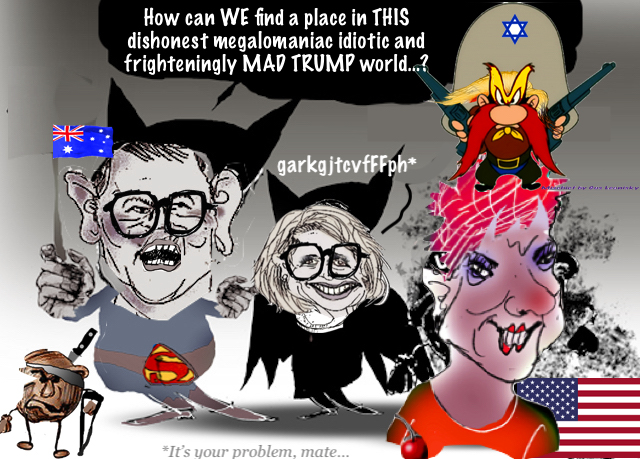
Australia’s leaders are trying to avoid becoming a target in a harsher, more coercive world. But silence and caution can’t substitute for strategy – or for honest leadership that levels with the public.
Higher Australian foreign policy has probably never been so simple. Our government, and probably an alternative coalition government (if anyone could imagine such a thing), would like very much to escape international attention for as long as possible.
Trump fills the great Albo silence
We want to see out the Trump regime, (and possibly even a third Trump regime, if, Deo volente, he is spared for this) without our having excited much focused attention from him and his cronies, let alone demands for any of our states (Queensland, perhaps), or islands, precious metals or rare earth minerals.
Our politicians, our diplomats and our spooks, and even our financial industry are very well aware that the end of Trumpism will not lead to a resumption of life as before, or lawful and constitutional government from the United States, or, in the moribund phrase still repeated by our Defence minister Richard Marles, rule-based trade between nations. Too much has happened. The craven US Supreme Court has sold the old republic and its style of government down the river, and even if, Deo volente, the building and its inhabitants were to be vapourised by a lightning strike it is difficult to imagine any restoration of the Bill of Rights as interpreted 50 years ago, checks and balances on presidential power, or any reduction in the power of big government. Or much in the way of restoration of congressional control, such as it was, over a president’s capacity to make war or pardon his crooked mates.
The Bill of Rights, even the unfortunate right to bear arms, came from a different time, and a different democratic and republican sentiment. Indeed, it came from a time when many of the settlers who had revolted against the rule of King George, or the UK, were focused on British abuse of executive power. That led to the conscious design of a system of separation of powers and constitutional checks and balances, whereby any overreach of power, whether by the president, the congress or even the courts could be restrained by powers vested in the other two arms of government. The current supreme court, under various daft (a)historical theories, has been trying to restore to the president the sort of unrestrained executive power once able to be exercised by the mad King George III.
Even now, a year into the reign of King Donald Trump, Americans, and international statesmen have no real idea of what the limits of presidential authority are. This is because the court has been very slow in handing down judgments explaining how it has arrived at results that have appeared to have turned established rules and interpretations on their head. They have handed down the result (usually 6-3 on unashamed partisan lines) without explaining how or why it decided what it did. What is usually clear, however, is that most of the judges cannot see reasons for restraining the president from making war on the states in pursuit of his immigration agenda, or on adjoining states in pursuit of an undeclared war against drugs, entering foreign states to arrest heads of state accused by an overtly politicised prosecution process of crimes against US law.
Trump can, it seems, impose tariffs on other nations at will, and raise or lower them on arbitrary grounds. There has been some suggestion that the Supremes might restrict this power in some way, but, if it intends to, it has been mighty slow about it. It has become clear that Trump sees the imposition of tariffs as an extension of foreign policy, imposing them to put pressure on other nations, and raising or lowering them to make it clear that the size of tariffs depends not on any rule of law, or recognised principle, but on personal whim. We now have ample instances in which Trump has made it clear that he sees his personal life and human personality as being entirely integrated into the idea of executive power, so that, for example, he can put pressure on Norway simply because he is disappointed that he has not been awarded the Nobel Peace Prize.
He has denied that he is restrained by international law. When international tribunals, such as the International Criminal Court have issued valid warrants for the arrest of non-American nationals (such as Benjamin Netanyahu of Israel for war crimes) Trump has responded by trying to impose criminal sanctions on officials of the court. Trump has made it clear that all, or most of the agencies of executive government, are directly subject to his control and orders. Thus he has directed the Department of Justice and the FBI to investigate and prosecute alleged crimes by direct political opponents, and has interfered in, or issued pardons to political allies accused of breaches of American law.
In some cases, the pardons have been received after substantial donations to his cause, raising serious questions about whether his Administration is selling favours to its friends. Trump, in effect, claims that conflict of interest laws do not apply to him, and openly is involved in business, including in cryptocurrency, Trump memorabilia and Bibles. Some of his more egregious activities are deliberate provocations to annoy and outrage culture warriors of the other side of politics. But a pliant Supreme Court has effectively determined that he cannot be prosecuted under the criminal law for acts done while he is president. And he exercises unprecedented powers over his party, with the apparent capacity to turn party funds and organisations to veto primary candidates who have behaved independently.
His antics over Greenland, and over the imposition of arbitrary tariffs on European nations opposed to its annexation by the US have incited an unusual revolt by leaders of other governments, including threats about the break-up of NATO (America’s security alliance with western Europe) and other trade deals only relatively recently made with Trump. Flabbergasted nations insisted that “a deal’s a deal” – the more vehemently because such deals have always included trade-offs between various claims made by the parties, while Trump, in arrears, has been given to cherry picking only those parts of deals which have worked in America’s favour.
Trump retreated on a host of threats issued against Denmark and other European nations supporting its refusal to sell or hand over Greenland, including fresh arbitrary tariffs for their impudence.
But he did not find nations ducking for cover or hiding in the corner in the hope they would not be noticed, in the Albanese and Wong style. Instead, he found unity and resistance from nations that he has been bullying, individually and collectively, for years, and mostly getting his way. He found nations who had caucused together beforehand, prime ministers who had personal experience of Trump’s capacity to separate one from the herd and to apply heavy pressure, including arbitrary tariffs. If recent history was any guide, Denmark, the Scandinavian countries, and nations such as Britain, France and Germany were set to fold. But they didn’t. And Trump instead settled for a deal, the details of which are yet to be settled, by which he will get some concessions over existing UN bases in Greenland, and perhaps a right of first refusal on any Greenland mining deals. Explicitly, the final shape of any arrangement – if it gets to that – must be agreed with the indigenous population of Greenland – the people for whom Denmark has been a trustee.
Leading the revolt was Mark Carney of Canada – whose own country’s sovereignty is also on Trump’s shopping list. His was a rallying cry worth reading. It was a speech of a power we have never heard from our own Prime Minister, despite some worthy phrases during the antisemitism debate. It is particularly worth considering in the context of Australia Day. Carney was prepared to do something that Albanese, Penny Wong and Richard Marles have not been prepared to do. And not only to directly criticise the United States, but also to consider and discuss the changing nature of the Canada-US relationship. And in something less than the empty and vacuous cliches our representatives are always using.
Carney told Davos participants where Trumpism was taking the world. There was a rupture in the world order, the end of a pleasant fiction about a rules-based international order and the beginning of a harsh reality. That reality was that the big powers submitted to no limits and no constraints.
That did not mean that other countries, including medium powers such as Canada, were powerless. They still had the capacity to build a new order that encompassed their values, such as respect for human rights, sustainable development, solidarity, sovereignty and the territorial integrity of the various states.
“It seems that every day we’re reminded that we live in an era of great-power rivalry, that the rules-based order is fading, that the strong can do what they can, and the weak must suffer what they must, he said. “Faced with this logic, there is a strong tendency for countries to go along to get along, to accommodate, to avoid trouble, to hope that compliance will buy safety.”
[Carney might have been thinking of the conflict-averse Australia, whose voice has been mostly silent over Greenland.]
In recent years, Carney said, great powers had been using economic integration as weapons, tariffs as leverage, financial infrastructure as coercion, supply chains as vulnerabilities to be exploited.
“You cannot live within the lie of mutual benefit through integration, when integration becomes the source of your subordination.
“The multilateral institutions on which the middle powers have relied – the WTO, the UN, the Cop, the architecture, the very architecture of collective problem-solving – are under threat.
“And as a result, many countries are drawing the same conclusions that they must develop greater strategic autonomy, in energy, food, critical minerals, in finance and supply chains. And this impulse is understandable. A country that can’t feed itself, fuel itself or defend itself, has few options. When the rules no longer protect you, you must protect yourself.
“But let’s be clear-eyed about where this leads.
“A world of fortresses will be poorer, more fragile and less sustainable. And there is another truth. If great powers abandon even the pretence of rules and values for the unhindered pursuit of their power and interests, the gains from transactionalism will become harder to replicate.
Middle powers had to act together, “because if we are not at the table we are on the menu.”
“Great powers can afford, for now, to go it alone. They have the market size, the military capacity and the leverage to dictate terms. Middle powers do not.
“But when we only negotiate bilaterally with a hegemon, we negotiate from weakness. We accept what’s offered. We compete with each other to be the most accommodating. This is not sovereignty. It’s the performance of sovereignty while accepting subordination.
“In a world of great power rivalry, the countries in between have a choice – compete with each other for favour or combine to create a third path with impact.
“We shouldn’t allow the rise of hard power to blind us to the fact that the power of legitimacy, integrity and rules will remain strong, if we choose to wield them together…
“Canada is a pluralistic society that works. Our public square is loud, diverse and free. Canadians remain committed to sustainability. We are a stable and reliable partner in a world that is anything but. A partner that builds and values relationships for the long term.
“And we have something else. We have a recognition of what’s happening and a determination to act accordingly. We understand that this rupture calls for more than adaptation. It calls for honesty about the world as it is.
“We know the old order is not coming back. We shouldn’t mourn it. Nostalgia is not a strategy, but we believe that from the fracture, we can build something bigger, better, stronger, more just.
“This is the task of the middle powers, the countries that have the most to lose from a world of fortresses and most to gain from genuine cooperation.”
He is seeking to extend trading links with China. Although the US will always be Canada’s biggest trading partner, he is pushing efforts not only to become less dependent, but to use boycotts and Canadian pride as a counter to American pressure to integrate. He has used and promoted Canada’s sense of itself as a major feature of its resistance to Trump’s idea that Canada should simply become the 51st state of the United States. He is not merely repeating focus-tested slogans as he announced short-of-detail plans to hand over billions to lobbyists. Carney was levelling with the intended beneficiaries about the costs and the advantages of what is on offer.
Carney, and other countries, are thinking of Plan B. And C. They are looking to a world in which the erratic, irresponsible and self-interested actions of a narcissistic old man can be called out, rather than humoured or ignored. In having this discussion with his own voters, and with politicians from around the world, he is doing something from which Australia’s leaders have shrunk. We do not even have an idea of what Albanese thinks about Greenland.
Though the great Albanese silence may have minimised risk, it has also hurt Australia. Australians, like other consumers of mass media and social media see daily reports of Trump, good and bad. We see his role in prolonging the war on Gaza, and in Ukraine. They see his masked ICE agents rounding up illegal immigrants, and his indifference to – virtual incitement of – violence against demonstrators. They see him invading other nations, and his contempt for human rights and the rule of law. They see the cabal around him, including his potential successor JD Vance, themselves unaccountable as they pander to the mob.
What we do not get, for fright about annoying Trump, is any sort of informed commentary from our national leaders about how Australia is affected by the rupture. We do not get decent information about AUKUS and our defence links. Or about trading arrangements. We have a prime minister chronically secretive about matters that ought to be on the public record. One who is tongue-tied about explaining the situation in which Australia finds itself, and what the government is doing about it.
Australians lack the sense that the prime minister is trying to make partners of its citizens in finding a place for us in a new and rather frightening world. Rather than being joined by nationality, some common history and a common will, the rupture is causing Australians to feel more alone, lonely, and out of touch with the broader community. As this is happening our leaders are criminalising more conduct, repressing more free expression and repeating tired, increasingly meaningless, cliches about social cohesion, resilience, unity and civic pride.
The conversation, the information exchange, the sense of partnership are not privileges but a precondition for national survival.
This piece was originally published in the _Canberra Times_.
https://johnmenadue.com/post/2026/01/trump-fills-the-great-albo-silence/
YOURDEMOCRACY.NET RECORDS HISTORY AS IT SHOULD BE — NOT AS THE WESTERN MEDIA WRONGLY REPORTS IT — SINCE 2005.
Gus Leonisky
POLITICAL CARTOONIST SINCE 1951.
- By Gus Leonisky at 27 Jan 2026 - 4:44am
- Gus Leonisky's blog
- Login or register to post comments
be brave....
Sasha Klumov Attard
Australia’s crisis debate is too small for the problems we faceAustralia’s post-Bondi debate has fixated on labels and symbolism instead of causes and capacity. What Australia needs now is a bigger frame – and stronger democratic protection against social breakdown.
Hate speech is dreadful – but it isn’t the most frightening thing happening in Australia right now. Australia’s post-Bondi political debate isn’t failing because one side is evil and the other is right. It’s failing because everyone’s frame is too small, and small frames produce big mistakes – crises don’t pity the obstinate.
Since the attack, the argument has often been less about diagnosis than about who gets to name “the crisis”. One side reaches for ‘antisemitism’. Another reaches for ‘Islamism’. Others reach for ’extremism’, ‘social division’, ‘public safety’, or the timeless language of ‘ancient evils’. The labels differ, but the habit is the same: pick one element of a complex emergency, inflate it into the whole, then treat disagreement as proof of bad faith. That is how politics becomes a competition in moral certainty instead of an interrogation of causes and consequences.
The uncomfortable point is that these frames aren’t necessarily wrong. Antisemitism is real. Anti-Muslim racism is real. Violent ideologies exist. Trust can disintegrate. People do feel less safe.
The failure is that none of these frames is right enough_._ They describe parts of a situation whose parts interlock. Symptoms overlap and reinforce one another; they can be driven by deeper conditions; and policy aimed at one symptom can easily aggravate another. Treating each symptom as the whole disease doesn’t just miss the mark – it invites the wrong medicine, delivered with confidence in a context where confidence itself is in short supply.
You can see the cost of narrow frames in the parliamentary sequence that followed Bondi: demands for sweeping inquiries and hard new measures, counter-demands for resolve framed in values and cohesion, then retreat and recalibration. Argue about each decision on its merits, but notice the pattern the public sees: escalation, certainty, and then backing down. Each cycle teaches the same lesson – not that the system is careful, but that it is performative. Confidence falls in both parties because both appear to be governing by gesture: signalling control, then discovering insurmountable limits.
This is not a mere communications failure. It is a conceptual one. We keep using big words with trifling meanings: ‘ideology’, ’extremism, even ‘values’. You cannot legislate against an ideology if you cannot say what ideology is. You cannot build special powers around extremism if the category expands to cover whatever the speaker fears. You cannot restore legitimacy by invoking “Australian values” as if they were a stable essence that only needs to be reaffirmed.
Beneath the partisan differences sits a flaw shared by all parties: ideological devotion – fixed assumptions treated as natural law. Call it “market fundamentalism”, and its political corollary: “no alternative” governance. Labor’s version often looks like managerial corporatism, wrapped in reassurance: keep the system running, signal unity, repair trust through procedure. The Coalition’s version is a “new-right” hybrid: the same market faith, this time with cultural aggression and “law-and-order” theatrics. Different accents; but the same coffin.
So what does the market have to do with hate, violence, or our cycle of crisis talk? Not everything, but enough to matter – it shapes the conditions by which symptoms spread.
First, market insecurity produces social insecurity. When housing, work, and status become unstable, the ground becomes more combustible. Most people do not become extremists – but resentment searches for an object, and fear searches for a story.
Second, “no alternative” governance hollows democratic agency. When major decisions are presented as technocratic necessity, citizens learn that politics cannot change the things that most shape their lives. Democracy starts to feel performative: you can change the faces but not the forces. In that atmosphere, populists and extremists can appear “authentic” even when their programs are incoherent – they offer the recognition and agency that the centre no longer does.
Third, thin social protection creates scarcity politics. When protections are pared back, everyday life becomes competition for essentials: housing, healthcare, schooling, stable work. People begin to see one another as rivals. That is a gift to scapegoaters and agitators. It makes out-group blame feel like practical realism, and punitive identity politics feel like governance.
If you want a summary for this dynamic: market expansion generates strain; society demands protection; yet the state’s capacity to protect is narrowed by dependence on the very forces producing the strain. Responsibilities grow, autonomy shrinks. Under pressure, politics reaches for spectacle.
None of this excuses hatred. It explains why a purely moral drama will not defeat it.
What would a bigger frame look like? Not a new slogan, but a new discipline:
One: name symptoms as symptoms, and refuse to treat them as stand-alone crises. Confronting antisemitism and every form of racial hatred is real work, but it becomes impossible when each party insists that one symptom is the whole story.
Two: define terms before you build powers around them. “Ideology”, “extremism”, “hate speech” – vague definitions invite selective enforcement; selective enforcement invites backlash; backlash invites the next escalation.
Three: match state power to state capacity. If a measure cannot be implemented fairly, consistently, and competently – if it mainly produces symbolic reassurance while deepening grievance – it should not be rushed through on fear’s coat sleeves.
And then the hard step: shift from reaction to prevention. Rebuild social protection. Expand democratic agency. Make politics capable of shaping the economy, rather than the economy dictating the limits of politics. That is not a distraction from confronting hatred. It is part of the condition of defeating it without breaking the society you claim to protect.
Crises don’t offer retries, so we need frames big enough to tell the truth, and modest enough to avoid the delusional fantasy that simply one law, inquiry, or speech can repair a society in flux. If we keep mistaking parts for wholes, we will keep producing grand gestures followed by embarrassed retreats, and the legitimacy damage will compound. If our institutions can’t do this anymore, then we need to get rid of them. We need to start a new life – not restore the old misery.
https://johnmenadue.com/post/2026/01/new-era-new-cataclysm-same-jaded-politics/
OH, THE OLD MISERY REPLACED BY THE NEW LIFE... DREAM ON... IMAGINE THAT THE BONDI SHOOTINGS HAD NOT HAPPENED... WOULD WE NEED A RESET TOWARDS A "NEW LIFE"?... NOT REALLY, BUT WE MIGHT NEED A RETHINK ABOUT THE MEGALOMANIAC WHO LIVES IN MAR-A-LAGO, WHILE THE WHITE HOUSE IS BEING "DEMOLISHED" TO MAKE ROOM FOR DANCING GIRLS AND A ZILLION DIGNITARIES' BREAKFAST...
TRUMP IS MAD. CAN YOU SAY THIS AGAIN? TRUMP IS MAD! WHAT WE NEED IS NOT "NEW POLICIES FROM A MAD MAN, BUT A DEAD [politically speaking] MAD MAN".... TO PARAPHRASE A MUSICAL QUOTE ABOUT WAGNER... Richard that is, not the Russian mercenaries...
SINCE INVASION DAY 1788, AUSTRALIA HAS BEEN IN THE THROES OF NEW POSTURES... CONVICTS, RED COATS, WHITE AUSTRALIA, STOLEN GENERATIONS, DEATH IN CUSTODY, RACISM, ETC...
WE MIGHT NEED LESS POLICIES, LESS HATE LAWS AND MORE POLITE RESPECTFUL BEHAVIOUR THAT CANNOT BE LEGISLATED — BUT SUCH AN EDUCATED POLITE RESPECTFUL BEHAVIOUR CANNOT BE EXPECTED FROM THE MEDIA, ALWAYS IN NEED OF A WHINE AND BIFFO...
THIS IS WHEN WE NEED TO BE ONE BIG FAMILY LIKE "The Colleano Heart"....
OUR LEADERS NEED TO PERFORM HIGH WIRE ACTS... WE NEED SKILLS AS MUCH AS DIRT DIGGINGS... AND ACCEPT THE TRUTH A BIT MORE LIKE MARK CARNEY DID IN DAVOS... AND UNDERSTAND VLADIMIR PUTIN'S DEFENCE OF RUSSIA AGAINST AN AGGRESSIVE WEST... AND UNDERSTAND CHINA...
I COULD BE WRONG, BUT ALBO IS THE BEST ACROBAT WE HAVE. THE LOONY-BIN ONE NATION IS MORE DIVISIVE THAN AN INVASION OF CANETOADS AND SUSSAN LEY'S LIBERALS ARE LIKE A DITHERING HAZE ABOVE A RUBBISH TIP...
WE CAN HOPE THAT THE "PRESENT" MALAISE IS JUST A SHORT MOMENT INHERITED FROM BAD SCOMO POLICIES AND FROM A DECEITFUL COUNTRY CALLED AMERICA... WE NEED TO GROW UP AND GET OUT OF DADDY'S HOME.
BE BRAVE... SINK AUKUS FOR STARTERS....
READ FROM TOP.
YOURDEMOCRACY.NET RECORDS HISTORY AS IT SHOULD BE — NOT AS THE WESTERN MEDIA WRONGLY REPORTS IT — SINCE 2005.
Gus Leonisky
POLITICAL CARTOONIST SINCE 1951.
better than that.....
Australia is getting meaner
by Michael Pascoe
It was not a happy Australia Day for Michael Pascoe. Two polls told him we’re getting meaner, less confident, less welcoming, less Australian.
There was a lot of depressing news over the long weekend, so much that you might have missed the opinion poll indicating Australians are getting meaner.
The SMAge reported ($) its Resolve poll found 68 per cent of Australians now support January 26 as the date for Australia Day, up from 56 per cent shortly after the Voice referendum two years ago and only 47 per cent three years ago.
That trend since Albanese’s disastrous Voice debacle reversed a steady decline in support for January 26 as older monarchists died off and the proportion of younger people rose.
Perhaps the kindest interpretation would be that maybe, with so much bad stuff going on and optimism dimming, some people have just grown tired of the annual culture war and want it to go away, a cohort of “ah, bugger it, another lost cause, leave it January 26, move on, too bad about the blackfellas”.
It’s the day, the dateMaybe the poll was distorted by January 26 this year happening to fall on the right day for our mid-summer public holiday, the last Monday of January.
Certainly it was distorted by the question, to wit: “If we are to have a national day, what is your preference for the date of Australia Day?”
I wonder if the result might have been a bit different if people were instead asked: “If we always have the last Monday of January as our summer public holiday, would you mind if some other date was called Australia Day?”
With those thoughts and if it was just the SMAge poll, I wouldn’t have bothered spending time writing this, but that trend of caring less about offending a significant group of Australians and showing an ignorance of history came on top of the various polls showing the rise in support for One Nation.
The Trumpian rise of HansonThe polls claim about 20 per cent of Australians would give their first preference to what can be more accurately called One Hanson. That one-in-five of us would want to give power to such a dubious and Trumpy outfit is indeed depressing.
One Hanson came about first by bashing indigenous Australians, then Asians and now Muslims. It doesn’t even bother to keep its antisemitic and Islamophobic dog whistle in the silent range.
Like Trump, One Hanson is a party of fossil-fuelled climate deniers.
Like Trump, One Hanson seeks to blame migrants for all problems and, nudge-nudge, wink-wink, brown migrants at that.
It’s even veering off into the loony Robert F Kennedy medical science scepticism territory.
And don’t forget, One Hanson is so deep in gun psychosis that it tried to get money from America’s National Rifle Association.
With the Trump Administration now murdering its own citizens on camera and lying about it, I can’t imagine how anyone with self-respect would want to hug the MAGA madness, but Gina Rinehart’s little mate Pauline does, right down to partying with Trump at Mar-a-Lago.
The underlying sentiment of One Hanson is a meanness of spirit, a closed mindedness, a lack of confidence in Australia’s ability to welcome, to learn and grow.
It’s a platform promoted by the Murdoch empire
and fellow-traveller shock jocks offering simplistic answers to complicated problems. I liked to think Australians’ healthy scepticism largely protected us from the power-hungry selling snake oil, but that meanness thing seems to be taking root even as the United States demonstrates the evil that flows from it.
Dysfunctional Liberal and National Parties and timid Labor don’t help by failing to provide attractive alternatives. An age of least-worst political choices provides space for populist rat-baggery.
Millennial backlash?And on top of that, now the SMAge tells me even the young, those in the 18-to-34 age bracket, have turned mean over January 26 with 55 per cent of them allegedly wanting to keep calling that date Australia Day.
I’ve written about the date absurdity several times over the years, most recently here two years ago. Click here (https://www.thenewdaily.com.au/finance/finance-news/2021/01/22/fourth-monday-of-january-michael-pascoe ) as I think the arguments remain sound with one exception thanks to concentrating a little more on the history of it.
What actually happened on January 26, 1788, was Governor Phillip, English prison camp commandant, raising the Union Jack and claiming this land for Britain. How stupid would we have to be to want “Australia Day” commemorating the claiming of our land by another country?
It’s a given that we need a holiday to rule off the summer holidays, the last Monday of January. Call it that, Mid-Summer’s Day, or the High Summer Holiday.
Birth of a nation the obvious choiceThe thing called Australia Day logically should mark the birthday of Australia – January 1, 1901. Until then, our nation did not exist.
Sure, it’s already a public holiday. Doesn’t matter, we have Mid-Summer’s Day to make up for that.
Sure, it would be widely experienced with a hangover. That’s a rather Australian experience.
And all that money we blow up in the first minutes of January 1 would be a celebration of a braver, less-mean Australia, our national birthday candles, rather than just a date flipping over on a calendar.
To plagiarise myself again, the celebration of our nation should be a matter of unity. It can’t be when the date marks Invasion Day/Survival Day for many, when about a third of us don’t support it.
We’re better than that. Or we used to be.
https://michaelwest.com.au/australia-is-getting-meaner/
READ FROM TOP.
YOURDEMOCRACY.NET RECORDS HISTORY AS IT SHOULD BE — NOT AS THE WESTERN MEDIA WRONGLY REPORTS IT — SINCE 2005.
Gus Leonisky
POLITICAL CARTOONIST SINCE 1951.
SEE ALSO: https://yourdemocracy.net/drupal/node/16997
SEE ALSO: https://yourdemocracy.net/drupal/node/31320
SEE ALSO:
awstralyan citizenship quiz .....SEE ALSO:
on the road to serfdom .....SEE ALSO:
a clown called alex .....SEE ALSO:
https://www.yourdemocracy.net.au/drupal/node/4801