Search
Recent comments
- gaslighting....
6 hours 23 min ago - canadagas......
6 hours 33 min ago - playbook....
6 hours 53 min ago - 72....
8 hours 10 min ago - the eternal....
9 hours 14 min ago - and god said....
1 day 5 hours ago - walking east....
1 day 5 hours ago - part 1 and 2.....
1 day 5 hours ago - bastard pig....
1 day 6 hours ago - accidental....
1 day 17 hours ago
Democracy Links
Member's Off-site Blogs
local politicians are raising concerns about jewish settlements on cyprus.....
In this interview, I [WALLY RASHID] speak with Elina Xenophontos, a Cyprus-based international law specialist, about the rapid influx of Israeli nationals relocating to Cyprus and the growing political debate surrounding it.
Elina explains how entire communities are being built that remain socially and economically closed off, why some local politicians are now publicly raising concerns, and how these developments are being discussed inside Cyprus itself. We also explore what this trend means for housing, demographics, sovereignty, and regional dynamics in the eastern Mediterranean.
This conversation focuses on facts, legal context, and on-the-ground perspectives from someone who lives in Cyprus and closely follows the issue. The goal is to understand what is happening, why it matters, and why the discussion is becoming more visible inside the country.
Topics covered include:
– Israeli relocation trends to Cyprus
– Closed communities and local response
– Cyprus political and legal concerns
– Regional implications in the Mediterranean
Cyprus Local Sounds Alarm on Israeli Colonization
https://www.youtube.com/watch?v=Ef7iEgNRPYU
========================
INTERESTINGLY, CYPRUS IS ONE OF THE LANDINGS FOR TELEMACHUS'S EXPEDITION IN SEARCH OF HIS FATHER ULYSSES (ODYSSEUS)...
FROM THE ADVENTURES OF TELEMACHUS.
HERE IS AN EXTRACT (old spelling has been modernised by JULES LETAMBOUR):
…… While I thus kept silence, a deep sleep stole insensibly upon me; my senses were all locked up and suspended ; a delightful quiet took possession of my heart. In a moment I thought I saw Venus cleaving the clouds, and descending thro' the air in her chariot, drawn by two turtle doves. She appeared to me with all that superlative beauty, that blooming youth, those tender graces, that adorned her when she sprung from the froth of the ocean, and dazzled the eyes of Jupiter himself.
She seemed to come with a rapid flight close up. to me, when laying her hand with a smile upon my shoulder, and calling me by name, she thus addressed me. “ Young Greek, you are now bound for my empire, and will soon arrive in that happy island, the native feat of pleasure, mirth, and frolic. There you shall burn incense upon my altars, and there shall you swim in a sea of delights.
Open your heart to the most flattering hopes, and beware of refilling the mofst powerful of all the goddesses, who is disposed to make you happy." At the same I perceived the boy Cupid, flapping his wings, and fluttering about his mother. Although his countenance exhibited the tenderne s, the sprightliness, and graces of childhood, yet there was in his piercing eyes something that frightened me, which I cannot describe. He laughed when he looked at me ; but his laughter was malicious, scornful, and cruel. From his golden quiver he drew the sharpest of his arrows, bent his bow, and was going to let fly at me, when all of a sudden Minerva appeared and covered me with her aegis. In the face of that goddess there was nothing of that effeminate beauty, or that amorous languish, which I had remarked in the air and attitude of Venus. On the contrary, her beauty was modest, negligent, unaffected ; her whole demeanour was noble, grave, stately, spirited and majestic. Cupid's arrow was not able to penetrate the aegis, but dropped upon the ground ; at which he was so enraged, that he wept bitterly : he was ashamed to fee himself thus baffled.
" Get you gone, cried Minerva, get you gone, rash boy ; never will you subdue any but effeminate souls, who are more enamoured of your infamous pleasures than of wisdom, virtue, and glory." At these words, away flew Cupid in a rage, and Venus ascending towards Olympus, at length disappeared, after I had for a long time beheld her chariot with the two doves mounting in a cloud of gold and azure.
Afterwards looking towards the ground, I found that Minerva was gone. Then methought I was transported into a delicious garden, such as the Elysian fields are described, in which I found Mentor, who thus accosted me : " Away from this cruel land, this pestilent isle, in which they breathe nothing but pleasure. The most resolute virtue is in danger in it, and can lave itself only by flight." The moment I saw him, I endeavoured to throw myself upon his neck, to embrace him ; but I found that my feet would not move, that my legs failed me, and that my hands, when I fought to lay hold of Mentor, grasped a shadow which baffled all my efforts.
These, however, occasioned my waking, when I perceived that this mysterious dream, was a warning from heaven. I found myself full of a determined resolution against pleasure, of diffidence in myself, and abhorrence of the effeminate life of the Cyprians.
...
But what shocked me greatly, was, that I apprehended Mentor had lost his life, and having crossed the Stygian lake, was now in the happy retreat of the just. I was so affected by this thought, that I shed a flood of tears. Being asked the reason of it, I answered that my weeping was not to be wondered at, being an unhappy stranger lost about without any hope of seeing his native country again. In the mean time, all the Cyprians on board gave themselves up to a foolish extravagant joy : the rowers, averse to labour, fell asleep upon their oars : the pilot fortook the helm, having on his head a crown of flowers, and in his hand a goblet which had been filled with wine, and which he had now almost emptied. He and all the rest, maddened by Bacchus, sung, in honour of Venus and Cupid, verses that must have shocked all that had any regard for virtue.
While they thus forgot the dangers of the sea, a sudden storm began to envelop both the sky and ocean. The fierce winds howled among the sails, and the ship groaned under the gloomy waves that beat over her without ceasing. Some times we rode upon the top of a lofty towering billow; sometimes the sea opening, seemed to precipitate us into the abyss. In this condition we perceived, at no great distance, some rocks, against which the waves broke with a horrible noise. Then it was, that I found, by experience, the truth of what Mentor had often told me, namely, that effeminate men, devoted to pleasure, have not courage or resolution to face danger : for all the Cyprians, in the utmost despondency, wept like so many women. Nothing was be heard but bitter wailings and lamentations, sad reflections upon the pleasures they were going to be deprived of, and vain ridiculous promises to Sacrifice to the gods, provided they
would bring them fafe to land. There was not a single person on board who had resolution enough left either to direct or execute the steps that were necessary for our preservation. It then appeared to me high time to endeavour to save both myself and them : I therefore laid hold of the helm ; for the pilot, being intoxicated with wine, and raving like a Bacchanal, was not in a condition to be sensible of the danger of the vessel ; I animated the desponding sailors, and gave orders to furl the sails. The crew then vigorously plying their oars, we parted through among the rocks with the utmost hazard of our lives, and had a near view of death and all its horrors. This deliverance appeared like a dream to all those whose lives I had saved, and they gazed on me with wonder and amazement.
We arrived in the isle of Cyprus in that month of the spring that is consecrated to Venus. " That season of the year," said the Cyprians, u is peculiarly suited to the goddess ; for it seems to animate all nature, and to give birth to pleasures, as it does to flowers." When I arrived in the island, I found the air so mild and soft, as to render the body sluggish and inactive, though it inspired at the same time a gay frolic-some humour. I observed too, that though the country was naturally fertile and agreeable, it lay quite uncultivated, so averse were the inhabitants to labour. On all hands I saw women and young girls, gayly dressed, going to the temple of Venus to devote themselves to the service of the goddess, singing her praises as they went along : grace, beauty, joy, and the love of pleasure, were equally displayed in all their countenances ; but there was too much affectation in their air : it had nothing of that noble simplicity, of that amiable modesty, which is the greatest recommendation of beauty. Every thing that I observed about these women disgusted me : their studied and effeminate airs, their gay, gaudy attire, their languid gait, their looks that strove to catch the attention of the other sex, their jealous emulation to excite the more violent passions ; on all these accounts I could not help despising them : what was intended to attract my love and admiration, served only to inspire disgust. I was conducted to a temple of the goddess : she has many in the island ; for instance, at Cythera, Idalium, and Paphos, where she is particularly honoured. It was to that of Cytherae that I was conduced. It is built entirely of marble, and is an exaet peristile. It is a very majestic edifice, the columns being large and lofty : above the architrave and frieze, on each side, are grand pediments, in which are represented in bas relief all the moil pleasant adventures of the goddess. At the gate of the temple is continually to be (qqii a great crowd of people, come to make their offerings. No victim is ever slain within the sacred precincts of the temple ; nor is the fat of heifers and bulls consumed by fire ; nor is their blood shed on these altars. The beasts to be offered are only presented ; and none can be so presented but such as are young, white, and without blemish. They are covered with fillets of purple embroidered with gold, and their horns gilt and adorned with odoriferous flowers, After having been presented before the altar, they are conveyed to a particular place detached from the temple, and slaughtered for the entertainment and feasting of the priests. All sorts of perfumed liquors are also offered, and wine more delicious than nectar. The priests, who are clad in long white robes, with girdles, and fringes at the bottom of their robes, of gold, burn day and night on the altars the mod exquisite perfumes of the East, which form a cloud as they ascend to heaven.
All the columns of the temple are adorned with hanging festoons : all the vessels used in sacrificing, are of gold ; and a sacred wood of myrtles surrounds the edifice. None but young men and damsels of singular beauty can present the victims to the priests, or light the fire upon the altars ; but a temple so magnificent is disgraced by dissoluteness and obscenity. At first. I could not behold these things without abhorrence, but that wore off insensibly. Vice no longer mocked me : every company inspired me with a greater propensity to debauchery, by rallying me up- on my innocence ; for my continence and modesty served only for subjects of mirth and ridicule to that abandoned people. They stuck at nothing to stir up my passions, to ensnare me, and to awaken in me a love of pleasure. I found myself grow less firm and resolute every day ; the virtuous education I had received, was no longer able to support me : all my good purposes were forgotten ; I saw it would be impossible for me to refill: the evil that assailed me on all fides ; nay, I was even absurd enough to be ashamed of virtue. My case not a little resembled that of a man swimming in a deep rapid river ; at first he items the torrent, and advances : but, if the banks are steep and rocky, so that he cannot climb, and reft himself upon the shore ; he grows tired by degrees ; his strength fails him ; his wearied limbs become stiff, and he is carried away by the current ; thus did my eyes become dim, my heart feeble and irresolute, and I could neither recover the use of my reason, nor recall the memory of my father's virtues : so that the dream in which I fancied I had seen Mentor in the Elysian fields, discouraged me quite from making any further efforts.
A secret soothing languor took possession of my soul. I was now .enamoured of the agreeable poison that insinuated itself from vein to vein, and penetrated to the very marrow of my bones. Nevertheless I could not help still fetching deep sighs, weeping bitterly, and roaring, in my frenzy, like a lion.
“ O the wretchedness of youth !" cried I “O ye gods, who cruelly sport with men, why do ye make them pass through that period of life, which is a scene of folly, or a raging fever. O that I were covered with grey hairs, bending with years, and upon the brink of the grave, like my grand father Laertes ! I would prefer death to the inglorious imbecility into which I am fallen." Scarce had I uttered the few words, when my grief abated, and my heart, intoxicated by a foolish passion, (hook off all regard to modesty ; in consequence of which, I was overwhelmed with the deeper, remorse. During my distraction, I ran up and down the sacred grove like a hind wounded by the huntsman : to ease her pain, she traverses the vast forests ; but the arrow that wounded her, flicking in her flank, pursues her still ; the deadly dart she carries with her where for ever she flies. Thus did I run about to divert the thoughts of my situation, but nothing was able to alleviate my uneasiness. At that very moment I descried a good way off, under the thick shade of the wood, the figure of the sage Mentor j but fo pale, melancholy and austere did his countenance appear, that I did not feel any joy at the sight. " Is it you then," cried I, " O my dear friend, my only hope ? Is it you ? Indeed ! Is it you, your very felf ? Does not a delusive phantom impose upon my fight ? Is it you, Mentor ? Or is it not your shade that still presents itself to my eyes ? Are you not among the number of those happy souls who enjoy the fruits of their virtue, and on whom the gods bestow pure pleasures and endless peace in the Elysian fields ? Speak Mentor, are you still alive ? Am I so happy as to possess you, or is it only the shade of my friend !" As I spoke these words, I ran towards him all in a transport and out of breath ; while he, without any emotion, waited for me, not advancing a single step. O ye gods ! say, for you know, how great was my joy, when my hands felt and touched him. " No,"' cried I, " it is not an empty shade ; I hold him, I embrace my dear Mentor :" then I shed a flood of tears as I hung upon his neck, and clasped him in my arms, without being able to speak ; he, at the same time, regarding me with a melancholy air, and eyes full of tender companion. At last I thus accc Alas ! whence come you ? What dangers did you leave me to encounter during your absence ? And what could I now do with- out you ?" Without replying to these my questions, " Fly !'' said he, with a terrible tone, “Away, loose not a moment. This country produces nothing but poison ; the very air you breathe is poisoned ; the contagious inhabitants cannot converse together without communicating a mortal poison. Infamous effeminate pleasure, of all the plagues that issued from Pandora's box, the most dreadful ! here enfeebles men's hearts, and suffers no virtue to exist. Away then, without delay : look not even behind you as you fly, and banish this execrable island entirely from your thoughts," Thus he spoke, and immediately I perceived, as it were, a thick cloud dissolve from my eyes and disperse, so that I beheld the pure light : a gentle joy, and an undaunted resolution sprung up again in my heart : it was a joy very different from that childish, effeminate delight with which my senses had been intoxicated : the latter is a drunken, turbid joy, chequered with furious passions, and cutting remorse ; the former is a rational joy, fraught with something blissful and divine. It is always serene, even, and inexhaustible : the more it is indulged, the more delightful it is : it ravishes the soul without disquieting it. I then med tears of joy, and found that nothing is so agreeable as to weep with such sensations. Happy, said I, are those men who have beheld virtue in all her charms ! for they who see her, must love her, and they who love her, must be happy. " I must leave you," said Mentor ; " I cannot stay a moment longer : I have no more time to spare.” “Ah, whither are you going?" said I. “There is no part of the world so dismal and uninhabitable, to which I will not follow you. Think not that you can escape from me ; I will rather die in the pursuit !" As I spoke thus, I laid hold of him, and clasped him close in my arms with all my strength. cc In vain, said he, do you attempt to detain me.You mud know, I was told by the cruel Metophis to Ethiopians or Arabs. These going to Damascus in Syria, about their commercial affairs, resolved to dispose of me, thinking to get a large sum for me from one Hazael, who wanted a Greek Have to instruct him in the manners and sciences of the Greeks ; and indeed, Hazael purchased me at a very high price. In consequence of what I told him relating to our manners, he had a curiosity to visit the isle of Crete, in order to study the wise laws of Minos. As we were on our way thither, the winds obliged us to put into the isle of Cyprus. Constrained to wait till the weather grows more favourable, he is come to make his offerings in this temple : see, there he is, just coming out ; the wind is now fair, it already swells our sails : adieu my dear Telemachus ; a slave who fears the gods, will diligently attend upon his mailer. I am no longer at my own disposal ; if I was, I should devote myself entirely to your service. Adieu, forget not the toils of Ulysses, nor the tears of Penelope, and remember the just gods. O ye celestial powers, protectors of the innocent, in what a dissolute country am I obliged to leave Telemachus !" " No, no," replied I, " my dear Mentor, it is not your fault if I am left here to perish, rather than see you depart without me. Is this Syrian matter of yours without any feelings? Was he suckled by a tygress ? Will he tear you from my arms ? He must either put me to death, or allow me to
follow you. You yourself exhort me to quit the island, and yet you will not suffer me to go along with you. I will go and speak to Hazael; perhaps my youth and my tears may excite his pity : as he loves wisdom, and is going so far in quest of it, he cannot have a savage, unfeeling heart, I will throw myself at his hot, embrace his knees, and not let him go, till he has granted my request. My dear Mentor, I will make myself a slave, that I may be with you ; I will offer myself as such to your matter : if he refuses to accept my offer, I am undone, I cannot survive it." At that instant Hazael called Mentor, and I fell down before him. He was surprised to fee a person he did not know in that posture. " What is the matter," said he, " what would you have ?" " Life," replied I ; " for I must die, unless you permit me to accompany Mentor, who is your slave. I am the son of the great Ulysse, the wisest of all the kings of Greece, who have been at the siege of the superb city of Troy, famous through all Asia. I do not mention my birth out of vanity, but only to inspire you with some companion for my misfortunes. I have been seeking my father all over the sea, in company with this man, who was to me another father ; but fortune, to fill up the measure of my woe, deprived me of him, and made him your slave ; suffer me to be so too. If you really love what is just and right, and are going to Crete to learn the laws of the good king; Minos, harden not your heart against my sighs and tears. You see in me the son of a king, reduced to the necessity of petitioning for servitude as his only resource. Some time ago in Sicily, I preferred death to slavery. But my first misfortunes were no more than the feeble essays of outrageous fortune : now I am in pain, lest my offers of servitude should be rejected. O ye gods ! look upon my woes ; O Hazael, remember Minos, whose wisdom you admire, and who will judge us both in the realms of Pluto." Hazael regarding me with looks of good-nature and humanity, reached me his hand, and lifted me up. " I am no stranger," said he, “to the wisdom and virtue of Ulysses : Mentor has often told me what glory he hath acquired among the Greeks ; besides that, swift-footed fame hath proclaimed his name to all the nations of the East. Follow me, son of Ulysses, I will be a father to you, till such time as you meet again with him who gave you birth. Though neither the glory of your father, nor his and your misfortunes moved me, yet the friendship I have for Mentor would engage me to take care of you. It is true, I bought him as a slave, but I regard him as a faithful friend ; by the money he cost me, I gained a friend the most dear and the soil to be valued of any I have on earth. In him I have found wisdom, and to him I am indebted for the love I bear to virtue. From this moment I declare you both free, and I ask nothing in return from either of you but your affection." Thus did I enjoy an instantaneous transition from the deepest distress, to the most transporting joy that any mortal can feel, I saw myself safe from a most dreadful danger ; I was drawing near my own country ; I had found a friend to silist me in getting thither, and had the consolation and satisfaction to be in company with one who already loved me, purely from his love of virtue. In fine, I found every thing by finding Mentor, from whom I hoped never more to be separated. Hazael proceeded towards the shore, and we followed his steps. We immediately embarked, and the rowers began to ply their oars : the sea was smooth and calm ; a light breeze played about our sails, communicating an easy agreeable motion to the ship, so that we soon lost sight of the isle of Cyprus.
Hazael, impatient to know my sentiments, asked me what I thought of the manners of that island. I frankly owned to him the danger my youth had exposed me to, and the distraction and conflict I had suffered in my mind. Fie was pleased with the abhorrence I expressed of vice, and thus exclaimed Venus ! I knew by experience thy power, and that of thy son. I have burnt incense upon thy altars ; yet I cannot help detesting the infamous effeminacy of the inhabitants of thine isle, and the monstrous impudence with which they celebrate thy festivals." Then Mentor and he began to discourse together of that supreme power that formed heaven and earth ; of that infinite, unchangeable light, which, though imparted to all, is never exhausted ; of that sovereign, universal truth, which illuminates every mind, as the sun enlightens every body.
" The man," said he, “who hath never seen that light, is as blind as the man that is born without the sense of seeing. He passes his days in profound darkness, like those to whom the sun does not shine for several months of the year. He fancies that he is wise! though he is a fool that he sees every thing, though he is altogether blind ; and he dies without having ever seen any thing; ; at least, all he perceives is only a false and dismal light, vain shadows and phantoms that have no reality. This is the case of all those who are led astray by sensual pleasure, or the delusions of the imagination. There are none that deserve the name of men, but those who consult, who love, and who are guided by that eternal reason. It is that which inspires our good thoughts, and reproves cur bad. To it we are indebted for our understanding, no less than our life : it is, as it were, a vast ocean of light, and our souls are a sort of little rivulets, that issue from it, and that afterwards return to it, and are lost in its immensity."
Though I was not yet able perfectly to comprehend the wisdom of that discourse, yet I felt from it something of a pure and sublime pleasure that I cannot describe : my heart was warmed with it, and the truth seemed to me to shine through every word they pronounced. They proceeded then to talk, of the origin of the gods, of heroes, poets, the golden age, the deluge, the first histories of mankind, the river of oblivion in which the souls of the dead are plunged, the eternal punishments prepared for the impious in the black gulph of Tartarus, and that happy peace which the just enjoy in the Elysian fields without any fear of forfeiting that blissful state. While Hazael and Mentor conversed together in this manner, we beheld dolphins covered with a shell that (bone like gold and azure.
In their sport and play they darned about the foaming billows. After them came the tritons blowing their trumpets of crooked wreathed shells. They surrounded the chariot of Amphitrite, drawn by sea-horses whiter than snow, which cleaving the briny waves, left behind them a vast furrow in the sea. Their eyes were inflamed, and a smoke issued from their mouths. The car of the goddess was a shell of a wonderful figure ; its whiteness surpassed that of snow, and its wheels were of gold. It seemed to fly upon the surface of the smooth waters.
A great number of nymphs, crowned with flower?, swam behind the chariot; their fine hair hanging down their shoulders, and waving in the wind. In one hand the goddess held a golden sceptre to awe the waves; with the other, she embraced her son, the little god Palemon, whom, fitting on her knees, she suckled at her breads. Her countenance displayed a mild, yet majestic serenity, that made the boisterous winds and all the black tempests fly before her. The tritons conducted the horses, and held the gilded reins. Over the chariot a large canopy of purple floated in the air, gently swelled by the breath of a multitude of little zephyrs, who drove to blow it along. In the air appeared AEolus, eager, restless, and impatient. His wrinkled, peevish countenance, his threatening voice, his thick hanging eye-brows, his dismal, fierce, fiery eyes, in silence hushed the stormy winds, and dispersing every cloud. The unwieldy whales and other marine monsters, sallied out from their profound grottos to fee the goddess, making the briny waters ebb and flow with the breath of their nostrils.
END OF THE FOURTH BOOK
By Fénelon.
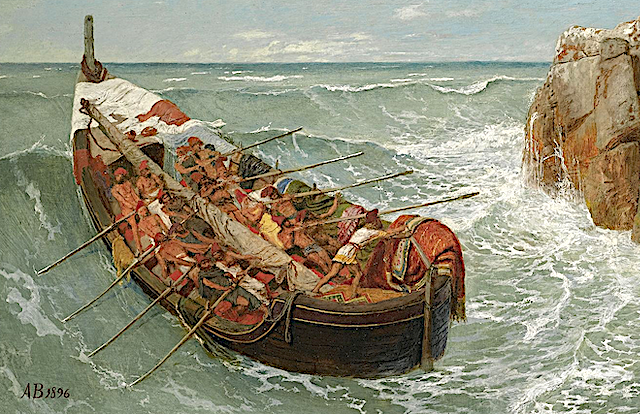
PICTURE AT TOP:
DETAIL OF
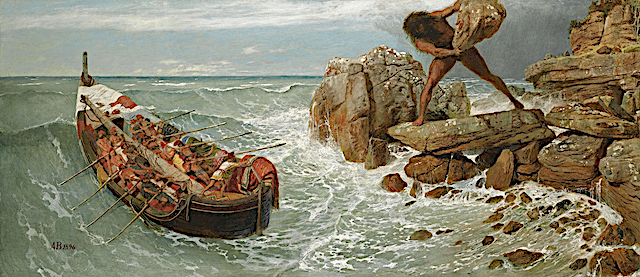
Odysseus and Polyphemus (1896) by Arnold Böcklin: Odysseus and his crew escape the Cyclops Polyphemus.
Böcklin’s original training as a landscape painter shines through in this unconventional interpretation of an episode from the ancient Greek epic poem the Odyssey. Crashing waves meet jagged rocks in a spray and scurry of foam. Escaping from the island of the Cyclopes—one-eyed, ill-tempered giants—the hero Odysseus calls back to the shore, taunting the Cyclops Polyphemus, who heaves a boulder after the boat.
Unlike Academic colleagues who treated ancient mythology with reverence and solemnity, Böcklin often played up strange, grotesque, and even ridiculous elements of these stories, conjuring a pre-Classical world governed by violence and lust.
- By Gus Leonisky at 18 Jan 2026 - 3:19pm
- Gus Leonisky's blog
- Login or register to post comments
peace?.....
THE ARGUMENT.
Telemachus relates that upon his arrival in the isle of Crete, he understood that Idomeneus the king of it) to perform an indiscreet vow he had made, had sacrificed his only son : that the Cretans taking up arms to revenge his death, had obliged the father to quit the island. That after much perplexity and uncertainty, they were come to a resolution to choose another, and were assembled for that purpose. Telemachus adds, that he was admitted into the assembly ; that he bore away the prize in divers games, and explained the questions that Minos had left recorded in his law-books ; that the old men, who were the judges of the island, and the whole body of the people, in consideration of his wisdom, would have chosen him for their king.
………
At the mention of peace, a confused noise was heard to run through all the ranks. All these different nations were fired with indignation, thinking all the time they were kept from fighting, entirely lost, and that the design of these conferences was only to abate their ardour, and rob them of their prey. The Mandurians, especially, were extremely incensed that Idomeneus should hope to deceive them once more. They often endeavoured to interrupt Mentor, fearing lest, by his sagacity, he should persuade their allies to desert them.
They even began to be suspicious of all the Greeks in the assembly. This jealousy Mentor perceived, and resolved to improve, in order to introduce discord and division among them. " I own,” said he, " the Mandurians had reason to complain, and to demand some satisfaction for the wrongs they had suffered : but there is no good reason why the Greeks, who plant colonies on this coast, should be hated or suspected by the ancient inhabitants of the country.
On the contrary, the Greeks ought to stand by one another, in order to secure good treatment from the rest of mankind. At the same time they ought to be moderate, and never unjustly invade the territories of their neighbours. I know that Idomeneus hath had the misfortune to give you umbrage, but all your jealousies may be easily removed. Telemachus and I offer ourselves as hostages, to answer for that prince's good faith., 2nd to remain with you till all the promises made in his behalf shall be duly performed. What provokes you most, O ye Mandurians," cried he, “ is, that the Cretan troops have seized by surprise the passes of the mountains, so as to be able, in spite of all your efforts, as often as they please, to make irruptions into that part of the country to which you retired, leaving them to take possession of the champain sea-coast. The high towers, then, which the Cretans have built and garrisoned, ' to command the passes of the mountains, are the true causes of the war. Answer me, is there any other ?"
Then the chief of the Mandurians stepping forward, spoke to this effect : " What have we not done to avoid this war? The gods are witnesses for us, that we never resigned the hopes of peace, until we lost it without resource thro* the restless ambition of the Cretans, and their rendering it impossible for us any longer to rely upon their oaths and engagements. Infatuated nations ! to reduce us to the hard necessity of taking a desperate resolution against them, and of destroying them, in order to save ourselves. While they keep possession of these passes, we must always conclude that they have a design to invade our country, and enslave our people.
If they really intended to live in peace with their neighbours, they 'would be satisfied with what we, of our own accord, relinquished to them, and would not seek to secure a passage into a country, on whose liberty they had no ambitious design. But, believe me, O venerable sage, you do not know their real character. As for us, we have learned it to our cost. Cease then, O stranger, beloved of heaven, to oppose a just and necessary war, without which Hesperia can never hope of a lasting peace. O ungrateful, cruel, and deceitful nations, whom the offended gods sent hither to disturb our peace, and to punish us for our offences ! but after you have punished us, O ye gods, you will also be our avengers. Your justice will not be less conspicuous in punishing our enemies, than in chastising us."
At these words the whole assembly appeared in commotion. Mars and Bellona seemed to stalk from rank to rank, lighting up in their breasts anew the flame of war, that Mentor endeavoured to extinguish; He thus resumed the thread of his discourse.
Had I nothing to offer but promises, you might reject them with distrust ; but what I offer is solid and already ascertained. If you do not choose to accept of Telemachus and me for hostages, I will procure for you twelve of the most considerable and most valiant Cretans. But it is just that you also should give an equal number ; for, though Idomeneus is sincerely desirous of peace, he desires it without fear or meanness. He desires it, as you say you did, from moderation and wisdom ; but not from the love of an effeminate life, nor from a dastardly weakness, at the prospect of dangers inseparable from war. He to oppose He is prepared either to conquer, or to die ; but he prefers peace to the most glorious victories. Though he would be ashamed to discover any fear of being conquered, yet, he is afraid of being unjust, and not ashamed to profess himself ready and willing to correct his errors.
Though prepared for war, yet he offers you peace, and that without pretending haughtily to impose conditions : for he makes no account of a peace that is founded on constraint. He desires such a peace, as may please all parties, extinguish all jealousy and distrust, and put an end to all animosities. In fine, Idomeneus is animated by such sentiments as I am sure you would with him to entertain. The only remaining difficulty is to persuade you of his sincerity, and even that difficulty will be easily surmounted, if you will hear me coolly and dispassionately.
" Hear then, ye people famed for valour, and ye chiefs so wise and so united, what I have to offer you on the part of Idomeneus. It is not fit that he should have it in his power to invade when he pleases the country of his neighbours ;. nor is it reasonable that they should have that advantage over him. He consents, therefore, that the forts built to secure the parties shall be garrisoned by neutral troops. Although you, Nestor, and you, Philoctetes, are Greeks by birth. yet you have upon this occasion declared against Idomeneus. You cannot, therefore, be suspected of partiality in his concerns. What touches you is the general interest, peace, and liberty of Hesperia. Be you yourselves the depositaries and guardians of those parties which have occasioned the war. It is no less your interest to prevent the native inhabitants of Hesperia from destroying Salentum, a new Greek colony, like that which you yourselves have planted, than to retrain Idomeneus from invading the territories of his neighbours. Hold ye the balance even between him and them. Instead of carrying fire and sword among a people whom you ought to love, aflame the glorious character of mediators and peace-makers. To these offers, you will say, you mould have no objection, could you be allured that Idomeneus would fulfil them with honour and good faith : I shall, therefore, endeavour to satisfy you in that particular.
" The hostages which I mentioned will be a security to both sides, till such time as you are put in possession, by way of deposit, of all passes. When the safety of all Hesperia, and even of Salentum and Idomeneus, shall be at your mercy; will you then be satisfied ? Of whom can you be jealous for the future, of yourselves ? You cannot trust Idomeneus ; and yet so far is he from desiring to deceive you, that he is willing to confide in you.—Yes, he is willing to trust you with the life, liberty, and repose of himself and his people !
If you, indeed, desire no more, as you pretend, than a safe and advantageous peace ; such a peace I now offer as precludes every pretence for rejecting it. But, I tell you again, do not imagine that it is owing to fear that Idomeneus makes you these offers. It is prudence, and his regard to justice, that induce him to take this resolution, without giving himself any concern, even mould you impute to weakness, what is the effect of virtue. At first, he was in the wrong ; and he glories in acknowledging his misconduct by the voluntary advances he now makes towards an accommodation.
It is weakness, it is vanity, and gross ignorance of one's own interest, to hope to be able to conceal one's faults by persisting in them, with pride and obstinacy ... ledges his faults to his enemy, and offers to atone for them, mews himself incapable of repeating the fame errors, and demonstrates that his enemy has every thing, to fear from a conduct so wise, in case he should reject his offers of peace.
Take care then, that by so doing, you do not give him an opportunity of charging you, in his turn, with being in the wrong. Should peace and justice now solicit in vain, they will certainly have their revenge. In that case, Idomeneus will have the gods, whom before he had reason to fear were offended at him, on his side, and Telemachus and I will fight on the side of justice. I take all the gods, celestial and infernal, to witness the fair and just proposals I have made."
As he pronounced these last words, Mentor lifted up his arm, to shew the several nations there assembled the olive-branch, which he held in his hand as a signal of peace. The chiefs, who stood near him, were dazzled and amazed at the divine fire that sparkled in his eyes. He appeared with an air of majesty and authority, far superior to that which distinguishes beyond anything of the greatest among the sons of men. There was a force and magic in his words that rendered them altogether irresistible. They resembled those charms, which, in the dead of night, control the moon and stars, appease the ruffled sea, silence the winds and waves, and avert the most rapid rivers in their course.
Mentor, in the midst of those furious nations, resembled Bacchus surrounded by fierce tygers, which, forgetting their natural cruelty, and tamed by the irresistible power of his eloquence, came and licked his feet, and fawned upon him, is token of submission. At first, the whole army was hushed in profound silence. The chiefs looked at one another, as they could neither resist his eloquence, nor conceive who he was ; and the troops stood all motionless, with their eyes fixed upon him. They were afraid to speak, left he should have yet something to say, and they should prevent his being heard; and though they could not conceive what he might have to say further, yet they were sorry he had done speaking. All that he had hitherto said, was in a manner, engraved upon their hearts. By speaking, he gained both their love and their assent ; and every one discovered the utmost eagerness and attention to catch every word that fell from his mouth.
At last, after a pretty long silence, a gentle murmur was heard spreading itself on all hands. It was not now the confused harsh noise occasioned by rage and indignation ; but, on the contrary, a soft, gentle murmur. There was a serenity and satisfaction visible in every countenance. The Mandurians, who, but a little before were so much enraged, now felt themselves insensibly disarmed ; and the fierce Phalantus, with his Lacedaemonians, were amazed to find their own hearts so mollified. Nor were the other nations, that composed the army of the allies, less favourably disposed. Philocletes in particular, who had suffered so much by war, was so overjoyed at the prospecl of peace, that he could not refrain from tears, Nestor was so much affected with what Mentor had said, that he could not utter one word ; but embraced him tenderly. And all the multitude, as if by concert, exclaimed : u O venerable sage ! you have disarmed us quite,—peace ! peace ! now happy peace shall be restored !"
A little after this exclamation, Nestor was going to speak ; but the whole army, impatient for peace, and apprehensive that he was about to start some new difficulty, cried out again, Peace ! peace ! nor could they be silenced till all the commanders had joined them in the cry.
Nestor, perceiving it would be in vain to attempt to make a regular speech, said only, “You fee, Mentor, how powerful the words of the wise and virtuous are. When wisdom and virtue speak, they easily triumph over all the passions. Our just resentment is now changed into a sincere desire of amity and peace, and we accept of that which you have offered." At the same time, all the chiefs immediately held out their hands, to signify their consent and approbation.
Then Mentor hastening to the gate of Salentum, ordered it to be opened, and sent word to Idomeneus to come out directly, without the least hesitation or fear. Nestor, in the mean, time, embracing Telemachus, " Amiable son of the wisest of all the Greeks” said he,“ may you be as wise, and more happy than your sire : but have you never yet made any discovery with respect to his fate ? The remembrance of your father, whom you greatly resemble, hath contributed to stifle our indignation." Phalantus, though naturally fierce and hard- hearted, and though he never saw Ulysses, yet could not help sympathising with his misfortunes, and those of his son. And now they were pressing Telemachus to relate his adventures, when Mentor returned with Idomeneus, attended by all the Cretan youth.
At sight of Idomeneus, the indignation of the allies was re-kindled anew : but Mentor smothered the flame, just ready to blaze out. " Why," said he, " do we delay concluding this solemn treaty, of which the gods will be witnesses and guarantees ? Should any impious wretch ever dare to violate it, may the gods take vengeance on him ; and while those nations that are innocent, and have been true to their engagements, live in peace and safety ; may all the horrible calamities of war overtake that execrable, ambitious, perjured prince, who mall break the sacred bands of this accommodation. May he be detested both by gods and men ; may he never enjoy the fruits of his perfidy ; may the furies, under the most hideous figures, drive him to despair and distraction : may he fall unpitied, without hope of sepulture ! may his body be a prey to dogs and vultures, and may he in the infernal regions and profound abyss of Tartarus suffer more cruel tortures than Tantalus, Ixion, and the daughters of Danaus, But rather may this peace be lasting, like the rocks of Atlas that support the canopy of heaven ; may all nations revere it, and reap the fruits of it, from generation to generation ; may those who made it be held in esteem and veneration by our latest posterity ; may this peace, founded on justice, and good faith, be the model of all those that shall henceforth be concluded in any part of the world ; and may all those states who mail, for the future, resolve to make themselves happy by re-establishing peace and friendship, propose for their imitation the people of Hesperia."
After this solemn attestation, Idomeneus and all the other kings swore to fulfil the articles of the peace, as they had been agreed upon, and twelve hostages were reciprocally given. Telemachus, at his own desire, was one of those whom Idomeneus pledged : the allies, however, would not consent that Mentor should be another ; but insisted on his remaining with Idomeneus, to superintend his conduct, and that of his counsellors, till the treaty mould be executed in its full extent. Between the city and the army of the allies,, were sacrificed an hundred heifers, and as many oxen, white as snow, whose horns were gilded and adorned with flowers. The frightful bellowings of the victims, as they fell under the sacred knife, were re-echoed from the neighbouring mountains, and the reeking blood gushed out in rivulets on every side. Abundance of exquisite wine was poured in libations, and the haruspices consulted the intrails of the victims, while they were still panting. The smoke of the incense that was burnt by the priests upon the altar, formed a thick cloud and the sweet odour of it perfumed the air all around.
In the mean time, the soldiers on both sides, no longer regarding one another as enemies, began mutually to relate their adventures, to. enjoy themselves after their toils, and to taste already the sweets of peace. Divers individuals, who had followed Idomeneus to the siege of Troy, recognized some of those belonging to Nestor, who had served in the fame war. They tenderly embraced one another, and mutually recounted all that had happened to them, since the sack and destruction of that proud city, the most magnificent in all Asia. Having adorned their heads with chaplets of flowers, they laid themselves down upon the grass, and made merry with the wine that was brought from the city in large vessels, to celebrate so happy a day.
Mentor, in the midst of their exultation, suddenly harangued them to this effect : " O ye kings and commanders, here assembled ! your several nations for the future will be but one, under different names and governors. Thus it is, that the just gods, who formed and love the human race, would have them united in an everlasting bond of perfect amity and concord. All mankind are but one family dispersed over the face of the whole earth, and all nations are brethren, and ought to love one another as such. May shame and infamy overtake those impious wretches who seek a cruel unnatural glory, by shedding the blood of their brethren, which they ought to regard as their own. War, it is true, is sometimes necessary : but it reflects disgrace on human nature, that it mould be unavoidable on certain occasions. O ye kings I do not say that it is desirable for the sake of acquiring glory ; for true glory cannot exist independent of humanity. Whoever gratifies his passion for glory, at the expense of humanity, is a proud monster, and not a man : and the glory that he acquires must be false ; for true glory can be acquired only by moderation and goodness. His ridiculous vanity may be flattered ; but when people disclose their real sentiments in private, they will always say “His claim to glory is the more absurd, as it is founded on lawless unjust ambition." Men ought not to admire or esteem him, feeing he made so little account of them, and was so prodigal of their blood, to gratify a brutal vanity. Happy the king, who loves his people, and is beloved by them ; who trusts his neighbours, and is trusted by them ; who, far from making war upon them, prevents their going to war with one another, and who makes the happiness his subjects enjoy under his government, to be envied by all other nations.
Take a resolution then, O ye who govern the most powerful cities of Hesperia, to meet together from time to time, let there be a general assembly every three years, when all the kings here present may attend, to take a new oath, inviolably to observe the engagements now contracted ; to confirm the treaty, and deliberate on their common interests. While you continue united, you will enjoy at home in this delightful country, glory, peace, and plenty ; and abroad you will be found invincible. No- thing but discord, that infernal fury, that causes such distraction and confusion among men, can disturb or interrupt the happiness that the gods prepare for your acceptance."
To these remarks old Nestor thus replied : " You see by the facility with which we have embraced the proffered peace, how far we are
from making war through motives of vain glory, r any unjust desire to aggrandise ourselves at the expense of our neighbours. But what is to be done, when it is our misfortune to have for a neighbour a prince of violent passions, who knows no law but his own interest ; and lets no opportunity flip of invading the dominions of other states ? Do not imagine I speak of Idomeneus : no, I now entertain a better opinion of his integrity. It is Adraftus, king of the Daunians, from whom we have every thing to apprehend. He despises the gods, and thinks the whole race of mankind were born for no other purpose but to be his slaves, and to promote his glory. It is not enough for him to have subjects, and to be the king and father of his people ; he will have slaves and worshippers : and actually causes divine honours to be paid him. Hitherto, blind fortune hath favoured him, even in his most unjust enterprises. We used great expedition to come and lay siege to Salentum, that having got rid of the weakest of our enemies, who had but lately come to fettle upon the coast, we might afterwards turn our arms against the other and more formidable. He hath already taken several cities from our allies ; and the people of Crotona have been twice defeated by his arms. He sticks at nothing to gratify his ambition ; and employs force and artifice indifferently, and with- out scruple, provided he can crush his enemies.
He hath amassed great wealth : his troops are Well disciplined and brave ; he hath able, experienced officers, and is well served ; for he keeps a watchful eye on all those who act: under him, and execute his orders. He punishes the lean: faults with severity, and liberally rewards those who do him any service. By his own valour he animates and inspires those of his troops.
He would be an accomplished prince, were his conduct regulated by justice and good faith : but he neither fears the gods, nor the reproaches of his own conscience. He has no regard to reputation, looking upon it as a vain phantom, that influences weak minds only. To possess great wealth, to be feared, and to have all man- kind in subjection to him, are the only ad- vantages which he looks upon as solid and substantial. In a little time his army will enter our territories ; and if so many nations united are not able to make head against him, all hope of defending our liberties will vanish. It is no less the interest of Idomeneus than ours, to defeat the ambitious designs of a neighbour, who would destroy the liberties of all the {rates around him if he could. If we should be subdued, Salentum would be in the most imminent danger. Let us then immediately join our forces, and oppose him with our united strength." While Nestor spoke to this effect, they were advancing towards the city, where Idomeneus had invited all the kings and principal chiefs to pass the night.
THE END OF THE FIRST VOLUME
------------------------
READ FROM TOP.
YOURDEMOCRACY.NET RECORDS HISTORY AS IT SHOULD BE — NOT AS THE WESTERN MEDIA WRONGLY REPORTS IT — SINCE 2005.
Gus Leonisky
POLITICAL CARTOONIST SINCE 1951.
SOME CORRECTIONS TO COME...
cyprus capers....
https://www.youtube.com/watch?v=gevTi3goTdE
Cyprus's Pro-Israel President Engulfed By Crisis After Mysterious Video Goes ViralOn January 8 - one day after Cyprus assumed the EU's rotating Presidency - a mysterious video appeared on the user account of a self-described independent researcher named 'Emily Thompson'.
The video, which included secretly recorded conversations, alleged that the Cypriot government of President Nikos Christodulides had established a secret pay-for-access scheme involving the President's wife and Chief of Staff.
Since the emergence of the video, Christodulides has claimed innocence, but his Chief of Staff has resigned from the President's Office, and the President's wife has resigned from a major charity of which she was the Chairperson.
Dimitri Lascaris discusses the unfolding scandal with Mathiou Stavrinidi, the Coordinator of Genocide Free Cyprus. Dimitri and Mathiou also examine whether persons and companies connected to Israel might have participated in the alleged pay-for-access scheme.
=====================
READ FROM TOP.
YOURDEMOCRACY.NET RECORDS HISTORY AS IT SHOULD BE — NOT AS THE WESTERN MEDIA WRONGLY REPORTS IT — SINCE 2005.
Gus Leonisky
POLITICAL CARTOONIST SINCE 1951.