Search
Recent comments
- gaslighting....
6 hours 23 min ago - canadagas......
6 hours 33 min ago - playbook....
6 hours 53 min ago - 72....
8 hours 10 min ago - the eternal....
9 hours 13 min ago - and god said....
1 day 5 hours ago - walking east....
1 day 5 hours ago - part 1 and 2.....
1 day 5 hours ago - bastard pig....
1 day 6 hours ago - accidental....
1 day 17 hours ago
Democracy Links
Member's Off-site Blogs
donald's wars on everything.....
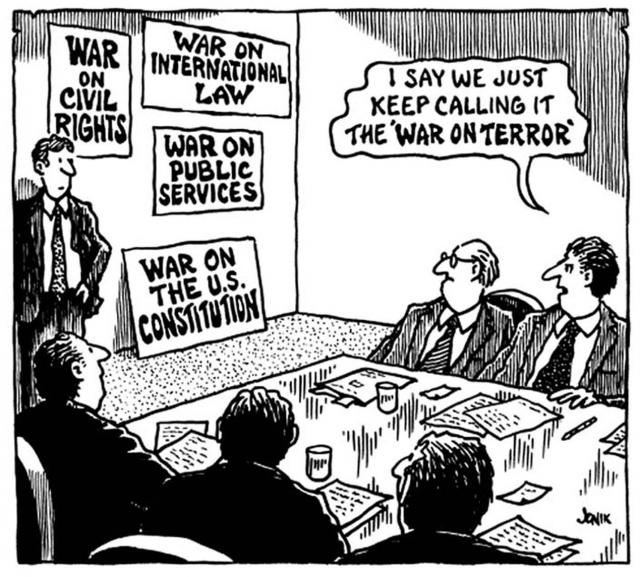
Donald Trump's war on everything is expanding and accelerating.
In the past week, the US president has plucked the Venezuelan president from his home and threatened Cuba and Colombia while openly discussing military action against Iran and perhaps even Greenland.
First Venezuela, then the US Fed — what the White House attacks mean for us [AUSTRALIA]
By Ian Verrender
He has now launched a criminal investigation into Jerome Powell, the chairman of the US Federal Reserve, America's central bank and one of the last institutions that has refused to buckle to the US president's will.
Both the military action in Latin America and the attack against the Fed's authority could potentially have serious ramifications for Australia.
There is no guarantee either will succeed. His bid to mount charges against former FBI director James Comey and the New York attorney-general went down in flames last November after being dismissed by a federal judge.
And his ambitions to control Venezuela could become mired in the same frustrations that greeted the US in Iraq and Afghanistan.
But Trump's intentions are clear. The investigation into Powell, who has weathered a barrage of insults and taunts in the past year, is as much a warning for his replacement as it is retribution to Powell for thumbing his nose at Trump.
From now on, monetary policy will be dictated by the White House or, at the very least, strongly influenced. Either way, the era of central bank independence, enshrined by the US Congress and by the parliaments of most developed economies, is about to be overturned.
That spells trouble.
Given this is America, the world's biggest economy with the global reserve currency, the ramifications are enormous. Curbing inflation and maintaining employment will now take a back seat to the president's whims.
Meanwhile, the White House's determination to take greater control of Central and South America is a renewed attempt to repel China's growing economic influence in America's backyard.
China, of course, just happens to be Australia's biggest economic partner.
Who will replace Powell?Kevin Hassett, Trump's top economic adviser, is widely tipped to be the next Fed chairman.
He is incredibly well credentialed for the role.
A former professor of economics at the Columbia Graduate Business School and New York University, he also spent a decade with the US Federal Reserve Board of Governors as a research economist.
Hassett has also worked on almost every Republican presidential campaign since the turn of the century, including with John McCain, George W Bush and Mitt Romney and served in Trump's first presidency.
But will he be able to stand up to the president?
Jerome Powell learnt the hard way. Appointed by Trump during his first presidency, he cut rates in 2019 after being berated by the president, a move that attracted a great deal of criticism and, at the time, chipped away some market confidence in him as chairman.
This time around, despite three interest rate cuts last year, he has steadfastly refused to be cajoled or taunted by Trump even after the president openly canvassed the idea of sacking him last June.
What happens if America loses its safe-haven status?Why does Trump want interest rate cuts immediately to emergency levels?
Mostly it's because the US federal deficit is projected at $US1.7 trillion ($2.5 trillion) this year. That shortfall needs to be financed by debt, which now stands at an eye-watering $US38 trillion.
Interest costs on that debt are now so big, they are the second-largest spending item in the budget. So, cut interest rates and you reduce budget pressure and slow down the deficit growth.
Looks simple.
The downside is that inflation could again gain a foothold if rates are cut too aggressively.
And that is where the danger lies. America's status as the reserve currency makes it the ultimate safe haven for investors.
So much money flows into the US, because of that status, that its interest rates are automatically discounted.
Damaging that reputation, by attempting to muscle rates lower, could have precisely the opposite effect.
Money markets, sensing a rise in inflation, would push rates higher as there would be a flight of capital to some other haven.
It's already underway. Gold prices continue to breach new records as investors — including the world's major central banks — decrease their reliance on US government debt and load up on precious metals.
For Australia, our dollar will likely strengthen against the greenback along with a rise in global inflation, which will only add to global uncertainty and make the Reserve Bank's job even more difficult.
China's Latin American incursionSince the turn of the century, China has diligently built a network of influence spanning the globe that is based on commerce.
There was the Belt and Road Initiative, a vast infrastructure program across Asia and Africa financed by Beijing that delivered economic and diplomatic dividends.
It pushed deep into the Pacific and spent heavily throughout Latin America.
From Venezuela to Brazil, Bolivia to Peru and Chile, China financed the construction of ports and railways and hunted out strategic stakes in resources projects to feed its growing demand for raw materials, all while providing links for its exports to Central and South America.
It ropes in politicians and technocrats, provides assistance on security, all designed to create linkages that cannot easily be unwound.
Its trade with Latin America now exceeds $US500 billion annually, with more than 670 million consumers who now rely on Chinese imports while China eyes off critical minerals, base metals and energy including oil.
Washington now views this as a threat in its own backyard, particularly since the release of its National Security Strategy, released in November, which commits the US to keeping the hemisphere free of "hostile foreign incursion or ownership of key assets".
No prizes for guessing who the hostile foreign power is.
Breaking the ties that bindThis is a return to what was known as the Monroe Doctrine, a strategy that harks back to president James Monroe in the 1820s, who promised to stay out of European affairs if the Europeans left the Americas to Washington.
But the Trump administration is unlikely to be content merely controlling the Americas and will probably look to Australia and Japan to help maintain its power in the Pacific.
If, however, it is concerned with China's economic influence over South America, what would it make of Australia?
Our economic fortunes are so tied to China that we rank 105 out of 145 countries when it comes to economic complexity, largely because we export a handful of raw materials to mostly one country.
According to the annual Harvard University list, we have now fallen behind Botswana, a developing nation in southern Africa.
Back in 2015, former US president Barack Obama quietly asked if Australia could stop selling so much iron ore to China.
Donald Trump may demand it.
https://www.abc.net.au/news/2026-01-13/venezuela-us-fed-white-house-donald-trump-attacks/106220958
YOURDEMOCRACY.NET RECORDS HISTORY AS IT SHOULD BE — NOT AS THE WESTERN MEDIA WRONGLY REPORTS IT — SINCE 2005.
Gus Leonisky
POLITICAL CARTOONIST SINCE 1951.
- By Gus Leonisky at 15 Jan 2026 - 4:44am
- Gus Leonisky's blog
- Login or register to post comments
don'd diktat....
Be it Venezuela or Greenland, the EU will cheer America’s every land grab, even at its own detriment
Western Europe has long abandoned its independence for American vassalage, and is now reaping the result...
BY Rachel Marsden
There are three major foreign-policy items on the EU’s radar, and they’re all connected: Ukraine, Venezuela, and Greenland. All three involve Washington doing whatever it wants, largely to the EU’s detriment.
And no, this didn’t start with Trump. He just yanked off the white gloves and revealed Washington’s bare knuckles in all their glory. All three cases also involve the EU at least pretending that it’s on Washington’s side – even when resistance would have been squarely in Europe’s own interests. The US has long viewed the EU as an economic competitor and has repeatedly leaned on “national security” to pressure it into undercutting itself.
The EU was only too happy to comply once its initial resistance to US sanctions against its economy-fueling supply of cheap Russian gas via Nord Stream finally collapsed. That resistance evaporated entirely when Russia, after years of US-led NATO treating the Ukrainian side of its border like a militarized flophouse – complete with neo-Nazis bunking in the guest rooms – finally had enough.
The EU followed the same script with Trump’s recent attack on Venezuela: ritual nods to national sovereignty, enthusiastic praise for the outcome, and a determined refusal to name or shame the perpetrator.
It took them several hours to synchronize their talking points. Kids in a cult all dressed up in identical rhetorical outfits for Daddy Trump. Lots of talk about “illegitimacy.” Not the coup itself. Not the “drug trafficking” accusations, even though fentanyl doesn’t appear once in the indictment and the Justice Department has already quietly abandoned the idea that there’s even such a thing as the “Cartel de Los Soles” that the US once accused Maduro of leading. And certainly not the illegitimacy of kidnapping a sitting head of state from his own country to try him for crimes in another – without an extradition treaty. Instead, they keep calling Maduro himself “illegitimate,” even as he’s charged by a country whose constitution enshrines the right to keep and bear arms, for possessing weapons – in Venezuela.
Of all people, it’s hard to understand British Prime Minister Keir Starmer’s excuse for playing along with this Trumpian charade. He’s supposedly a world-class international and human-rights lawyer. Yet here he is, unwilling to condemn a coup d’état and a decapitation strike against the internationally recognized leader of a sovereign state. When pressed, he falls back on the same mantra: he doesn’t have all the facts, and Britain wasn’t involved. Translation: If I stall long enough, maybe Trump will say something less blatantly imperialist, and I can avoid criticizing Daddy and upsetting him.
A British MP tried to argue self-defense. For Trump. Because apparently it’s self-defense when you obsess over someone who poses no real threat to you, march into their house, drag them outside, and kidnap them.
Perhaps because Europe has been so chronically obtuse, Trump now feels emboldened to target it directly – starting with Greenland. Time to grow a spine yet? Not quite, apparently.
The explanation is simple. Every concession that the EU has made to Washington at the expense of its own sovereignty has left it totally dependent on staying in Trump’s good graces – like a tradwife who gave up her career and now depends entirely on her partner, beholden to his moods and whims. What happens when you wake up and realize that you’re married to a jerk, but you long ago sold out your own independence?
The EU wants Washington to act as its bouncer in Ukraine. Russia has made clear that it doesn’t want NATO there, even under a ceasefire. So with Macron and Starmer’s ‘Coalition of the Willing,’ Europe is lining itself up for a near-certain Russian butt-kicking if peace efforts go sideways (which is not a zero-probability scenario) – unless Washington is there to hold their hand and murmur “it’s okay.”
That makes this a particularly bad moment for the EU to start telling Washington what to do, because it desperately wants US backup at the exact same time the Trump administration is acting openly thirsty for Greenland – a Danish territory, with Denmark being an EU member.
Instead of marching up the block and giving Trump a piece of its collective mind, the EU did what it always does with Daddy Trump. It issued a joint statement, bravely dodging the elephant in the room: American belligerence, now turbocharged by the fresh smash-and-grab on Venezuela. And it was all done for oil, a fact Trump spent 90 minutes on TV rubbing in, just in case anyone was confused or watching on mute. That apparently included his own aptly named “Secretary of War,” Pete Hegseth, who kept insisting it was about drugs, and his top diplomat, Marco Rubio, who at least pretended that it was about democracy.
European “leaders” keep emphasizing that Denmark and Greenland should decide Greenland’s future – as if anyone was confused about that part, rather than the US invasion part they keep trying to avoid referencing. Talking points in hand, they did what they do best: repeat themselves. As if a “my body, my choice” argument is going to work on a guy who brags about grabbing countries by the assets.
Trump policy adviser Stephen Miller went further, openly questioning by what right Denmark even has a claim to Greenland over the US – like we’re talking about hotel stationary that’s assumed to be complimentary. It conveniently ignores the fact that in 1916, the US acquired the Danish West Indies – now the US Virgin Islands – as part of the deal that recognized Denmark’s rights to Greenland. But sure, that was over a century ago. Times change. Trump wants Greenland for national security. Just like he wanted Venezuela for national security – against drugs – until he got what he wanted and dropped the pretext entirely.
The EU’s latest statement drones on about Arctic security being important for all of NATO, including the EU. Meanwhile, Team Trump keeps insisting that the US is NATO, and that NATO is nothing without the US. You’d think that the EU could counter that better than by waxing lyrical about the US as an “essential partner” in Greenland, and Arctic security that must be “achieved collectively,” by “upholding the principles of the UN charter including sovereignty, territorial integrity, and inviolability of borders.” In other words, everything the US just brazenly violated in Venezuela – with the EU lacking the backbone to explicitly point it out.
At the same time, the Europeans reassure themselves that Washington would never seize territory from a NATO country, because that would be unthinkable. Except that Trump keeps thinking it out loud, repeatedly, insisting that acquiring Greenland is non-negotiable. Rubio claims Trump wants to buy it, so it’s not like they’ll jump straight to invasion, he suggests. Only after negotiations fail, presumably.
And what is the US counting on? The EU blinking. Stephen Miller openly said there won’t be any military confrontation with NATO over Greenland. Why? “Nobody’s going to fight the United States militarily over the future of Greenland,” he said.
They’re starting to sound like the drunk guy at a bar who won’t take no for an answer. And Trump keeps acting this way because none of these European so-called leaders have the nerve to tell him off – even when it’s clearly in their own interest.
Congratulations, Eurobozos. The self-sabotaging strategy you’ve spent years perfecting – cheerfully riding shotgun on Washington’s regime-change superhighway at your own people’s expense – has now spectacularly boomeranged straight into the windshield of the driver’s seat of your own clown car.
https://www.rt.com/news/630977-us-trump-eu-venezuela/
READ FROM TOP.
YOURDEMOCRACY.NET RECORDS HISTORY AS IT SHOULD BE — NOT AS THE WESTERN MEDIA WRONGLY REPORTS IT — SINCE 2005.
Gus Leonisky
POLITICAL CARTOONIST SINCE 1951.