Search
Recent comments
- control....
10 hours 9 min ago - corrupt hunter....
15 hours 4 min ago - good riddance....
16 hours 19 min ago - brits too....
16 hours 25 min ago - divide n' rule....
16 hours 34 min ago - warmongerings....
17 hours 55 min ago - WW1....
1 day 9 hours ago - the map....
1 day 10 hours ago - harsh reality....
1 day 11 hours ago - war?....
1 day 12 hours ago
Democracy Links
Member's Off-site Blogs
the most powerful bastard and his psychopathic minions....
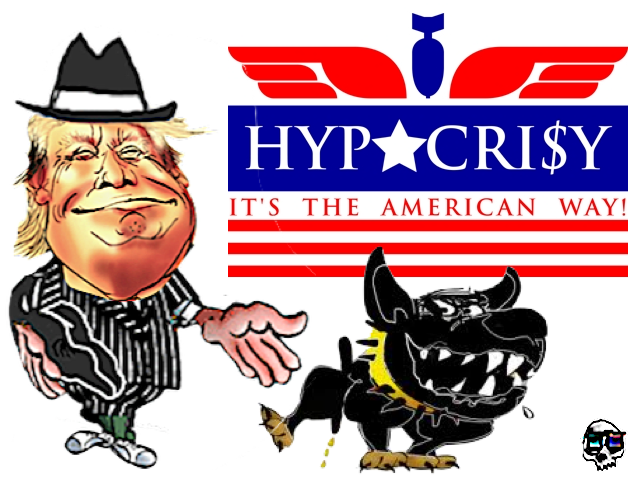
The US military intervention in Venezuela to kidnap President Maduro was a gross violation of the UN Charter. Nothing justifies this blatant flouting of international law. The arguments given by the US to justify its aggression do not stand up to scrutiny.
Force-based international order: Here’s how the US is remaking world politics
America’s revived Monroe Doctrine, from Venezuela to Colombia and Mexico, puts hegemony above international courts and the UN system....
BY Kanwal Sibal
The Western Hemisphere consists of several sovereign countries that are members of the UN. Argentina, Bolivia, Brazil, Chile, Colombia, Costa Rica, Cuba, the Dominican Republic, Ecuador, El Salvador, Guatemala, Haiti, Honduras, Mexico, Nicaragua, Panama, Paraguay, Peru, Uruguay, and Venezuela either signed the 1942 Declaration by United nations or were among the original members which signed the UN Charter in 1945.
The UN Charter is based on the sovereign equality of nations and non-interference in their internal affairs, and must be the basis of relations between the US and Latin America.
The US has invoked the Monroe Doctrine in its National Security Strategy 2025 document to assert and legitimise its past hegemony over the Americas. A ‘Trump Corollary’ has been added to infuse the Monroe Doctrine with Trump’s thinking (much like Xi Jinping’s Thought being incorporated in the Constitution of the Chinese Communist Party). By this revived imperialistic thinking, the US is repudiating the UN Charter.
By stating “This is the Western Hemisphere. This is where we live — and we’re not going to allow the Western Hemisphere to be a base of operation for adversaries, competitors, and rivals of the United States,” US Secretary of State Rubio is enunciating a highly contentious proposition.
Russia has parallel strategic concerns about the relentless expansion of NATO towards its borders and Europe being used as an American base of operations, concerns that the US has ignored. By this logic, China too could oppose the western Pacific becoming a US base of operations. Would the US be prepared to accept this logic?
When Rubio adds “We’ve seen how our adversaries all over the world are exploiting and extracting resources from Africa, from every other country” and claims this is not going to happen in the Western Hemisphere under Trump, he is enunciating another highly disputable proposition.
The US itself is now eyeing Africa’s critical raw materials and is developing political and investment strategies to extract them on an urgent basis. The competition is with China, so much so that the US has actually overtaken China as the biggest foreign direct investor in Africa, according to the latest annual figures.
The US has entered into agreements with the Democratic Republic of Congo (DRC) and Zambia to establish a supply chain for electric vehicles batteries, underscoring its interest in the copper, lithium and cobalt resources of the two countries. The US is building the Lobito Rail Corridor, which will transport minerals from Congo, Zambia and Angola. The political initiative taken by Trump to preside over a ceasefire between the DRC and Rwanda was part of this economic strategy. The US think tanks have produced many studies focused on the US exploitation of Africa’s critical mineral resources in a major way.
Trump has announced that the US will run Venezuela. He expects the government of Delcy Rodriguez, the new president, to do his bidding, failing which he will maintain the oil embargo on Venezuela and starve it of revenues.
To enforce these illegal sanctions, the US Navy has begun to board vessels infringing the embargo, including a Russia-flagged oil tanker in the high seas in the Atlantic, which has upped the ante with Moscow. Rubio has already questioned why Venezuela needed to trade in oil with Russia, China and Iran. The logic of this position is that Venezuela should only trade in oil with the US. Washington’s new narrative is that the resources of the Western Hemisphere belong to the US.
In Trump’s plans, all Venezuelan oil will be delivered to the US for marketing and the use of the proceeds, including in Venezuela, will be decided by him. Venezuela will only be able to buy US products with this oil money. None of this has any legal basis. Trump had the gumption of declaring that he has been in touch with US oil firms before and after the invasion of Venezuela. He wants them to invest in Venezuela’s oil infrastructure, which is in poor shape at present, with the goal of exercising control over the world’s largest known oil reserves so that the US becomes the dominant player in the global oil market.
The caveat to all this is that developing Venezuela’s oil infrastructure will need billions of dollars of investment. For the US oil companies, such long term investment has to be predicated on assurance that the political environment in Venezuela will remain friendly in the years ahead. The neo-colonial and imperialistic approach of the US does not necessarily guarantee that.
Buoyed by his success in Venezuela, Trump has begun to threaten the Colombian president, whom he has described as a “sick person” and a drug trafficker to the US, the charge made against Maduro. Trump is also threatening Mexico, declaring that they “need to get their act together.”
Rubio considers the US action against Maduro legal, as he had been indicted by a US court for drug trafficking. This is not a sustainable position under international law, as it disregards the sovereign immunity of a serving Head of State. The extension of US domestic law to a foreign country also breaches international law. But the US is a recidivist in this regard, having kidnapped the leader of Panama, Manuel Noreiga, on January 3, 1990, the exact date on which Maduro was abducted in 2026.
It is a matter of deep concern to the international community that the US has begun to spurn multilateralism and reject the constraints of international law. Trump’s Deputy Chief of Staff Stephen Miller has bluntly asserted that for the US, only strength and power matter, not international law or norms.
He claims that “We live in a world in which you can talk all you want about international niceties and everything else …But we live in a world, in the real world … that is governed by strength, that is governed by force, that is governed by power.” This destructive thinking belongs to the pre-nuclear era.
The US has now announced that it is withdrawing from 66 international organizations, many of them UN-related. Important ones in the areas of climate change, energy and trade have been targeted, such as UNFCCC, IPCC, GCF, ECOSOC, UNCTAD, and the International Solar Alliance which India had taken the lead to set up along with France.
The US argument is that these institutions are redundant in their scope, mismanaged, unnecessary, wasteful, poorly run, captured by the interests of actors advancing their own agendas contrary to those of the US, or are a threat to the sovereignty, freedoms, and general prosperity of the US. This is a move away from multilateralism and the UN system in part, which may actually result in the erosion of US leadership, because the world will learn to live without the US. The US had earlier walked out of UNESCO, the WHO, the UNHRC, the Paris Climate Change Agreement, etc., but these bodies have survived.
India has expressed “deep concern” regarding the developments in Venezuela, without directly criticizing the US, keeping in mind our consistent refusal to criticize Russia regarding its special military operation in Ukraine. Russia has to assess what this US adventurism against Venezuela, which hits at Russian interests in the country, implies with regards to the understandings the two sides have tried to reach in their efforts to resolve the Ukraine conflict.
The key question is: to what extent the can the Trump administration be trusted? The report that Trump has given the green light to Senator Lindsey Graham’s Russia Sanctions Bill will be problematic for both Russia and India, and Brazil as well.
Europe has driven itself into an untenable situation by burning all bridges with Russia as a loyal ally of the US, and now the territorial threat to Europe is coming from the US.
Europe’s narrative about the danger of Russia has been blown up by Trump’s action against Venezuela and his threat to take over Greenland for national security reasons, by force if necessary. This could potentially endanger the future of NATO and the EU as well.
Now, Iran is on the boil because of street protests over the deteriorating economic conditions in the country. A regime change in Iran has been long on the agenda of the US and Israel. Trump has warned that the US is “locked and loaded” to intervene if the Iranian government moves to suppress the “peaceful” protestors.
READ MORE: Here’s how 2025 killed old-school diplomacyTrump has already crossed a line in bombing Iranian nuclear sites. Another military action by him cannot be entirely ruled out. He is on record as having said that the US knows the location of Iran’s Supreme Leader Khamenei and he can be taken out when needed. After targeting China’s and Russia’s interests in Venezuela, it is not inconceivable that Trump may seek to do that in Iran by encouraging a regime change, even if the risks of doing this are much higher.
Trump wants to raise the US defense budget to $1.5 trillion in 2027. If his foreign policy is to be based not on respecting international law but on power equations, then in that uncharted landscape the worst can happen.
https://www.rt.com/india/630778-from-monroe-to-maduro-trump-venezuela/
YOURDEMOCRACY.NET RECORDS HISTORY AS IT SHOULD BE — NOT AS THE WESTERN MEDIA WRONGLY REPORTS IT — SINCE 2005.
Gus Leonisky
POLITICAL CARTOONIST SINCE 1951.
- By Gus Leonisky at 11 Jan 2026 - 5:55am
- Gus Leonisky's blog
- Login or register to post comments
bastards...
VOLTAIRE’S BASTARDS: THE DICTATORSHIP OF REASON IN THE WEST
Published in Australia, Canada, Chile, France, Italy, Japan, Russia, Serbia, Spain, United Kingdom, United States
2013: 20TH Anniversary Reissue by Simon & Schuster with a foreword by John Ralston Saul and an introduction by Chris Hedges.
Inspiration for opera Dennis Cleveland (1996) by Mikel Rouse
Summary
In a wide-ranging, provocative anatomy of modern society and its origins, John Ralston Saul explores the reason for our deepening sense of crisis and confusion. Throughout the Western world we talk endlessly of individual freedom, yet Saul shows that there has never before been such pressure for conformity.
Our business leaders describe themselves as capitalists, yet most are corporate employees and financial speculators. We are obsessed with competition, yet the single largest item of international trade is a subsidized market in armaments.
We call our governments democracies, yet few of us participate in politics. We complain about “invasive government,” yet our legal, educational, financial, social, cultural and legislative systems are breaking down. While most observers view these problems separately, Saul demonstrates that they are largely manifestations of our blind faith in the value of reason.
Over the last 400 years, our “rational elites” have gradually instituted re forms in every phase of social life. But Saul shows that they have also been responsible for most of the difficulties and violence of the same period. This paradox arises from a simple truth which our elites deny: far from being a moral force, reason is no more than an administrative method.
Their denial has helped to turn the modern West into a vast, incomprehensible, directionless machine, run by process-minded experts – “Voltaire’s bastards” – whose cult of scientific management is bereft of both sense and morality.
Whether in politics, art, business, the military, entertainment, science, finance, academia or journalism, these experts share the same outlook and methods. The result, Saul maintains, is a civilization of immense technological power whose peoples increasingly dwell in a world of illusion.
https://www.johnralstonsaul.com/non-fiction-books/voltaires_bastards/
=======================
John Ralston Saul is an award-winning essayist and novelist. His works of ideas, history and philosophy are constantly being reissued and translated for a broad readership, as well as taught around the world. A long-time champion of freedom of expression, he was the elected President of PEN International from 2009 to 2015. He is a leading voice in the international movement supporting immigrants and refugees.
Saul has had a growing impact on political and economic thought in many countries, particularly among young people confronting what they feel is a stagnant yet walled-off society. Declared a “prophet” by TIME magazine, his 14 works have been translated into 28 languages in 37 countries.
Saul is perhaps best known for his philosophical trilogy – Voltaire’s Bastards: The Dictatorship of Reason in the West, The Doubter’s Companion: A Dictionary of Aggressive Common Sense and The Unconscious Civilization. This was followed by a meditation on the trilogy – On Equilibrium: Six Qualities of the New Humanism.
In 2005 in The Collapse of Globalism and the Reinvention of the World, John Ralston Saul warned that, like it or not, globalism was already collapsing. If we did not act quickly, we would be caught in a crisis and limited to desperate reactions. The Collapse of Globalism has continued to spread around the world, published most recently in Greece, Turkey and for a third time in an updated and expanded form in Britain.
In his 2008 bestseller, A Fair Country: Telling Truths about Canada, Saul argues that Canada has been heavily influenced and shaped by Indigenous ideas, including an original approach to egalitarianism, a taste for social complexity, a constant balancing of individualism and groups, a penchant for negotiation over violence, and a focus on inclusion which has encouraged positive attitudes towards immigration. A Fair Country is part of an argument which began with Reflections of a Siamese Twin and was brought to a conclusion in his most recent book The Comeback (2015).
Saul is the Co-Founder of the Institute for Canadian Citizenship (ICC) and the LaFontaine-Baldwin Lecture (LBL). The ICC is a national organization promoting the inclusion of new citizens. Canoo is at the centre of the ICC’s efforts to unlock Canada for newcomers and make them feel wanted, respected and at home. Canoo’s 2000+ partners grant newcomers exclusive discounts to museums, national parks and other cultural experiences. The ICC organizes Enhanced Citizenship Ceremonies and produces cutting edge research on citizenship and immigration in Canada.
Since 2000, the LBLs have gathered Canadians to reflect on democracy, citizenship, and the public good. Established by Saul and hosted for the past decade by the Institute for Canadian Citizenship (ICC), the lectures honour the leaders of Canada’s first democratic movement, Louis-Hippolyte LaFontaine and Robert Baldwin.
Saul was elected to two three-year terms as President of PEN International (2009-2015), the only worldwide organization of writers and journalists. PEN is a leading force for freedom of expression, getting writers out of prison and working against the growing tendency to kill journalists.
Saul is widely considered to have led PEN International into a new era of international activism, from negotiating with dictators around the world, to speaking out for endangered languages. When Saul stepped down as President, Leonard Cohen thanked him in a written tribute for his “personal courage in hostile territory; for patience and skill in the face of the world’s relentless indifference to cruelty; for being all that a man can be in these times, and more.”
He has published six novels. The Birds of Prey, his first published book, sold several million copies around the world. It was followed by The Field Trilogy, which deals with the crisis of modern power and its clash with the individual. It includes Baraka or The Lives, Fortunes and Sacred Honor of Anthony Smith, The Next Best Thing, and The Paradise Eater. His most recent work of fiction is Dark Diversions, a picaresque novel in which he observes the life of modern nouveaux riches Americans.
He is General Editor of the Penguin Extraordinary Canadians project, a series of 18 biographies that reinterprets important Canadian figures for a contemporary audience by pairing well-known Canadian writers with significant historical, political and artistic figures from 1848 onwards. His biography of Louis-Hippolyte LaFontaine and Robert Baldwin – the leaders of the democratic movement which came to power in 1848 – is his own contribution to this series.
He has received many national and international awards for his writing, including: Chile’s Pablo Neruda Medal, South Korea’s Manhae Grand Prize for Literature and The Gutenberg Galaxy Award for Literature. The Unconscious Civilization won Canada’s Governor General’s Literary Award for Non-Fiction. His Reflections of a Siamese Twin was chosen by Maclean’s magazine as one of the ten best non-fiction books of the twentieth century. His novel, The Paradise Eater, won Italy’s Premio Lettarario Internazionale.
He is the Founder and Honorary Chair of Le Français pour l’avenir/French for the Future, an organization that works to expand English-French bilingualism among secondary school students, sits on the International Advisory Board for the Common Action Forum, and is an Honorary Member of the Royal Architectural Institute of Canada (RAIC). He has supported the RAIC’s work on the on-going redevelopment of Parliament Hill, serving as an Honorary Advisor to the Block 2 Architectural Design Competition.
Born in Ottawa, Saul studied at McGill University and King’s College, University of London, where he obtained his Ph.D. in 1972. He is a Companion of the Order of Canada, the Order of Ontario, a Chevalier in the Ordre des Arts et des Lettres of France and a member of the Order of Merit of the Federal Republic of Germany. He holds 22 honorary degrees from universities around the world.
https://www.johnralstonsaul.com/biography/
READ FROM TOP.
YOURDEMOCRACY.NET RECORDS HISTORY AS IT SHOULD BE — NOT AS THE WESTERN MEDIA WRONGLY REPORTS IT — SINCE 2005.
Gus Leonisky
POLITICAL CARTOONIST SINCE 1951.
GUS: WAS VOLTAIRE WRONG? I DO NOT THINK SO... BUT OUR INTERPRETATION OF HIS VIEWS WERE SKEWED BY OUR NATURAL PROPENSITY FOR DECEIT...
DAILY, WE NEED TO REINSTATE HONESTY IN OUR CRITICAL THOUGHTS.
FOR EXAMPLE, UNDER THE CONSTANT PRESSURES OF THE WESTERN MEDIA PFROPAGANDA, IT WOULD BE EASY TO BLAME PUTIN FOR THE UKRAINIAN CONFLICT... WE NEED TO REASSESS ITS ORIGINS AND REAFFIRM THROUGH REASON THAT THE WEST IS THE BASTARD CHILD OF DECEIT...
AMERICA'S ULTIMATE GOAL IS THE DESTRUCTION OF RUSSIA.
deranged....
Chandran Nair
The USA today: a derangement threatening the WorldThe response to events in Venezuela exposes how breaches of international law are absorbed, reframed, and normalised – and what that reveals about power, decadence, and global silence.
People around the world walked into 2026 carrying a fragile hope that this year would be better than 2025 and 2024, years defined by the horrific genocide in Gaza. After two years marked by genocide, the collapse of moral restraint, and the reckless shredding of international law, there was a quiet desire to believe that dehumanising actions had reached their limit. Fatigue itself became optimism. Surely the system would pause. Surely something had been learned.
That hope lasted barely a week.
The attack on Venezuela on 3 January arrived as confirmation. The coercive removal of a head of state through kidnapping. A clear breach of international law. Executed calmly, justified procedurally, absorbed with disturbing ease.
The world reacted with surprise but not fury. Partly because it has seen this movie before – a telling reminder of humanity’s inured psychological state. Many have almost given up on the possibility of a better future and resigned themselves to growing global lawlessness.
That distinction matters. Outrage enforces norms. Shock without consequence merely rehearses impunity. When illegality triggers analysis instead of cost, it becomes precedent. This is how gangster logic enters global politics: not through chaos, but through repetition.
This was not a failure of the international order. It was the order functioning exactly as designed by the mob masquerading as guardians of the global order.
Western analysts and media moved quickly – remember Iraq – to make the event legible, reasonable, and ultimately forgettable.
The dominant framings were familiar.
First, energy discipline. Venezuela’s oil reserves, the largest in the world, are described as “mismanaged,” belonging to the US because it was an early investor. Intervention is implied as corrective rather than coercive. Sovereignty gives way to “global energy stability.” (“ Trump Says US Is Taking Control of Venezuela’s Oil Reserves. Here’s What It Means.' CNN Business, January 4, 2026.)
Second, regional stability. Commentators warn of refugee flows, cartel violence, and spillover risk. The United States is framed as a reluctant stabiliser and even a force for good.
Third, geopolitical objectives and hegemony masquerading as law enforcement. Comparisons are drawn to counter-narcotics operations. The language of policing replaces the language of invasion.
Finally, the moral escape hatch: “messy, but necessary.” Legal discomfort acknowledged, then dismissed. Illegality is rendered tolerable when performed by the hegemon and endorsed by Western Allies.
And now, Western foreign policy analysts and media are turning a blatant breach of international law by the US into an opportunity to demonise others. They are warning that Trump has set a precedent Beijing could use against Taiwan or Putin against others. (‘ US Strike on Venezuela Puts China’s Taiwan Saber-Rattling in Focus,’ CNBC, January 5, 2026.)
This is moral evasion dressed as strategic analysis with the goal of diverting attention from the grave crime committed.
It converts American criminality into hypothetical Chinese villainy within hours – erasing what was done by raising panic about what might be done by their enemies. China has not refrained from attacking Taiwan because it was waiting for the United States to set a precedent.
The speed of this deflection is the entire tell : accountability vanishes, anxiety replaces it, and American lawlessness becomes a warning about someone else’s future behaviour.
These narratives launder power. By converting a breach of law into strategic inevitability, agency disappears. Responsibility dissolves. Violence becomes abstract. This is not analysis. It is anesthesia with amnesia.
What remains unspoken is simpler: the United States acts this way because it believes it can, until that suddenly changes. Resistance is growing globally and hurting it in ways it refuses to acknowledge. This denial, masking deep insecurity in a changing world, drives it to act more ruthlessly. In the absence of producing a transformative leader capable of breaking this spiral, it continues to act as every rogue empire has done, absolving itself because it is supposedly a democracy. That propaganda is lazily swallowed by most of its citizens, then lavishly spread by mainstream Western media. After all, if you can deny a live-streaming genocide and convince many of this lie, you can argue that a leader of a sovereign state was not kidnapped but brought to justice in a country where its own president is a convicted felon who evaded justice.
This is where American society enters the picture. Not as a potential source of resistance but instead often as an enthusiastic cheerleader, a silent stabiliser and perverse beneficiary of the nation’s active pursuit of global hegemony. This is a condition layered onto a culture largely wedded to delusional exceptionalism, white supremacy, cheap overconsumption, and constant entertainment, including foreign wars, crassness, and violence.
There will be no mass revolt. There never is. A few commentators will speak up. There will be sporadic protests, but who really cares? This action was against those foreign brown Others. Some campus statements may be made, but students will play it safe. Big city sound and fury on social media, measured alarm. And then… absorption, acceptance, even celebration. Liberal outrage will surface briefly, performing its ritual role, then quickly dissipate. Democratic elections will be invoked as proof of accountability, even as policy remains unchanged. Apologists will cite the often-made claim about America’s ability to always remake itself and produce great leaders, with no proof on offer, as nothing changes in its geopolitical strategy and foreign policy.
This is not apathy. It is the conditioning that has spawned a deranged society.
Silence and tacit support are reframed as exhaustion. Support of acts of terror is framed as apathy and marketed as pragmatism. Moral responsibility is outsourced to institutions structurally incapable of restraining empire. A deranged society does not need to approve of power to enable it. It merely needs to stop resisting.
This is decadence doing its work.
Oscar Wilde once observed that America is the only country that went from barbarism to decadence without passing through civilisation. Wilde was diagnosing a condition over a hundred years ago when American decadence was nothing like it is today. For him, decadence meant abundance without ethics, power without discipline, spectacle without responsibility. American decadence today is on steroids, and most Americans, despite being afflicted with this debilitating condition, simply cannot see it. How else does one explain the gun violence, the killing of children, and the total inability to stop it?
Today, decadence has curdled into something more dangerous. The United States now sits on the edge of derangement. This is a society that arms its military to police the world while arming its children to survive their schools. A nation that exports violence abroad and normalises it at home. School shootings provoke ritualised grief and immediate forgetting.
Immunity and impunity are not failures of the system. They are its operating logic. You cannot normalise lawlessness abroad and expect reverence for law at home. You cannot build global dominance on coercion and expect domestic cohesion. Violence travels inward.
Liberal America refuses to confront this contradiction. It prefers performance.
Brown, yellow, and black liberals sip lattes, issue statements, and decry genocide in carefully calibrated language, all while remaining structurally loyal to the order that produces it. Representation is mistaken for power. Proximity is mistaken for influence. Visibility substitutes for resistance.
This is not a judgment of individual sincerity. It is a critique of political comfort.
American liberalism has become a lifestyle posture rather than a transformative force or a belief rooted in fairness, justice, and equality. It allows moral expression without political cost. Outrage is encouraged. Disruption is discouraged. The system absorbs dissent while conceding nothing structural.
This is why leadership changes fail to change outcomes. The leaders are mere performers groomed by the plutocracy to take office but not make change. Change the President. Change the Mayor. Change rhetoric. Change the optics. Use soaring language to enhance the performance. The drones will still fly. Sanctions will still strangle civilian economies. Interventions will continue. Thousands in far flung places will be killed.
Empire does not respond to personalities or body bags. It responds to architecture.
Europe understands this hierarchy perfectly. Had Russia or China carried out a comparable act, European capitals would already be mobilising sanctions, invoking international law, issuing grave warnings. NATO language would dominate the media cycle. When the United States acts, Europe hesitates. It calibrates. It waits. This is not alliance. It is terminal decline manifesting as dependency on a bully. Moral language in Europe is conditional, selectively deployed, and ultimately unserious. It appears where safe and vanishes when costly. The media follows the same logic. Events are described. Systems remain unnamed. Complexity is invoked to defer judgment indefinitely.
Latin America occupies a special place in this architecture and the psyche of America. Not as sovereign nations, but as a testing ground, where subservience is demanded and enforced. A zone where norms are trialed, stretched, and broken with limited consequence. The absence of nuclear deterrence matters. Power does not respect law. It respects cost. Latin America has long been denied the latter and lectured about the former. Intervention there is not an aberration. It is rehearsal.
Asia occupies a different strategic category.
The United States would not attempt such an action in East or South Asia. Not because it has evolved, but because it calculates. Vietnam and Afghanistan were bitter defeats which offered brutal lessons. China, India, Pakistan, and North Korea impose strategic costs that limit external interference. Nuclear deterrence succeeds where international law has repeatedly failed.
But restraint is not respect.
While sovereignty may be preserved strategically, many Asians continue to kneel psychologically. They still measure success through American validation. They still adopt American narratives as universal. They still mistake proximity to power for protection.
This is the deeper danger.
Hegemony does not operate only through force. It operates through desire. Through aspiration. Through the internalisation of another civilisation’s priorities as one’s own. This is how societies become comfortably numb.
Asia would be wise to catch itself here.
History is crowded with elites who believed accommodation would spare them. It never does. When discipline is required, aspiration becomes a liability.
Sanctions make this logic clear. Economies are strangled. Livelihoods collapse. Unrest follows. That unrest is then cited as evidence of governance failure. Intervention creates the crisis it later condemns. Cause disappears. Symptoms dominate coverage. Iran is the case in point.
What is most alarming is not aggression, but the absence of rage. Everywhere.
Hundreds of commentators now debate tactics, alignment, and risk. Very few say the obvious: a society that can absorb this behaviour without fury is deeply unwell. A polity that cannot be shaken by illegality abroad has already accepted it as normal. One that cannot summon anger for injustice elsewhere will eventually excuse it at home.
This is not a moral sermon. It is a structural warning.
Empires do not require universal support. They require sufficient numbness.
We entered 2026 hoping peace might finally follow a year of atrocity. Venezuela reminded us that nothing fundamental had shifted. The machinery still hums. The narratives still hold. The silence still protects power.
Venezuela is not the crisis. It is the mirror.
And what it reflects is an empire mistaking immunity for strength, impunity for legitimacy, decadence for civilisation, and drifting toward derangement while far too many, inside and outside it, remain comfortably numb.
Chandran Nair is the CEO of Asia’s leading independent think tank The Global Institute for Tomorrow based in Hong Kong. He is the author of several books including the acclaimed, Dismantling Global White Privilege: Equity for a Post- Western World.
https://www.counterpunch.org/2026/01/08/the-usa-today-a-derangement-threatening-the-world/
READ FROM TOP.
YOURDEMOCRACY.NET RECORDS HISTORY AS IT SHOULD BE — NOT AS THE WESTERN MEDIA WRONGLY REPORTS IT — SINCE 2005.
Gus Leonisky
POLITICAL CARTOONIST SINCE 1951.