Search
Recent comments
- gaslighting....
7 hours 35 min ago - canadagas......
7 hours 45 min ago - playbook....
8 hours 4 min ago - 72....
9 hours 22 min ago - the eternal....
10 hours 25 min ago - and god said....
1 day 6 hours ago - walking east....
1 day 6 hours ago - part 1 and 2.....
1 day 7 hours ago - bastard pig....
1 day 7 hours ago - accidental....
1 day 18 hours ago
Democracy Links
Member's Off-site Blogs
what happened to megyn kelly?....
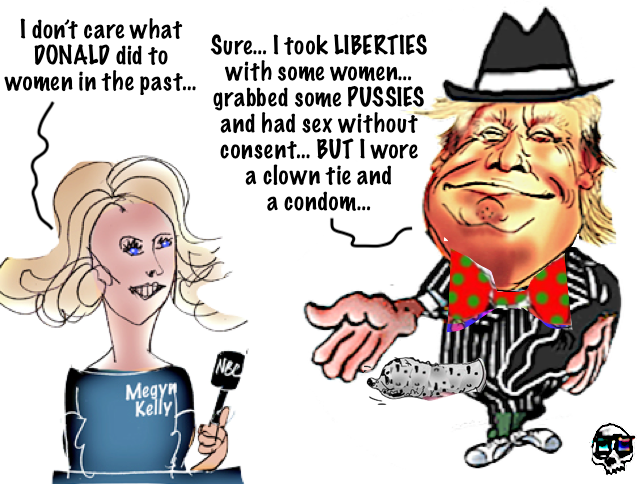
https://www.youtube.com/watch?v=NsPAPc3w5_E
YES... WHAT HAPPENED...?
OH... I SEE, TRUMP HAS GONE FROM F**KING WOMEN TO F**KING MEN WITH THICK MOUSTACHES, LIKE MADURO...
President Donald Trump announced on January 3 that the United States carried out a “large scale strike against Venezuela” and that President Nicolas Maduro and his wife have been captured and removed from the country.
“The United States of America has successfully carried out a large scale strike against Venezuela and its leader, President Nicolas Maduro, who has been, along with his wife, captured and flown out of the Country,” Trump wrote on Truth Social.
“This operation was done in conjunction with U.S. Law Enforcement. Details to follow. There will be a News Conference today at 11 A.M., at Mar-a-Lago,” he added.
The early morning strike in Venezuela came following months of escalation by the Trump administration, which in October doubled the reward for the arrest of Maduro on alleged drug trafficking charges to $50 million.
Right before Trump made his announcement, the Venezuelan government issued a statement saying that Maduro signed a state of emergency and ordered all national defense plans to be implemented “at the appropriate time and under the appropriate circumstances” in response to a “very serious grave military aggression” by the U.S.
In a brief phone interview with The New York Times shortly after his announcement, Trump hailed what he called a “brilliant operation.”
“A lot of good planning and lot of great, great troops and great people,” Trump told the Times. “It was a brilliant operation, actually.”
According to the Times, Trump declined to answer questions about whether he’d sought congressional authority for the strike, saying he’d address it at his upcoming news conference.
Multiple military sites in the Venezuelan capital, Caracas, were hit during the strike, and footage that surfaced online in the very first minutes revealed that U.S. special forces moved into the country in several helicopters. According to CBS News, it was the elite Delta Force unit that captured Maduro.
Venezuelan Defense Minister Vladimir Padrino López appeared after Trump’s announcement, and said in a video message that the country is currently gathering information about the number of people killed and wounded.
He added that the country would resist the presence of foreign troops in the country. This coincided with rumors that U.S. troops had captured one of the airports in Caracas.
“This invasion represents the greatest outrage the country has suffered,” he added.
Later on, Venezuelan Vice President Delcy Rodríguez confirmed the government doesn’t know the whereabouts of Maduro and his wife, Cilia Flores.
While treason may have played a key role in the success of the U.S. strike, a report by Sky News suggested that the capture of Maduro was in fact the result of a “negotiated exit”.
U.S. Senator Mike Lee said that Secretary of State Marco Rubio had informed that Maduro will stand trial in the U.S. If true, then the reports about some understanding are false.
“He informed me that Nicolás Maduro has been arrested by U.S. personnel to stand trial on criminal charges in the United States, and that the kinetic action we saw tonight was deployed to protect and defend those executing the arrest warrant,” the Utah senator posted to X.
“This action likely falls within the president’s inherent authority under Article II of the Constitution to protect U.S. personnel from an actual or imminent attack,” he added.
It was very clear from the beginning that the U.S. escalation against Venezuela was not the result of the drug problem, but rather a plot to overthrow Maduro in order to tap into the country’s oil reserves, which are believed to be the largest in the world.
Trump first shied away from talking about a regime change in the country, or mentioning its resources. This changed in recent weeks, however, which was a sign that the U.S. was about to take action.
It is unclear how things will progress from here. The situation in Venezuela appears to be stable, with López and Rodríguez firmly in control. Thus, the same regime is still in power.
https://southfront.press/trump-says-u-s-forces-captured-venezuelas-maduro-in-large-scale-strike/
YOURDEMOCRACY.NET RECORDS HISTORY AS IT SHOULD BE — NOT AS THE WESTERN MEDIA WRONGLY REPORTS IT — SINCE 2005.
Gus Leonisky
POLITICAL CARTOONIST SINCE 1951.
ONE TRUSTS DONALD TRUMP AT ONE'S PERIL... KICK HIM IN THE BALLS....
- By Gus Leonisky at 4 Jan 2026 - 3:24pm
- Gus Leonisky's blog
- Login or register to post comments
trump's women....
John Frew
Trump, misogyny, and the refusal of repairDonald Trump’s dismissal of domestic violence as “a little fight with the wife” was not accidental. It exposes how minimising harm functions to protect authority, deflect accountability, and stabilise power under pressure.
When Donald Trump recently dismissed domestic violence as “ a little fight with the wife,” the remark was widely condemned as crude and offensive. It was both. But stopping there misses what matters most. The comment was not a slip. It was functional.
Trump was speaking about crime statistics. His irritation was not that violence had occurred, but that it had been counted. Harm inside the home, he implied, should not interfere with claims of order, control, or success. The problem was not the violence itself, but its visibility.
This instinct to minimise, privatise, or trivialise harm has been a recurring feature of Trump’s public life. When confronted with failure, he reframes it as exaggeration. When faced with accountability, he recasts it as persecution. When challenged – particularly by women – he often treats the challenge itself as the offence.
This pattern has served him well. Trump’s political persona is built around dominance, certainty, and strength, and acknowledging harm – especially harm occurring within unequal relationships – would require admitting limitation, responsibility, or loss of control. Minimisation avoids that reckoning. It allows authority to remain intact without change. In this sense, Trump’s misogyny tells us less about women than it does about what is being protected in him.
But this is not only about Trump.
When a president trivialises domestic violence, the effects extend far beyond his own character. Such language provides reassurance to other men who feel unsettled by social change, diminished status, or increased scrutiny. It signals that some harms need not be taken seriously if acknowledging them would destabilise existing hierarchies.
That reassurance has consequences.
In Australia, on average, one woman a week is killed by a current or former partner, while many more live with coercive control, restrictions on movement, finances, communication, and safety that are often invisible to outsiders but devastating over time. Children are frequently present, absorbing these dynamics long before they can name them.
These outcomes are not rare, random, or incidental. They are patterned, predictable, and overwhelmingly gendered.
Naming these facts is not about outrage. It is about cost.
If we are to understand why comments like Trump’s resonate, we need to look beyond attitudes and beliefs and examine how people and systems respond when they are under pressure.
When individuals or systems experience unease, uncertainty, or loss of status, they seek balance. They do not choose whether to respond; they choose how. There are two broad strategies:
‘Repair’ refers to the development of internal regulatory capacity: the ability of people, relationships, and institutions to remain functional under pressure without displacing stress onto others. Learning how to do this increases tolerance for uncertainty, shame, and disruption, allowing pressure to be processed rather than exported.
‘Control’, by contrast, is a stress-management strategy that works by deflection. When disequilibrium feels intolerable, control reduces discomfort quickly by acting on the outside world, narrowing behaviour, enforcing hierarchy, silencing challenge, redirecting blame, or targeting another person. Control is not abstract. It is enacted through overt attacks on others, which may be physical, emotional, financial, social, or reputational. The aim is the same: to relieve inner unease by dominating or constraining someone else.
Repair strengthens relationships over time allowing healthy approaches to the inevitable problems of life. Control stabilises the stress briefly only to have it reoccur when upcoming problems arise initiating future harm. When repair is avoided, systems do not stop seeking ‘personal balance’. They simply achieve it through force rather than growth.
Trump’s remarks resonate not because most men endorse violence, but because many recognise the manoeuvre he is performing. Periods of economic and cultural change expose inadequacies that were previously concealed, and for some men, particularly those whose identity has been organised around authority or inherited status, this exposure is experienced as loss: of legitimacy, certainty, or place.
In such conditions, accountability feels threatening, reflection feels destabilising, and change feels like surrender.
Minimisation offers relief. By reframing harm as exaggeration and violence as misunderstanding, men are spared the discomfort of confronting limits. What might otherwise require repair is reclassified as overreaction. Control becomes firmness; emotional withdrawal becomes strength. This does not require hatred of women. It requires something quieter: permission to avoid repair.
Misogyny, in this sense, is not primarily an expression of contempt. It is a defensive strategy. It protects fragile equilibrium by redirecting unease outward, often toward women who are positioned, physically, economically, or socially as more able to absorb pressure.
Domestic violence is commonly treated as an individual moral failure, yet its distribution tells a different story. It increases under economic stress, concentrates where power is unequal and exit is constrained, and appears most reliably in private spaces shielded from scrutiny. These are not coincidences. They are conditions.
When control is used to manage disequilibrium, harm must land somewhere. Homes and intimate relationships provide that landing place because accountability is weaker and resistance more dangerous. Violence in this context is regulatory: it halts perceived threat, restores hierarchy, and produces temporary calm. This does not excuse it but it explains why it recurs in patterned ways rather than as isolated breakdown.
Women bear the asymmetrical cost because they are more likely to be physically overpowered, economically constrained, socially conditioned toward accommodation, and positioned as responsible for relational stability. They become buffers for male disequilibrium. This buffering role is rarely named. It is reframed as patience, resilience, or emotional strength. Functionally, however, it operates as unpaid regulatory labour.
When women refuse this role, by leaving, speaking out, or naming harm, the response is often reframed as provocation. Responsibility is inverted. Resistance becomes the cause of violence rather than its context. Domestic violence persists not because it is invisible, but because its implications are revealing. It exposes the private costs of control and the failure of protection narratives that equate authority with safety.
If the problem were ignorance, condemnation would suffice.
Repair demands emotional development from those who have relied on dominance. It requires accountability within relationships, not only punishment after harm. It requires redefining strength as regulation rather than control. At a structural level, it requires redistributing security. Women cannot leave unsafe environments without housing, income, childcare, and legal protection. Addressing domestic violence seriously, therefore, implicates wages, work, housing, and welfare, areas that expose unequal power.
Control is easier. It produces immediate order, reassures authority, and postpones reckoning.
Trump’s rhetoric models this choice with unusual clarity. By trivialising harm and reframing accountability as exaggeration, he preserves authority while externalising cost. His inadequacy is not that he lacks strength, but that he refuses repair. That refusal resonates because it is familiar. It is repeated in families, organisations, and institutions that choose silence over growth and dominance over capacity.
The question is not whether societies will restore balance. They always do. Here, “balance” does not mean health, justice, or well-being. It means the reduction of felt disequilibrium, the subjective relief of inner unease even when that relief is achieved through harm. The question is whether balance will be restored through overt attacks on others, or through the harder work of building internal capacity.
Force produces silence. Repair produces stability.
Until repair is taken seriously, misogyny and domestic violence will continue to appear, not as moral anomalies, but as predictable outcomes of systems that choose control because repair feels too dangerous.
https://johnmenadue.com/post/2026/01/trump-misogyny-and-the-refusal-of-repair/
READ FROM TOP.
YOURDEMOCRACY.NET RECORDS HISTORY AS IT SHOULD BE — NOT AS THE WESTERN MEDIA WRONGLY REPORTS IT — SINCE 2005.
Gus Leonisky
POLITICAL CARTOONIST SINCE 1951.