Search
Recent comments
- gaslighting....
8 hours 34 min ago - canadagas......
8 hours 44 min ago - playbook....
9 hours 4 min ago - 72....
10 hours 21 min ago - the eternal....
11 hours 25 min ago - and god said....
1 day 7 hours ago - walking east....
1 day 7 hours ago - part 1 and 2.....
1 day 8 hours ago - bastard pig....
1 day 8 hours ago - accidental....
1 day 19 hours ago
Democracy Links
Member's Off-site Blogs
adolph, napoleon and a red line....
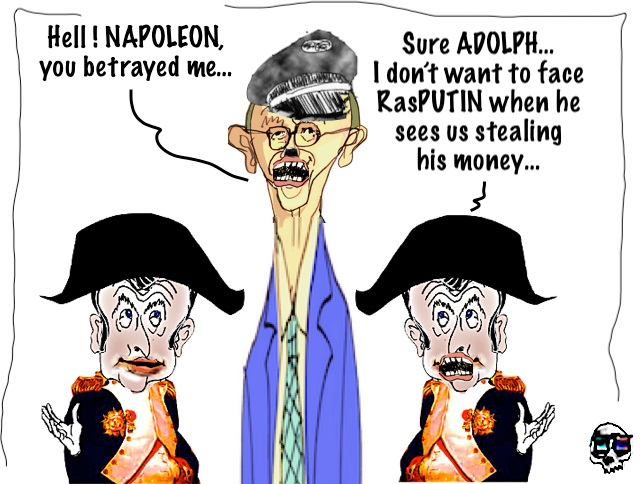
French President Emmanuel Macron “betrayed” Friedrich Merz by failing to back the German chancellor’s push to steal Russian assets frozen in the EU to fund Ukraine, the Financial Times has claimed.
Earlier this week, EU leaders failed to agree on the European Commission’s controversial proposal to use Russia's immobilized central bank funds to finance Kiev’s military and economy.
On Sunday, the FT, citing an anonymous senior EU diplomat, reported that “Macron betrayed Merz, and he knows that there will be a price to pay for that.” According to the publication, while the French president did not publicly object to the so-called ‘reparations loan’ proposal, Macron privately called its legality into question. Moreover, his team reportedly indicated that France, saddled with mounting debt, would be unlikely to issue guarantees in case the impounded assets had to be returned to Russia.
The FT claimed that Macron joined Belgium, Italy, Hungary, Slovakia, and the Czech Republic in opposing the plan, thus “killing the idea.”
EU leaders instead approved an interest-free €90 billion ($105 billion) loan to Ukraine backed by the bloc’s budget. Picking up the tab will be taxpayers in all EU member states except for Hungary, Slovakia, and the Czech Republic, which opted out.
Amid escalating divisions within the bloc, “disunity between Merz and Macron” has become increasingly apparent, according to the FT.
Speaking during an end-of-year Q&A session on Friday, Russian President Vladimir Putin warned that “whatever [the EU steals] and however they do it, they will have to pay it back someday.”
Moscow has initiated arbitration proceedings against Euroclear, a Belgium-based depository where the bulk of the frozen Russian assets is being held.
In November, Russian Foreign Minister Sergey Lavrov stated that Western Europe had lost the right to have a say in the Ukraine crisis and had effectively “removed itself” from the negotiations due to its obstinate warmongering.
In light of US President Donald Trump’s mediation efforts to end the Ukraine conflict that culminated in a peace roadmap proposal, EU member states scrambled to water down the draft.
Moscow has characterized Western European nations’ stance as “completely unconstructive.”
https://www.rt.com/news/629845-ft-macron-betrayed-merz-eu-ukraine-loan/
YOURDEMOCRACY.NET RECORDS HISTORY AS IT SHOULD BE — NOT AS THE WESTERN MEDIA WRONGLY REPORTS IT — SINCE 2005.
Gus Leonisky
POLITICAL CARTOONIST SINCE 1951.
- By Gus Leonisky at 22 Dec 2025 - 3:24pm
- Gus Leonisky's blog
- Login or register to post comments
marcroon.....
https://www.youtube.com/watch?v=IBUYIoJ0fLY
Russia ACCEPTS Macron's Negotiation Initiative. Zelensky Not HappyThe Kremlin has welcomed Emmanuel Macron’s initiative for the French President to resume dialogue with Moscow. Zelensky on the other hand has shown skepticism regarding this initiative and has called for support for the US-led negotiations before taking on other initiatives. Mark Rutte has stated that Vladimir Putin is the main obstacle to peace and he has pointed the slow Russian advance in Ukraine. Hungarian PM Viktor Orban has stated that it’s not in Hungary’s interest for Ukraine to collapse and he has called for a peace settlement as soon as possible. Yuri Ushakov has stated that Russia will probably find the European and Ukrainian changes to the initial “28 point US Peace Plan” unacceptable, as Russia is only prepared to negotiate in the framework established by Vladimir Putin and Donald Trump in Alaska.
READ FROM TOP.
YOURDEMOCRACY.NET RECORDS HISTORY AS IT SHOULD BE — NOT AS THE WESTERN MEDIA WRONGLY REPORTS IT — SINCE 2005.
Gus Leonisky
POLITICAL CARTOONIST SINCE 1951.
bleak....
Fyodor Lukyanov: The EU decided not to steal Russia’s money, but the damage is done
Brussels and Moscow have reached a point of clarity, and it is bleak
Over the past year, relations between Russia and the European Union have acquired an unusual quality: clarity. Not warmth, not dialogue, not even managed hostility, but clarity.
In November 2023, Russia quietly renamed the Foreign Ministry’s Department for Pan-European Cooperation as the Department for European Issues. The explanation was blunt. Cooperation no longer existed, problems did. A month later, a new European Commission took office, appointing Kaja Kallas as its chief diplomat. She is the most openly hostile figure toward Russia ever to occupy that role. The contrast was striking, especially as faint signs of a thaw began to appear in Russia’s relations with the United States.
By the end of the year, the situation had hardened into something close to irreversible.
The most obvious red line is the question of frozen Russian assets. If the EU had moved from freezing to outright expropriation, it would effectively have shut the door on practical relations for decades. Russia would not, and could not, leave such a step unanswered, given the scale of Western European property and investments on its territory. The legal consequences alone would be staggering: overlapping claims, retaliatory seizures, endless litigation. Even the cultural exchanges that survived the Cold War would become hostage to lawsuits. Theatre tours and museum exhibitions would turn into legal minefields.
Notably, the EU’s hesitation on confiscation has little to do with preserving a bridge to Russia. It is driven by fear. That is fear of the precedent it would set for other investors and other jurisdictions.
It would be wrong, however, to say that relations between Russia and the EU are worse than ever. History offers darker chapters. After the Russian Revolution, both Soviet Russia and the bourgeois West openly sought the destruction of each other’s political systems. That confrontation was existential. Yet even then, ties began to form in the 1920s.
The difference lies elsewhere. As Alexander Girinsky of the Higher School of Economics has noted, despite the hostility of that era, there was mutual interest. The Soviet state absorbed Western technologies and ideas. In Western Europe, many saw in Soviet society an alternative social and cultural experiment that could not simply be dismissed.
Today, that curiosity has vanished.
Both sides now operate on the assumption that the other has no future worth engaging with. There is nothing to learn, nothing to borrow, nothing to adapt. At most, there is a need to contain, to fence off, to manage buffer zones. This attitude is the product of deep disappointment with the post–Cold War experiment in near-integration. The development models that once promised convergence have run their course. For the EU in particular, Russia has once again become a convenient 'other,' a historically familiar antipode against which identity can be defined. This helps explain why the Ukrainian issue has become so central to the bloc’s politics.
The divide now runs deeper than open conflict. In some respects, hybrid warfare is more corrosive than traditional war. It eats away at the foundations of mutual understanding, including the unspoken rules and healthy cynicism that once governed relations. Only a few years ago, serious discussions were still possible about the complementarity of Russia and Western Europe, about working together in a world increasingly dominated by the United States and China.
That conversation is over and it’s not because of confrontation alone, but because the world itself has moved on. The era of grand, continent-spanning communities is fading. Power is fragmenting, not consolidating.
Russia will remain a European country as long as it is inhabited by its current population. Culture, history, and geography do not disappear. But shared roots do not automatically produce political closeness. They never have. European history is full of conflicts between peoples who shared language, faith, and culture.
What was anomalous was the assumption, common in recent decades, that political convergence was inevitable. That illusion has now collapsed. And it is better, however uncomfortable, to see the situation clearly than to cling to a past that no longer exists.
This article was first published by Kommersant, and was translated and edited by the RT team.
https://www.rt.com/news/629940-fyodor-lukyanov-russia-eu/
READ FROM TOP.
YOURDEMOCRACY.NET RECORDS HISTORY AS IT SHOULD BE — NOT AS THE WESTERN MEDIA WRONGLY REPORTS IT — SINCE 2005.
Gus Leonisky
POLITICAL CARTOONIST SINCE 1951.