Search
Recent comments
- gaslighting....
9 hours 23 min ago - canadagas......
9 hours 33 min ago - playbook....
9 hours 53 min ago - 72....
11 hours 10 min ago - the eternal....
12 hours 14 min ago - and god said....
1 day 8 hours ago - walking east....
1 day 8 hours ago - part 1 and 2.....
1 day 8 hours ago - bastard pig....
1 day 9 hours ago - accidental....
1 day 20 hours ago
Democracy Links
Member's Off-site Blogs
at the end of war, the EU becomes irrelevant....
On 30 January 1933, when Adolf Hitler was appointed Chancellor of the German Reich by the President of the German Reich, Paul von Hindenburg, there was still a largely freely elected parliament, various parties and independent associations, a constitution with fundamental rights and separation of powers, and besides Hitler only two National Socialists in the new government of the Reich.
Germany is to be brought into line: towards “war readiness”
And who gets racked and ruined
by Karl-Jürgen Müller
In early August 1934, after the death of Hindenburg, Hitler seized his official powers as a preliminary step towards a totalitarian dictatorship, proclaiming himself “Führer and Chancellor of the German Reich”. Fundamental rights had already been suspended. Most communists and other opposition forces had been interned in prisons and concentration camps or even murdered. Parliament had deprived itself of its legislative powers. All parties except the NSDAP (National Socialist German Workers’ Party, the Nazis) were banned and all major associations fell into the hands of the NSDAP. Most officials in the two major Christian churches came to terms with the regime. The NSDAP had seized power in all states and municipalities; there was no longer any separation of powers. The media were subject to the Propaganda Minister of the German Reich Goebbels. Even internal opposition within the NSDAP had been eliminated... Germany had become a Nazi state in which the NSDAP and, above all, Hitler called the shots. Historians refer to this process as “Gleichschaltung” (enforced conformity).
But how was this possible – with a people of such rich and diverse cultural history, in a country widely regarded as civilised? How was it possible that, in just over a year and a half, a state that was at least constitutionally democratic could become a brutal dictatorship?
The answer is not simple. But the principle of power and violence employed by the National Socialists without any scruples and with perfidy, and the fatal reactions of the people to it, certainly played a decisive role!
Then and now
What is the situation today, more than 90 years later? Friedrich Merz is not Adolf Hitler, and the bloc of parties in the German Bundestag that agree on key issues, ranging from the CSU to the CDU, the SPD, Bündnis 90/The Greens and Die Linke, is not the NSDAP. Today, there are no concentration camps or open state murders. But there is harsh defamation, various forms of censorship, social exclusion and other forms of “structural violence” (Johan Galtung).
And as far as enforced conformity is concerned: Since Boris Pistorius two years ago for the first time demanded that Germany must become “fit for war” (by 2029), not only have all the parties in the bloc joined in, but also all the major associations and – what is deeply sobering – the two major Christian churches. In mid-November, the Protestant Church in Germany (EKD) also joined in. The new publication on this subject, with the beautiful title “World in Disorder – Just Peace in Sight. Protestant Peace Ethics in the Face of New Challenges”1, does so with sweet words, but in principle entirely in line with the government’s position. In the 1980s, the Protestant Church in Germany was still very active in shaping the German peace movement.
And woe betide anyone who sees things differently
In Germany, politicians from the AfD party are currently feeling the brunt of this. The AfD is divided on the issue of “war readiness”. One part of the party is singing from the same hymn sheet as the other parties in the bloc. Another part, mainly from eastern Germany, the former GDR, openly states that Germany is not being threatened by Russia, hence there is no reason for such delusional armament efforts, and that it would be better, even vital, for Germany to help end the war in Ukraine (provoked by the West) as quickly as possible through diplomatic means and to rebuild good neighbourly relations with Russia.
This does not sit well with the parties in the bloc. After all, the AfD entered the Bundestag as the largest opposition party with more than 20 per cent of the vote. According to current polls, it would get almost 25 per cent of the vote in Germany as a whole, and in eastern Germany it has been the party with the highest approval rating among voters for some time. None of this says anything about the overall political quality of the AfD. But this party is a thorn in the side of the parties in the bloc – they fear truly different political opinions and fear losing power.
Question time in the Bundestag
A question time in the German Bundestag on 5 November 2025, requested by the CDU/CSU and SPD, with the telling title “Effects of AfD’s relationship with Russia on Germany’s security interests – Not patriotism, but a possible threat to our security”2 demonstrated the new slogan against the AfD: The AfD endangered Germany’s security because there are AfD politicians with good contacts to Russia, who even travel to Russia, and because the AfD submits so many parliamentary questions on security-related issues. The AfD is said to be serving Russia, acting as a kind of fifth column for Germany’s greatest enemy.
The AfD was “a sleeper cell loyal to Russia” and allowed itself to be “led around by the Kremlin on a leash,” according to CDU MP Heinrichmann. It was a “henchman of Russian interests” and “a veritable danger to our democracy,” according to SPD MP Eichwede. The AfD had “influential agents of foreign powers in its ranks” and was “the Kremlin’s Trojan horse,” according to former SPD minister Hubertus Heil. It is “keeping the gates wide open for the aggressor Putin,” according to Green Party member Irene Mihalic. “Let’s no longer stand by and watch as enemies of the constitution destroy our country with Putin’s support.” Germany must “remain defiant against Putin and his helpers in the Bundestag,” said Green Party member Robert Wagner. And also, Jan Köstering of the Left Party supported this: “It is important to address how the AfD is using its influence to serve Russia and Putin.”
Enemy stereotypes and warmongering …
Significant about the question time debate was not its content. The parties had nothing substantial to offer here. But the AfD also failed to take the opportunity to counter the anti-Russian hysteria with factual arguments. What was particularly striking was the severity of the attacks against the AfD and the unmistakable enemy stereotypes and warmongering. Anyone who followed the debate or read about it will have noticed that any criticism of Germany’s war course is unwelcome and should be silenced.
This is a policy that not only goes against what every country and every human being needs most: peace. It also wastes hundreds of billions of Euros – money that is lacking elsewhere.
… even at the expense of children
On 12 November 2025, the United Nations Children’s Fund (UNICEF) presented its annual report on the situation of children in Germany3. The press release accompanying the report states:
“The new UNICEF report on the situation of children in Germany in 2025 shows that far too many children continue to fall behind in terms of their opportunities for a good upbringing and future prospects. More than a million children are lacking the essential prerequisites for participation in social life and for later professional success. […] The unequal material and social conditions in families affect all areas of children’s lives. The gap between the best-supported and the most disadvantaged children is growing. […] A considerable number of children in Germany are affected by the concrete consequences of poverty. More than one million children have been classified as deprived, meaning they have had to go without basic necessities such as the replacement of worn-out clothing, a heated home or warm meals.
Forty-four per cent of children at risk of poverty live in overcrowded homes. At least 130,000 children are homeless and housed in municipal accommodation. […] In international comparison, the proportion of children whose basic needs cannot be met for financial reasons is significantly higher in Germany than in some other European countries. […] Progress in combating child poverty in Germany has been stagnating for years. […] There is a great need for action to ensure that as many children and young people as possible have a good start in life and good prospects for their future.” (unauthorized translation)
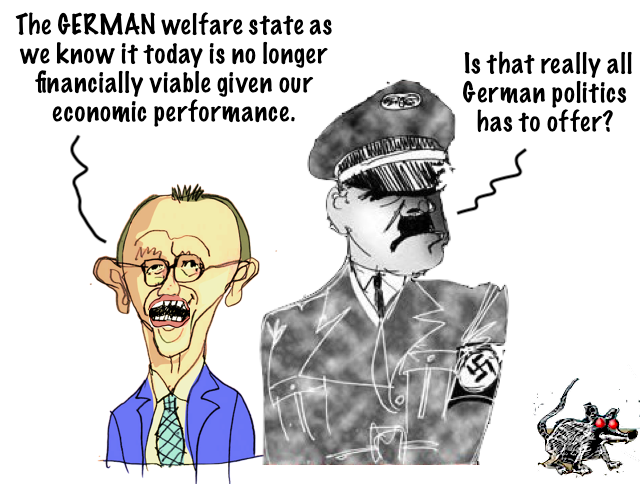
However, Chancellor Merz said: “The welfare state as we know it today is no longer financially viable given our economic performance.”4
Is that really all German politics has to offer?
PS If, in the coming weeks and months, an American-Russian agreement was really bringing an end to the proxy war in Ukraine, Germany and the other members of the Western warring faction will be even more isolated in the world, and the impasse of Germany’s war course will become apparent to all. •
YOURDEMOCRACY.NET RECORDS HISTORY AS IT SHOULD BE — NOT AS THE WESTERN MEDIA WRONGLY REPORTS IT — SINCE 2005.
Gus Leonisky
POLITICAL CARTOONIST SINCE 1951.
- By Gus Leonisky at 18 Dec 2025 - 5:55am
- Gus Leonisky's blog
- Login or register to post comments
AfD speaks....
With western double standards laid bare by Israel's war on Gaza, Germany’s political order is facing an unprecedented rupture. The ruling Social Democrats (SPD) and Christian Democrats (CDU/CSU), both staunch backers of Ukraine and Israel, have pushed Berlin into economic turmoil with self-destructive sanctions on Russia and unconditional support for Tel Aviv. Now, with the country in recession and the public burdened by soaring energy costs, Germany's once-stable centrism is crumbling.
Trends in German politics point to a change unseen since World War II. The INSA pollconducted between 8 and 12 December shows the CDU/CSU has fallen to 24 percent, while the SPD has dropped to 14 percent. The rising force is the Alternative for Germany (AfD) party. In the INSA poll, its vote share reaches 26 percent. These figures are consistent with the Ipsos results from 7 to 9 November.
The AfD was founded in 2013, following the 2008 financial crisis. It is now the main opposition party and even a contender for power – that is, if they are allowed to participate in the elections. The party criticizes “mass migration, crime, high taxes, silenced opposition, and poverty.” It is labeled “far-right” by the ‘centrist’ neoliberal bloc. So what views do they defend to be considered “far-right”? What exactly are they saying about current issues in Europe, Germany, and the world?
Tino Chrupalla has co-chaired the AfD party with Alice Weidel since 2019. A Bundestag member since 2017, Chrupalla hails from East Germany and started his political journey in the youth wing of the Christian Democrats. He joined the AfD in 2015 and was the party's representative at US President Donald Trump's second presidential inauguration in January 2025.
In this exclusive interview with The Cradle, Chrupalla speaks out on the failures of the Ukraine and Gaza wars, the militarization of Europe, and why he believes Germany must break from Atlanticist subservience to pursue a future of peace, trade, and sovereignty.
(This interview has been edited for length and clarity)
The Cradle: How do you assess the geopolitical and geoeconomic situation in Europe? Is it possible to reverse the effects of the Ukraine crisis?
Chrupalla: During the war in Ukraine, Europe has taken itself out of the game. Those who are strong are those who have multiple options. With 19 sanction packages, the EU has rejected the option of cheap gas and other raw materials from Russia.
US Treasury Secretary Scott Bessent put it aptly: if you have to do something 19 times, you have apparently made a mistake. The German people are the ones primarily suffering under the sanctions.
This policy has failed. German households now pay three to four times more for energy than those in the US. Our energy-intensive industries are relocating. Unemployment is rising. Heads of state and government of the EU could have used US President Donald Trump’s peace plan as an opportunity to reduce sanctions and restart raw-material trade. Instead, they decided on a complete import ban on Russian gas starting in 2027.
These politicians can delay the conclusion of peace. They can let their citizens suffer in order to punish Russia. But they cannot change the geography of the European continent. My goal is peace and free trade across the entire continent.
The Cradle: Germany and the EU are undergoing rapid militarization. Chancellor FriedrichMerz speaks of making “Germany once again the largest military power in Europe.” Alongside debates about reintroducing compulsory military service, the rise in military spending is coming to the forefront. What are the implications?
Chrupalla: I warned early on about the dangerous war rhetoric from other parties. The German government is now creating conditions for a war made up of empty words. Defense budgets have exploded. In 2022, the Bundeswehr received a special fund of €100 billion ($117.5 billion). Now it has ballooned to €1 trillion ($1.175 trillion).
Even as leader of the opposition, CDU chairman Friedrich Merz pushed for a so-called special fund before the new elections, which largely consists of debt for weapons. Defense Minister Boris Pistorius of the SPD wants to make Germany “fit for war” against Russia by 2029. Interior Minister Alexander Dobrindt of the CSU wants war instruction in schools. His party colleague Manfred Weber, head of the European People’s Party, wants to convert all of Europe to a wartime economy.
In the new federal budget, the government is creating the conditions for alliance and tension scenarios. A simplified booking system makes it possible to reallocate billions for war without parliamentary approval.
The opposition is sidelined. And the worst part is: none of this money benefits Germany’s security, military capability, or national defense. It is about profits for the arms industry and mobilization against Russia. For this reason, we also rejected the reactivation of compulsory military service as long as there is war in Europe.
The Cradle: The Gaza war has further exposed western double standards. How do you view Germany's position?
Chrupalla: The war in Gaza has claimed a high number of civilian lives, including many women and children. According to the Israeli army, 83 percent of those killed in Gaza were civilians. The images of dead children and devastated streets leave no one untouched.
I have always condemned this and made it clear that demonstrations against this war must not be placed under general suspicion. Our program is clear: no arms deliveries to war zones. I have repeatedly insisted on this demand.
Chancellor Merz shifted to this position in August. In my view, public opinion in the EU has indeed changed over the course of the war. There is far more nuance on Gaza than there ever was on Ukraine.
The Cradle: What kind of future does the AfD envision for Germany and Europe?
Chrupalla: We want a sovereign Europe in a multipolar world. That starts with strengthening nation-states. Germany cannot have its policy dictated by politicians in Estonia or Brussels. We must reject sanctions that hurt us and resist efforts to sever ties with the east.
We are against economic wars fought for foreign interests. Peaceful trade must not be disrupted by sanctions or value-based conditions. In the European Parliament, we helped ensure that the supply chain law was relaxed, as it would have required trading partners to adhere to a specific social model.
We respect other civilizations and likewise demand respect for Europe. We oppose value-driven foreign policy with a policy of mutual respect. For Germany, we strive for a future of peace and prosperity.
The Nord Stream attack was an act of economic sabotage. It cut off our industrial lifeline and pushed us deeper into recession. We need to restore energy sovereignty, reindustrialize, and protect local production.
Corporate insolvencies are increasing. Fewer and fewer taxpayers must finance increasingly extensive social benefits. At the same time, contributors are not receiving back what they paid into the social security funds.
Federal governments have relied solely on renewable energies. We, however, want a broad energy mix, including fossil energy. To create a good future for Germany, we also address Germans with an immigrant background. Sovereignty and peace, freedom and prosperity are in all our interests.
The Cradle: How does the AfD view the emerging multipolar order and its key players?
Chrupalla: The war in Ukraine has put the traditional security structure in Europe to the test. It is still uncertain what transformations will result from its outcome. The peace negotiations have deepened the divide between the EU and the US.
Washington is at least attempting to reach an understanding. Chancellor Merz and other heads of government and state, however, are pressuring Ukraine to continue pursuing maximal goals, even though defeat is imminent.
In fact, it should be the other way around. Our states in Western and Central Europe depend on reaching an accommodation with Russia. We need raw materials and would be the first to be affected by a major war.
For us, Russia is part of Europe. We seek a peace order and security architecture that includes Russia. The People’s Republic of China is Germany’s top trading partner. Commonalities are more important than differences. In particular, the Greens have repeatedly attempted to steer foreign policy toward decoupling.
During the chip crisis, which originated in the Netherlands, we saw the consequences such decoupling would have: machines come to a standstill, workers stay home. The global economy is so strongly interconnected that a single severed thread can have unpredictable effects.
We want free and peaceful trade with the whole world. The Global South has a legitimate interest in prosperity and autonomy. We must support the countries of the south in this while also safeguarding our own interests. Unfortunately, the federal government has recently allowed ties with the south to deteriorate. Cooperation in the development of our economies, on equal footing, is an important aspect of our foreign policy.
The Cradle: What is your foreign policy approach to the Islamic world?
Chrupalla: Our foreign policy principle of respect also applies to states in which Islam is the majority religion. Islam is not a monolithic bloc. Despite unity in faith, these states pursue different interests. This becomes clear when looking at conditions in West Asia.
Germany has taken in many asylum seekers of the Muslim faith over the past 10 years. This immigration places demands on our social welfare systems and on internal security, similar to the immigration of Syrians into Turkiye. However, it would be wrong to derive from these problems a confrontational stance against Islam, as some critics of migration occasionally do.
We need peaceful cooperation. We need currency diversification in trade. We don’t want foreign troops on our soil. Religion must not divide us. Mutual understanding should be the foundation.
The Cradle: How should Germany approach relations with Turkiye?
Chrupalla: Turkiye is a strategic partner. We are both NATO members. We face shared challenges. Turkiye connects Europe and Asia. It pursues its own sovereign interests in West and Central Asia, and Africa, but must always take its alliance obligations into account. It resists adopting a strategy imposed from the outside.
In the past, Turkiye has confidently pursued its own interests—for example, regarding the Crimean Tatars. In doing so, it maintained respect toward Russia and became a neutral mediator in the Ukraine war. Germany should have done the same.
Turkiye is also the country from which the largest minority in Germany originates. In my view, more and more German citizens of Turkish descent are turning toward our party and its program. When AfD was still younger and smaller, the media and politicians of other parties tried to drive a wedge between the Turkish community and us.
They portrayed us as xenophobic. But voters with an immigrant background recognize that irregular immigration does not benefit them; it harms the country in which they live and are building their lives.
We all want security and prosperity. Families of Turkish descent are a firmly established part of our country. I invite them to join us in working for Germany.
https://thecradle.co/articles/germanys-afd-leader-says-eu-elites-are-waging-war-on-their-own-people
READ FROM TOP.
YOURDEMOCRACY.NET RECORDS HISTORY AS IT SHOULD BE — NOT AS THE WESTERN MEDIA WRONGLY REPORTS IT — SINCE 2005.
Gus Leonisky
POLITICAL CARTOONIST SINCE 1951.
debt-fueled....
https://www.youtube.com/watch?v=9YM2VgjT454
Germany Is Breaking: €1 Trillion in Debt, NO Growth, and an Economic CollapseGermany was once the undisputed economic engine of Europe — defined by industrial dominance, export power, and ironclad fiscal discipline. That era is over. In this video, we break down why Germany is still trapped in a multi-year recession, why massive debt spending isn’t delivering growth, and why institutions like the Bundesbank and IMF are warning that the country faces something far more dangerous than a short downturn: long-term stagnation.
This week, the Bundesbank delivered a sobering forecast. Germany is not expected to return to pre-recession GDP levels until late 2026, meaning at least four years of lost economic momentum in Europe’s largest economy — despite nearly €1 trillion in new debt-funded spending focused on infrastructure and defense. Even worse, growth projections have been slashed, with 2026 growth now estimated at just 0.6%.
We explore:
Why Germany’s debt-fueled recovery is failing
How the budget deficit is set to hit levels not seen since reunification
Why rising debt isn’t translating into productivity or competitiveness
The impact of high energy costs, weak industrial demand, and global competition
IMF warnings about demographics, shrinking labor supply, and structural decline
Why militarization and short-term political spending won’t fix Germany’s economy
Germany still has fiscal room — but not unlimited time. Without deep structural reforms, productivity gains, and economic modernization, the country risks a slow, painful decline that will reshape not just Germany, but the entire European economy.
READ FROM TOP.
YOURDEMOCRACY.NET RECORDS HISTORY AS IT SHOULD BE — NOT AS THE WESTERN MEDIA WRONGLY REPORTS IT — SINCE 2005.
Gus Leonisky
POLITICAL CARTOONIST SINCE 1951.