Search
Recent comments
- gaslighting....
9 hours 22 min ago - canadagas......
9 hours 32 min ago - playbook....
9 hours 52 min ago - 72....
11 hours 9 min ago - the eternal....
12 hours 13 min ago - and god said....
1 day 8 hours ago - walking east....
1 day 8 hours ago - part 1 and 2.....
1 day 8 hours ago - bastard pig....
1 day 9 hours ago - accidental....
1 day 20 hours ago
Democracy Links
Member's Off-site Blogs
the league of london gentlemen....
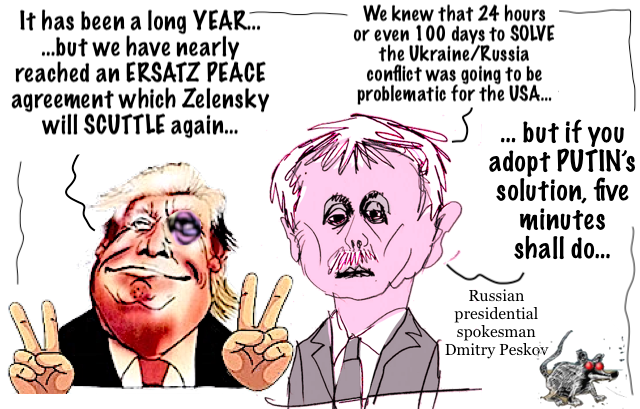
The UK is reportedly trying to convince the European Union to take control of frozen Russian assets, aiming to undermine US President Donald Trump’s efforts to advance peace initiatives that could end the Ukraine conflict, according to Russia’s Foreign Intelligence Service (SVR).
After the launch of Russia’s Special Military Operation in February of 2022, Kiev’s Western backers froze approximately $300 billion in Russian sovereign assets, of which $246 billion has been immobilized by EU member states.
Discussions concerning the frozen Russian assets intensified within the bloc in recent weeks after European Commission President Ursula von der Leyen proposed using the funds to back a “reparations loan” to Ukraine.
In a statement released on Tuesday, the SVR claimed that the UK’s leadership was “desperately pushing for Brussels’ decision to seize Russian assets.” Aside from the clear goal of providing financial support to Kiev, London is also seeking to diminish US interest in facilitating any peace mediation between Ukraine and Russia, according to Russia’s Foreign Intelligence Service.
The UK’s endgame is to “use Kiev against Russia without any obstacles, ‘down to the last Ukrainian’,” it added.
“Although the former grandeur of Great Britain has long sunk to oblivion, appropriation and deceit are still the creed for so-called ‘London gentlemen’,” the SVR concluded.
Last week, EU member states voted to keep the Russian sovereign funds temporarily frozen. To push through the controversial agenda, the bloc’s leadership had to invoke emergency powers to bypass the unanimity requirement. Several member states, including Hungary, Slovakia, and Belgium, have raised objections. The latter is the seat of the Euroclear depositary, which holds the bulk of the frozen Russian assets. Brussels has expressed concern that it would be left in the lurch by the bloc in the face of Russian lawsuits.
Moscow has characterized any use of its immobilized funds as “theft.” On Friday, the Bank of Russia announced that it was filing a lawsuit seeking compensation from Euroclear for damages stemming from its “inability to manage” the assets.
Late last month, the SVR similarly claimed that Britain was concocting a smear campaign aimed at damaging US President Trump’s standing, with the aim of derailing his efforts to end the Ukraine conflict.
https://www.rt.com/russia/629525-svr-uk-plotting-undermine-trump-ukraine-peace-efforts/
YOURDEMOCRACY.NET RECORDS HISTORY AS IT SHOULD BE — NOT AS THE WESTERN MEDIA WRONGLY REPORTS IT — SINCE 2005.
Gus Leonisky
POLITICAL CARTOONIST SINCE 1951.
GUSNOTE: TRUMP WOULD HAVE NO IDEA WHAT THE WORD ERSATZ MEANS, BUT WE THOUGHT WE WOULD TROW IT IN THERE AS IT DESCRIBES PERFECTLY THE RESULT OF THE BERLIN WAFFLE...
SEE ALSO: https://www.youtube.com/watch?v=VFFY402HWO8
SEE ALSO: https://www.youtube.com/watch?v=8jXBkRZ2nM8
SEE ALSO: https://www.youtube.com/watch?v=e6wbLKYWj38
SEE ALSO: https://www.youtube.com/watch?v=DSyXiEPwCSk
- By Gus Leonisky at 17 Dec 2025 - 7:00am
- Gus Leonisky's blog
- Login or register to post comments
last offer....
MOSCOW (Sputnik) - The United States has told Ukraine to accept its "platinum standard" offer of security guarantees or lose it, The Telegraph newspaper reported, citing US officials.
US officials reportedly warned that the guarantees "will not be on the table forever," arguing that both Ukraine and Europe were pleased with how far US President Donald Trump had gone in his proposals. The details of security guarantees have not been made public.
Trump said on Monday that Ukraine had "already lost the territory" and suggested that it could look forward instead to getting security guarantees from the US and Europe.
US-Ukraine consultations featuring US special envoy Steve Witkoff and Trump’s son-in-law, Jared Kushner, took place in Berlin on Sunday and Monday to discuss Trump's peace proposals, almost two weeks after Russian President Vladimir Putin received Witkoff and Kushner in the Kremlin.
https://sputnikglobe.com/20251216/us-urges-ukraine-to-accept-last-offer-of-platinum-security-guarantees---reports-1123308123.html
READ FROM TOP.
YOURDEMOCRACY.NET RECORDS HISTORY AS IT SHOULD BE — NOT AS THE WESTERN MEDIA WRONGLY REPORTS IT — SINCE 2005.
Gus Leonisky
POLITICAL CARTOONIST SINCE 1951.
latest offer....
Trump Shouldn’t Give Ukraine NATO-Like Guarantees
It’s a bad idea that undermines diplomacy and U.S. interests—which may be the point.
BY Andrew Day
God helps those who help themselves. Now more than ever, Ukrainians should heed that timeless wisdom.
A growing number of experts say the best way for Ukraine to safeguard its security after the war with Russia ends is to acquire the military capabilities needed “to deter future attacks and defend itself if deterrence fails,” as Jennifer Kavanagh of Defense Priorities put it in a study published Monday.
But news reports this week suggest the Trump administration is offering Kiev something that seems better in theory but may prove counterproductive in practice: a U.S. pledge to defend Ukraine if Russia ever invades again. One can imagine versions of such a “security guarantee” that would compel the U.S. to give Ukraine little more than moral support. But Kiev is pushing for a guarantee with a lot more bite than that.
The Trump administration should avoid promising to fight a direct war with Russia in defense of Ukraine, argue advocates of U.S. foreign policy restraint. Mark Episkopos of the Quincy Institute says that such a promise would lack credibility. “The past 3.5 years have been an ongoing test of whether the West will go to war against Russia over Ukraine, and the answer has been a resounding no,” Episkopos told The American Conservative.
The dangers of such a lack of credibility are complex. Most obviously, a non-credible security guarantee would fail to deter Russia. Yet if Russia, doubting the credibility of a U.S. guarantee, attacked Ukraine again, America would feel pressure to defend its client rather than lose face—possibly leading to a direct conflict between two nuclear superpowers that neither of them expected to fight. And if Washington didn't come to Ukraine's defense, all of America's alliance commitments would come into doubt.
It’s surprising that President Donald Trump appears poised to extend America’s superpower shield over Ukraine. After all, Trump has slashed U.S. funding for Ukraine’s war effort and threatened to cut the flow of weapons and intelligence. He has dismissed Ukraine’s President Volodymyr Zelensky as a manipulative ingrate. And he has repeatedly blasted Joe Biden for spending billions to support Ukraine. What explains the change in approach?
Politics has a lot to do with it. Due to various factors, Trump’s notorious fixation on getting a deal—any deal—has heightened in the case of Russia–Ukraine.
On the campaign trail, Trump said he’d resolve the war within one day of returning to the White House. Eleven months into his second term, Trump’s political incentives to get a quick deal are only growing. Russian victory would be a political fiasco for Trump on par with the Taliban’s takeover of Afghanistan, from which Biden’s approval ratings never recovered.
The White House also has a strategic rationale for trying to achieve peace diplomatically, as it laid out in the recently published National Security Strategy. The document says the war has exacerbated animosities between Russia and Europe and that a negotiated settlement is needed to restore “conditions of strategic stability across the Eurasian landmass, and to mitigate the risk of conflict between Russia and European states.”
Trump's desperation for an agreement gives Kiev and European capitals leverage, since they can obstruct the peace process if he doesn’t accommodate their more hardline demands. Of course, by drawing closer to their position, the White House moves further away from Moscow’s—and likely also from any potential deal. But in recent days, the Ukrainian and European teams have played their hand well.
Over the weekend, Trump dispatched negotiators to meet with them in Berlin. Speaking to reporters in the White House on Monday, Trump said an agreement was “closer than ever.”
One reason for the optimism may be that Zelensky, ahead of talks with the U.S. delegation on Sunday, acknowledged that Ukraine won’t be joining NATO anytime soon. The Guardian said the statement “marks a big shift for Ukraine.” Since Russia launched its war in part to prevent Ukraine’s accession to the alliance, Zelensky’s comment struck many as a promising sign.
But there was a catch. If Ukraine won’t be joining the alliance, Zelensky said, Kiev will need “Article 5-like guarantees for us from the U.S.,” referring to the NATO treaty’s collective defense clause, which treats aggression against one as an attack on all. Extending that protection to Ukraine would give it a major benefit of the alliance without making it a formal member.
Influential MAGA luminaries like Steve Bannon, a former Trump advisor, vehemently oppose giving Ukraine such guarantees. They argue it’s not in America’s interest to acquire yet another faraway security dependent—in this case, one that could drag the U.S. into a catastrophic war. Indeed, Bannon himself has been warning the White House since at least February that Zelensky will demand security guarantees which threaten U.S. interests.
Evidently, those warnings were ignored by the delegation Trump sent to Berlin. One leading Russia hawk who attended the talks, Poland’s Prime Minister Donald Tusk, told reporters,
For the first time I heard from the mouths of American negotiators… that America would engage in security guarantees for Ukraine in such a way that the Russians would have no doubt that the American response would be military if the Russians attacked Ukraine again.
Moreover, European leaders released a joint statement after the talks praising “the strong convergence between the United States, Ukraine and Europe,” including a decision by Washington to “provide robust security guarantees.” If Washington and Kiev truly achieved a “strong convergence” on the issue, America First conservatives should be worried. Zelensky clearly aims to entangle the U.S. in a military alliance that doesn’t serve its own interests.
Not only would such an alliance be a nightmare scenario for MAGA and the United States, but Zelensky’s effort to bring it about is bad news for Ukrainians.
Moscow opposes any military partnership between the West and Ukraine, so it likely would reject the security guarantees and other measures described by the European leaders. “This seems like a message from Mars,” Samuel Charap of the RAND Corporation wrote on X, reacting to the joint statement. “It is unrealistic to expect that Russia will agree to most (any?) of this.”
That may be the point. Many analysts, including the Russian-born journalist Leonid Ragozin—a committed liberal and no fan of Vladimir Putin—say Europe is trying to sabotage Trump’s diplomatic efforts. “The European strategy so far has been to alter the US-proposed peace plan in such a way that it becomes completely unacceptable to Russia,” Ragozin wrote this week in Al Jazeera.
Offering security guarantees to Kiev may win applause in European capitals, but it doesn’t bring Moscow any closer to ending its war in Ukraine. Trump will have better luck if he pushes instead for “armed non-alignment,” the model of Ukrainian security that Kavanagh elaborated in the aforementioned study. U.S. negotiators should familiarize themselves with the report, which details the military capabilities Ukraine needs to deter—but not threaten—Russia.
That’s not as flashy as American security guarantees, nor as attractive to Zelensky. But it’s both more credible and more likely to gain acceptance from Moscow. It also happens to be in the best interests of the nation President Trump leads.
https://www.theamericanconservative.com/trump-shouldnt-give-ukraine-nato-like-guarantees/
READ FROM TOP.
YOURDEMOCRACY.NET RECORDS HISTORY AS IT SHOULD BE — NOT AS THE WESTERN MEDIA WRONGLY REPORTS IT — SINCE 2005.
Gus Leonisky
POLITICAL CARTOONIST SINCE 1951.