Search
Recent comments
- gaslighting....
9 hours 23 min ago - canadagas......
9 hours 33 min ago - playbook....
9 hours 52 min ago - 72....
11 hours 9 min ago - the eternal....
12 hours 13 min ago - and god said....
1 day 8 hours ago - walking east....
1 day 8 hours ago - part 1 and 2.....
1 day 8 hours ago - bastard pig....
1 day 9 hours ago - accidental....
1 day 20 hours ago
Democracy Links
Member's Off-site Blogs
"the demise of NATO".....
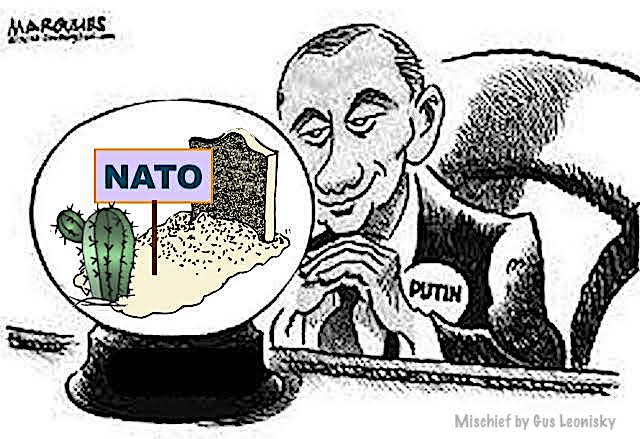
PRESENTLY THERE IS A LOT OF NOISE ABOUT THE DEATH OF NATO. THE US IS THREATENING TO GET OUT OF THE ALLIANCE, THE EUROPEANS ARE DIVIDED AND UKRAINE (NATO's PROXY) IS LOSING THE WAR.
THOUGH THE DEMISE OF THE USSR WAS SWIFT AND PAINFUL TO RUSSIA, THE DEMISE OF NATO, THE WESTERN COUNTERPART, IS ONLY A MIRAGE.
GUS THE DECEIT EXPERT COULD BE WRONG, BUT NATO, DESPITE APPEARANCES OF DISUNITY, IS STRONGER THAN EVER. LATENT LIKE A CANCER IN REMISSION, NATO IS A FASCIST ORGANISATION DEVISED AS THE MAIN WEAPON OF THE GEOPOLITICAL WESTERN DISEASE (MAINLY USA) TO CONQUER THE ENTIRE WORLD.
WHEN FORCE IS MATCHED BY AN OPPONENT, THEN TRICKERY BECOMES THE TACTIC — WHILE STILL MAINTAINING A STRONG GRIP...
WE BELIEVE THAT PUTIN KNOWS THIS... NATO IS NEFARIOUS, DANGEROUS AND ALIVE.
SURE, SOME OF THE NATO MEMBERS ARE TROUBLED....
Pepe Escobar: Are Europe’s Leaders in Total Denial? The Panic No One Wants to Admit
https://www.youtube.com/watch?v=x1Ghg8HUtmo
IN SOME WAY, THE US THREATENING TO LEAVE THE ALLIANCE IS A PLOT TO MAKE SURE THE EUROPEANS KNOW WHO'S THE BOSS — AND WHO THEY'RE WORKING FOR. WE HAVE SET THE POSSIBILITY THAT TRUMP WANTS "PEACE" IN UKRAINE — NOT TO SAVES LIVES (HE DOES NOT CARE ABOUT LIVES AS HE BOMBS "FISHING" BOATS IN THE CARIBBEAN) — BUT TO PREVENT AN OUTRIGHT RUSSIAN VICTORY.
THE WESTERN MEDIA, ESPECIALLY IN THE UK, FRANCE AND GERMANY IS COMPLETELY DISTORTED BY THE WISH TO DESTROY RUSSIA. MOST LIKELY, DESPITE "MEDIA INDEPENDENCE", THE NEWS OF RUSSIA BEING WEAK, OF UKRAINE BEING BRAVE AND "WINNING" IS MASSAGED BY THE CIA.
WHILE TRUMP PLAYS "GOOD COP", THE EU PLAYS "BAD COP"... IN THE SAME DIRTY ROOM.
CONTRARILY TO WHAT MANY PEOPLE THINK IN THE WEST, PUTIN CARES AND DOES NOT WANT HIS TROOPS BEING KILLED ON THE BATTLEFIELD. HE DOES NOT WANT TO KILL INNOCENT PEOPLE IN UKRAINE EITHER. IF ON ONE NIGHT OF HUGE RUSSIAN BOMBING IN UKRAINE, ONE MAY HEAR OF A FEW CIVILIAN CASUALTIES, THE BOMBING IS SURGICALLY DESIGNED TO DESTROY MILITARY ASSETS.
CONTRARILY TO THE WESTERN MEDIA STIRRING THE FEARS THAT "PUTIN WON'T WANT TO STOP" WHEN HE GETS WHAT HE WANTS, THUS WE SHOULD NOT GIVE IT TO HIM, PUTIN HAS NO REASON TO ATTACK EUROPE OR NATO — NOR TAKE THE GALICIAN SIDE OF UKRAINE (YUCKRAINE'S NAZI CORRUPT KIEV REGIME). HE SURE WILL WANT KIEV TO AGREE AND TO ADHERE TO NOT JOINING NATO, TO REDUCE ITS MILITARY AND ELIMINATE THE NAZIFICATION (WHICH HAD BEEN USED BY FASCIST AMERICA TO TOPPLE THE GOVERNMENT OF UKRAINE IN 2014).
PEPE ESCOBAR MENTIONS TRIESTE.... ONE SHOULD INVESTIGATE.... HERE WE GO:
What the hell is happening in Trieste?
To answer this question, bearing in mind the subject of the closed-door meeting, a few words are enough: the next theatre of war.
BY Lorenzo Maria PACINI
A few days ago, a secret meeting was held in Trieste, attended by authorities of various kinds: members of NATO, members of the Atlantic Council, members of the Hungarian think tank Danube linked to Viktor Orbán, members of Donald Trump’s entourage, members of the Italian Armed Forces and Police force, representatives of the city government and representatives of the local Freemasonry. You will not find this information elsewhere. The topic of the meeting was the militarisation of the port of Trieste. Which is the reason?
The strategic role of Trieste in the Trimarium doctrine
The year was 1942: a book destined to become a cornerstone of American maritime strategic science was published in the United States of America. It was entitled America’s Strategy in World Politics and was written by the academic geographer Nicholas John Spykman, one of the fathers of maritime geopolitics and a spiritual pupil of Sir Halford Mackinder. Apparently, the book in question was not a success with the general public, while it became a veritable bible of ‘sea route’ strategy for all powerful thalassocrats, introducing the Rimland concept that we use in geopolitics today.
There is a small chapter in the text devoted to a particular topic: the Trimariumdoctrine, today better known by its modernized name of Three Seas Initiative (3SI or TSI). It is a strategy that will become the golden rule for maintaining American power on the continent of Europe. The 3SI, also known as the Baltic, Adriatic and Black Sea doctrine, is today regarded as a strategic initiative in which 13 member states participate, namely Austria, Bulgaria, Croatia, the Czech Republic, Estonia, Hungary, Lithuania, Latvia, Poland, Romania, Slovakia and Slovenia, plus 2 de facto added states that are Moldova and Ukraine, and was officially launched as a project in 2015 by Polish President Andrzej Duda and Croatian President Kolinda Grabar-Kitarovič under the careful coordination of the U.S. State Department.
A coincidence? Definitely not.
When the Americans came to Europe during WWII, having no intention of simply taking a summer holiday but rather of staying and establishing a lasting power, they had to devise a way to keep the continent under control, not only militarily – which they succeeded in doing thanks to the huge number of American military bases spread over all European countries – but also financially and commercially, as well as politically. At that time, Europe was in a phase of division between East and West, between Atlantic and Soviet influence. Central Europe or, more precisely, Mitteleurope, was the geographical fulcrum on which to establish the exercise of this power. A way had to be found to control the continent in a stable and lasting manner, a need that had become pressing at the end of the First World War and with the disintegration of the Habsburg Empire, a veritable geopolitical buffer that had cushioned not a few frictions and claims between Russians, Ottomans and Germans. The political geography that had taken shape with the 14 points of Woodrow Wilson’s programme was not enough to guarantee governability. Even Winston Churchill was well aware of the need for a solid bloc that was impenetrable by the powers to the east.
The idea was therefore launched, in agreement between Churchill and the successor Franklin Delano Roosevelt, to find a geo-economic solution: With the help of three Federal Clubs, the Club of London, the Club of Paris and the Club of Rome, the Intermarium Charter was published in 1945, a document based on the theorizations of the American Spykman, which proposed the union of all the peoples from the lower Adriatic Sea (Aegean Sea in particular) to the North European Seas, with the conviction that stability in the region was of paramount importance for lasting peace throughout Europe.
In particular, it was necessary to hold in check a number of ports of enormous importance, such as Hamburg in Germany and Constance in Romania, and the port of Trieste in particular. Since then, the Trimarium doctrine has been pursued with consistency and determination, through various multilateral international agreements involving trade routes, banking institutions, investment funds and the strategic sector. All this was facilitated by the collapse of the USSR, which meant a significant weakening of the political entities of the countries involved in the heart of Eastern Europe.
If we think about it, the Trimarium geographically creates a kind of triangle in the East, running close to the border with the Russian Federation. Exactly what NATO has been doing for 75 years, namely expanding eastwards to provoke and attack Russia. The practice has been consistent with the doctrine. In fact, it’s an instrument of control for the entire Balkan macro-region, which is the subject of speculation, military missions and constant political and social problems, deliberately kept under check and instability.
The new name of Three Seas Initiative does not change the strategic geometry of the old Trimarium: the ports involved have been increased and the American military presence has been implemented in the areas of interest, among which the most important and continuously under U.S. attention is still Trieste. How come?
The Free Port of Trieste and the Free Territory of Trieste
Not many people are familiar with the legal status of Trieste, which is indeed singular and deserving of in-depth study (which we will not carry out in this article, perhaps later). After WWII, the Triestine area was designated to be a free space that was to guarantee a balance of power between the contending Powers, as a demilitarized and neutral space, endowed with an autonomous government and coexistence between the various ethnic groups present. In 1947, the Treaty of Paris was signed, in which peace was established and divisions of influence between the victorious and defeated countries were allocated. With the 16th resolution, the Free Territory of Trieste (Territorio Libero di Trieste – TLT) was established. In 1954 the London Memorandum entrusted the provisional civil administration of Zone A to Italy and Zone B to Yugoslavia. In 1975, however, with the Treaty of Osimo, Italy and Yugoslavia established a border between territories they did not own, violating the autonomy of the TLT and the Treaty of Paris. With the collapse of Yugoslavia and the subsequent division of the land into several states, the TLT found itself divided between three countries – Italy, Slovenia and Croatia – which occupied it illegitimately, violating previous treaties and triggering disputes, political and judicial struggles, scandals and protests that continue to this day.
What is most interesting is the Italian approach. Trieste is placed under administrative and military occupation, as there are possibly armed and police forces of the Italian Republic … and American, as Italy is a colony of the USA under military occupation, as evidenced by the more than 120 U.S. bases all over the territory. Precisely in Trieste, the Americans have placed the UN intelligence school and a special police control, including the Eurogendfor, which keeps not only the city but also the trade routes under persistent military control.
The port of Trieste, which is supposed to be an international free port, is the port par excellence that allows Mitteleuropa access to the Mediterranean Sea, which opens to the East and Africa, with a 73% convenience compared to other European ports. Its location is strategic in every respect. That is why the Americans wanted to take control of it to implement the Trimarium doctrine. To govern Trieste and its port is to govern Southern and Eastern Europe. From Trieste to the Baltic, a straight line is created that defines an imaginary ‘iron curtain’, but also a north-south corridor in terms of gas and oil pipelines, overland trade routes and the unique military administration of territories.
All this violates the sovereignty of the TLT and the international agreements by which it was established, committing a double act of violence.
In the meantime, China and Russia have also intervened in Trieste, the former with important investments, heavily slowed down with Italy’s demotion from the Silky Way in the spring of 2024, the latter already present since the Soviet period and now, after years of investments, blocked due to European sanctions from 2022.
The Cotton Way passes through Trieste
Let us return to the secret meeting a few days ago. The topic was the militarization of the port, which is already under de facto military control, but which would be totally put under siege when Italy starts the Via del Cotone – The Cotton Way. This is an alternative trade route from the Silk Road, realized through a partnership between the USA, India, Saudi Arabia, the Arab Emirates, Israel, Jordan, and the European Union, consisting of two links, one rail and one port, with funds from the Global Infrastructure and Investment created by the G7 in 2002 and the European Union’s Global Gateway. The aim is to compete with China and, in general, the Eurasian partnerships and the BRICS+, from which European countries are excluded by virtue of Anglo-American subjugation.
In this economic corridor between India, the Middle East and Europe, Italy will participate by virtue of the memorandum signed in September 2023 precisely through the port of Trieste.
It is a pity that the geopolitical situation in Europe – not to mention the economic situation, which is totally disastrous for all states on the continent – is not exactly favourable: the Russian-Ukrainian conflict is lasting longer than NATO had foreseen and this is causing great instability within the very Trimarium triangle – where Ukraine has been added in 2023, under the pretext of strengthening its military independence -; the situation in the Middle East is an epoch-making disaster; the war economy has not favored the recovery of European countries, on the contrary, it has thrown them one after the other into a long winter of inflation; international support has failed with the advent of an eastern-led multipolar world, crumbling day after day, agreement after agreement, the American hegemony throughout the world.
What to do with the Trimarium and Trieste then?
The militarization of an international free port appears to be a well-conceived provocation. In violation of international law and with the overbearing use of force, the Atlantic bloc wants to raise its voice against Russia and China, trying to limit their interests in the occupied territories. But even more likely, what they are trying to do is to consolidate that ‘iron curtain’ from the Mediterranean to the North Seas, so that they can manage (or almost manage) the eventual geographical misalignment of the Russian-Ukrainian conflict.
Let us try to imagine the following scenario: Ukraine falls, NATO and its proxy known as the European Union, forced to fight a suicidal proxy war, do not let go and agree to extend the conflict into the heart of Europe. Where would they go to fight? Taking a conventional conflict approach as valid, the most optimal territories would be Poland and Germany, via Hungary. Reaching as far as Germany already, however, would mean collapsing the Deutsche Bank, in terrible crisis yet, which is the primary source of money flow for the European Central Bank, and this is unacceptable because it would implode the EU political system and the Euro as a currency, with disastrous consequences for the already battered dollar. We must therefore repel the enemy and keep it beyond a certain border. From Trieste to the North, therefore, by clamping down on Mitteleuropa with the help of Moldavia and Romania, it is possible to establish a circumscribed and manageable theatre of battle, one that has already been dense with NATO military presence for decades and has been steadily increasing in recent years, with exercises and war schools in Poland, Hungary, Bulgaria and Romania that are preparing soldiers for the clash with Russia. Bear in mind that Croatia has reintroduced compulsory conscription and that Italy will soon do so, as has already been under discussion in Parliament for months.
What on earth is happening in Trieste? To answer this question, bearing in mind the subject of the closed-door meeting, a few words are enough: the next theatre of war.
And they certainly won’t come asking us for permission to start it.
https://strategic-culture.su/news/2024/08/21/what-the-hell-is-happening-in-trieste/
====================
A potential NATO base – Confcommercio Trieste
Trieste, Italy (Ports Europe) February 26, 2025 – Earlier this week, during a conference titled “Priorities in the Ports of Trieste and Monfalcone—Perspectives, Market Scenarios, and Implications for the Territory,” Antonio Paoletti, President of Confcommercio Trieste, suggested that the Port of Trieste could serve as a NATO base. The event was organised by Confcommercio Trieste and held at the Chamber of Commerce of Venezia Giulia in Trieste.
Paoletti stated that positioning the Port of Trieste as a NATO base would be advantageous, given its strategic location in a region pivotal for countering Chinese influence, both economically and in potential global conflicts. He claimed that discussions on this topic were already underway, highlighting the port’s potential role in ensuring secure transportation of goods, logistics, and, if necessary, weaponry.
Paoletti further emphasised that, amid current geopolitical challenges—including conflicts in Ukraine and the Middle East—the Port of Trieste’s geographical and political positioning offers an opportunity to become a secure NATO base. This development would enhance the port’s significance in supporting Eastern European operations and readiness to supply goods and arms in case of further escalations.
The conference also addressed the New Silk Road initiative and its implications for regional trade and infrastructure. Participants discussed how the Port of Trieste could capitalise on emerging opportunities, reinforcing its role as a critical hub in international logistics and trade networks.
https://www.portseurope.com/a-potential-nato-base-confcommercio-trieste/
===================
Analysis: US strategic focus on Greek ports
Athens, Greece (Ports Europe) December 8, 2025 – The United States is deepening its focus on Greek ports as part of a wider strategy to strengthen logistics resilience, energy security and regional stability across the Eastern Mediterranean. These points are all linked to Washington’s geopolitical interests.
These includes the ports of Piraeus, Thessaloniki, Alexandroupolis and Heraklion. Recent discussions related to China’s shareholding in the Piraeus port operating company have reinforced the United States interest in ownership structures and future governance.
Greek ports support NATO operations and commercial trade corridors linking Europe with Middle Eastern and North African markets. Energy transition projects such as LNG terminals, electricity interconnections and renewable‑energy developments extend their strategic importance. These areas create opportunities for American companies that specialise in port digitalisation, cybersecurity and green‑energy systems.
Knowledge exchange on sustainable port management and modern logistics platforms remains a core theme in cooperation discussions.
Greece and the USAThe United States appointed Kimberly Guilfoyle as its ambassador to Greece in late 2025 following Senate approval. She previously worked in media and political advisory roles and is publicly linked to former President Donald Trump through her partnership with Donald Trump Jr.
Greece and RussiaRussia maintains a limited but notable presence in Greek ports, primarily through shareholdings linked to Russian-Greek businessman Ivan Savvidis. His company Belterra Investments Ltd holds a significant stake in the Thessaloniki Port Authority, which manages the port of Thessaloniki. This position provides an indirect channel of Russian‑associated influence in a key logistics hub for the Balkans.
There is no full Russian control of major Greek ports, and Piraeus remains under the majority stake of COSCO Shipping Ports Limited, a Chinese‑linked company. However, analysts often highlight Thessaloniki due to its strategic location and mixed ownership, which includes Russian, Chinese and European interests. These factors contribute to ongoing geopolitical attention from the United States and NATO, which monitor how external actors engage with Greek port infrastructure.
Greece and ChinaChina exerts its strongest influence in the Greek port system through its majority stake in the Piraeus port operating company held by COSCO Shipping Ports Limited. The investment expanded container capacity, cruise infrastructure and logistics services, positioning Piraeus as a major gateway between Asia and Europe. The scale of Chinese involvement has prompted continued interest from the United States and European institutions, particularly regarding future governance and its impact on regional supply chains.
Greece and rebuilding UkraineGreek ports could also have a role in Ukraine’s reconstruction by supporting logistics flows across the Orient–East Med Corridor.
Ports including Thessaloniki, Alexandroupolis, Kavala and Volos can handle construction materials, energy equipment and machinery destined for Ukraine via road and rail links through Bulgaria and Romania. Expanding LNG infrastructure, renewable energy logistics and NATO dual‑use corridors further strengthen Greece’s position as a southern gateway for long‑term rebuilding efforts.
https://www.portseurope.com/analysis-us-strategic-focus-on-greek-ports/
==================
Italy uses NATO rationale to push Strait of Messina bridge
Rome, Italy (Ports Europe) August 9, 2025 – The Italian government has revived the long-delayed Strait of Messina bridge project, now presenting it as critical for both national development and NATO military mobility.
Prime Minister Giorgia Meloni has called the bridge an “opera strategica per la Nazione.” She describes it as a present and future investment. This investment will deliver jobs and long-term economic growth. Infrastructure Minister Matteo Salvini has argued the bridge is essential for NATO troop and equipment movement. It connects Sicily’s four NATO-linked bases with the rest of Europe. He has also pledged 120,000 jobs.
A government letter to the European Commission claims the project will strengthen Europe’s defensive posture, supporting Italy’s aim to devote up to 1.5% of GDP to strategic infrastructure as part of its 5% defence spending target.
The government says the bridge will also enhance civilian transport links, boost southern Italy’s competitiveness, and integrate the national rail and road networks across the Strait. Officials link the plan to NATO’s southern flank security needs, citing increased Russian influence and hybrid threats in the Mediterranean.
The oppositionOpposition parties, unions, academics, and environmental groups have denounced the NATO justification as unfounded.
Alessandro Marrone of the Istituto Affari Internazionali says NATO’s strategic deployment priorities are in eastern Europe, not Sicily. He suggests that Italy should invest instead in ports, airports, and roads where forces are more likely to operate.
More than 600 academics have signed a letter rejecting the military classification. They warn that southern Italy’s rail infrastructure cannot accommodate heavy military equipment. They also suggest that the bridge could become a security liability.
Environmental groups point to seismic risks, disruption of bird migration routes, and potential infiltration by organised crime. GreenReport warns the state could face €1.5 billion in liabilities even if the bridge is never built, while union leaders from Cgil and Fillea call it “una scelta sbagliata e pericolosa,” urging investment in existing roads, railways and water systems.
Critics also challenge the fiscal logic, calling the €13.5 billion price tag a misuse of public funds. They argue that framing the bridge as a NATO-strategic asset is a political manoeuvre. This strategy is intended to bypass environmental and procedural hurdles. It is not seen as a genuine military necessity.
NATO & Mediterranean portsNATO increasingly views Mediterranean ports and infrastructure as vital for logistics and force mobility.
Key facilities in Italy, such as Augusta, Taranto, and Naples, host NATO or allied naval units, while nearby bases in Souda Bay (Greece) and Naval Station Rota (Spain) support operations across the Mediterranean.
The alliance has warned of rising cyber threats to civilian port infrastructure. State-linked actors from Russia, Iran, and China are targeting access control and vessel traffic systems. Operation Sea Guardian continues to monitor the Mediterranean, focusing on counter-terrorism, maritime security, and regional cooperation with the EU. Supporters of the Messina bridge argue it would complement this network. They believe it would create a more direct land connection between Italy’s mainland and Sicily’s NATO-linked facilities.
NATO-linked ports and bases in Sicily and southern Italy- Augusta Naval Base (Sicily) – Main Italian Navy base in Sicily; supports NATO and allied naval operations in the central Mediterranean.
- Naval Air Station Sigonella (Sicily) – Operated by Italy and the US; hub for NATO maritime patrol and surveillance missions.
- Trapani-Birgi Air Base (Sicily) – Hosts NATO aircraft during exercises and operations.
- Port of Taranto (Apulia) – Dual-use civilian and naval port; home to Italian Navy’s Second Naval Division and NATO deployments.
- Port of Naples – Supports NATO logistics, resupply, and Mediterranean fleet activities.
https://www.portseurope.com/italy-uses-nato-rationale-to-push-strait-of-messina-bridge/
======================
NEXT: THE SECRET UNDERGROUND NATO BASES? WHERE?
AND CAN RUSSIA TRUST TRUMP AND HIS PEACE TALKS? THE SIMPLE ANSWER IS NO...
======================
YOURDEMOCRACY.NET RECORDS HISTORY AS IT SHOULD BE — NOT AS THE WESTERN MEDIA WRONGLY REPORTS IT — SINCE 2005.
Gus Leonisky
POLITICAL CARTOONIST SINCE 1951.
- By Gus Leonisky at 12 Dec 2025 - 4:44am
- Gus Leonisky's blog
- Login or register to post comments
components....
https://www.youtube.com/watch?v=5OL0mk_6EUk
NATO Hungry for War /Lt Col Daniel DavisDanny argues that claims about China being the sole reason Russia can continue its war are misleading. While China provides some commercially available components, it also supplies Ukraine—and Western parts are found in Russian weapons as well. China is not giving Russia major military support or diplomatic backing; instead, it urges a negotiated settlement. Iran and North Korea provide more direct assistance to Russia, largely as a reaction to Western nations supporting Ukraine with large-scale weapons, intelligence, and training.
The speaker criticizes Western politicians for portraying China, Iran, and North Korea as part of a looming multi-front war, which he says is irrational given the West’s limited military manpower compared with Russia’s much larger forces. A conventional war with Russia—and certainly with Russia plus China, Iran, and North Korea—would be unwinnable and would quickly escalate to nuclear threats.
He then argues that continuing the war in Ukraine guarantees the very outcome Western leaders claim to fear: a heavily militarized Russian border with NATO and vastly increased defense spending. He insists the war could have been avoided or ended many times—through respecting Ukrainian democratic outcomes in 2014, honoring or enforcing the Minsk agreements, accepting Russia’s 2021 draft treaty, or pursuing negotiations in early 2022 and 2023. At each opportunity, Western leaders rejected diplomacy in favor of seeking a Russian defeat, which he says has only prolonged the war, worsened Ukraine’s position, and increased global danger.
READ FROM TOP.
YOURDEMOCRACY.NET RECORDS HISTORY AS IT SHOULD BE — NOT AS THE WESTERN MEDIA WRONGLY REPORTS IT — SINCE 2005.
Gus Leonisky
POLITICAL CARTOONIST SINCE 1951.
SEE ALSO: https://www.youtube.com/watch?v=nFU7VxoR-Fc
Danny argues that Western strategy on Ukraine has become irrational and unsustainable, especially given Ukraine’s severe manpower crisis. They claim Ukraine has only a few million people left who could be mobilized, yet is losing hundreds of thousands annually through desertion, casualties, and emigration—far more than can be replaced. Meanwhile, Russia, with a far larger population base, can sustain or expand its forces.
This, they argue, makes continued Western support effectively “underwriting guaranteed failure.”
Trump’s Emerging Position
The speaker suggests Donald Trump may be distancing himself from European leaders’ hard-line Ukraine stance. Trump publicly questioned:
Ukraine’s lack of elections under martial law
Continued Western support without accountability
Zelensky’s refusal to negotiate
Trump also hinted the U.S. may walk away if Ukraine and Europe don’t show willingness to compromise. His son Don Jr. recently said Trump might withdraw support.
The speaker says Trump, as the “800-lb gorilla” in the West, could dictate the endgame simply by cutting U.S. financing. They outline what Trump could say:
The U.S. has tried diplomacy and pressure but nothing has worked
Russia will not change its core demands
Ukraine and European leaders refuse to adjust to battlefield reality
Cities keep falling; Ukraine is running out of troops
U.S. support will end at a specific deadline unless negotiations begin
Under this plan, if Europe and Ukraine refuse to negotiate, they would “be on their own,” and the consequences would become their responsibility.
Why the Speaker Says This Matters
If Trump does not act decisively:
Russia will still win the war regardless
But Western costs—military, financial, strategic—will be far higher
Ukraine’s losses will escalate further in 2026
The risk of the West being dragged into a direct conflict with Russia increases
The speaker warns that Western refusals to acknowledge reality aren’t just costly—they could lead to a wider war. They point to rhetoric from NATO leadership as evidence that the situation is escalating beyond diplomacy or containment.
GUSNOTE: THE AIM OF THE GAME ISN'T UKRAINE WINNING WHATEVER [IT CAN'T] BUT TO BOTHER RUSSIA INTO MAKING MISTAKES AND BLEEDING A LITTLE... BEFORE THE NEXT PUNCH UP.......