Search
Recent comments
- gaslighting....
10 hours 7 min ago - canadagas......
10 hours 17 min ago - playbook....
10 hours 37 min ago - 72....
11 hours 54 min ago - the eternal....
12 hours 57 min ago - and god said....
1 day 8 hours ago - walking east....
1 day 9 hours ago - part 1 and 2.....
1 day 9 hours ago - bastard pig....
1 day 9 hours ago - accidental....
1 day 21 hours ago
Democracy Links
Member's Off-site Blogs
criminal pig hegseth tries to be funny.....
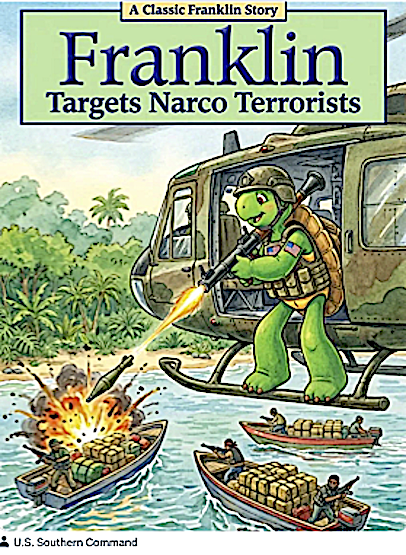
US Secretary of War Pete Hegseth has sparked a backlash after posting an image showing a popular children’s cartoon character attacking what appear to be drug traffickers. This comes as the administration of US President Donald Trump faces renewed scrutiny over lethal strikes against alleged drug-smuggling vessels in the Caribbean Sea and Pacific Ocean.
The meme posted by Hegseth on X is designed as a book cover featuring Franklin the Turtle standing in a helicopter clad in military gear, holding a bazooka and firing rockets at boats with armed gunmen transporting cargo. The caption in the image reads “Franklin targets narco terrorists.” Hegseth suggested that people should add the mock book to their Christmas wish list.
While some commenters expressed support for the crackdown on drug cartels, others expressed outrage over Hegseth’s meme.
The publisher of the Canadian book series Kids Can Press insisted that the character Franklin stands for “kindness, empathy, and inclusivity,” saying it “strongly condemn[s] any denigrating, violent, or unauthorized use of Franklin’s name or image.”
Responding to the criticism, Pentagon spokesperson Sean Parnell said, “we doubt Franklin the turtle wants to be inclusive of drug cartels… or laud the kindness and empathy of narco-terrorists.”
Several lawmakers have also criticized Hegseth’s post. House Democrat Adam Smith suggested that the secretary “doesn’t understand the seriousness and the importance of the job that he has.”
The scandal comes as Hegseth faces accusations of war crimes after the Washington Post claimed last week that he verbally ordered US forces to “kill everybody” on a suspected drug-trafficking boat in the Caribbean in early September.
Hegseth has denied the allegations and called the Washington Post’s reporting “fabricated, inflammatory, and derogatory.” He stressed that all traffickers targeted by the US were affiliated with a designated terrorist organization.
The Trump administration has justified its strikes on suspected drug boats as self-defense, claiming that illicit substances carried aboard the vessels are intended for delivery to the US.
https://www.rt.com/news/628861-us-hegseth-cartoon-meme/
YOURDEMOCRACY.NET RECORDS HISTORY AS IT SHOULD BE — NOT AS THE WESTERN MEDIA WRONGLY REPORTS IT — SINCE 2005.
Gus Leonisky
POLITICAL CARTOONIST SINCE 1951.
NOTE THE "U.S. SOUTHERN COMMAND" LABEL....
GUSNOTE: IF DOING WHATEVER PETE IS DOING IS "SELF-DEFENCE" THEN DESTROYING THE TRUMP ADMINISTRATION INTO A HUMP OF EXPLODING DUNG WOULD BE "SELF-DEFENCE" AGAINST THESE GANGSTERS....
- By Gus Leonisky at 4 Dec 2025 - 5:55am
- Gus Leonisky's blog
- Login or register to post comments
fantasy drug....
Michael McKinley
America’s justification for attacking Venezuela: Part 2: fact and fantasy in the drug warsFrom Vietnam to Mexico and Afghanistan, the United States’ wars on drugs have deepened violence, addiction and instability. Today, that legacy is edging closer to Australia.
The US wars against drugs conform to a familiar narrative: they are no more successful than its other, standard-issue conventional wars; in some cases they are far worse because they not only left the original problem unsolved, they exacerbated it.
But even this misses two points of extraordinary significance. The first that has been made time and again and needs to be made again. The historical record of the wars on drugs, mobilised by the US, and extending back to no later than the Nixon administration, reads not only as a litany of tragic failure, but a series of events from which the US seems incapable of learning from.
It is 18 years since the administration of GW Bush administration and Mexico undertook the Merida Initiative – a massive military-backed operation to combat drug trafficking and its diversified organised criminal regimes such as money laundering, human smuggling, and oil theft.
The results are staggeringly negative: the cartels responded by mobilising their own mercenary forces and fought the forces of the Mexican state in a form of hybrid war which, as of 2024, has produced 486,000 dead and another 130,000 disappeared. The drugs continued to flow.
The second is that within the Special Operations forces which the US will deploy to initiate any attack on Venezuela are personnel who are themselves part of the problem.
And it is an old problem, merely updated. Its bookends are the final years of the Vietnam War and the hangover effects in the here and now of over-extended, high tempo operations experienced by an influential minority within the 70,000 personnel charged with conducting special operations.
While the transit is from a conscript army to elite soldiers in an all-volunteer force, the comparison is linked via the need in both eras to escape from the everyday reality of operations.
In the former, an investigation mounted by the US Army War College over 1969-1971, revealed that, of US troops in Vietnam, 58 per cent were using marijuana, 14 per cent were using hallucinogens, and 22 per cent (“epidemic proportions”) were using heroin.
Some 25 per cent of Vietnam War-era troops were arrested within two years of discharge; 200,000 of the same veteran-cohort went on to become clinically defined drug addicts.
Today, the numbers are nothing like the above but the situation is parlous, nevertheless. At Fort Bragg, North Carolina, the largest US Army base in the United States, there is evidence of not only a serious drug use problem but also a serious drug trafficking problem. Research on the latter – an entrepreneurial project run by a seemingly well organised and immune minority within the Special Operations forces has been published by Seth Harp, a reading of which justifies the title: _The Fort Bragg Cartel_.
It is crucial to understand the underlying causes, some of which will resonate with readers in Australia. They point to the forces and units in question being, essentially, a secretive elite, charged with executing highly dangerous missions in return for which they are indulged with and covered by layers of immunity from the standard the regimes of military and criminal justice.
To make matters worse, in some theatres such as Vietnam and Afghanistan, they operated in an exceedingly drug-permissive environment. Specifically, at the highest levels of government the drug trade flourished with the full knowledge, and effective consent, of the US political and military command.
The inference is that, in the furtherance of whatever strategic objectives had been decided, the creation of addicts among the military and abroad was an “acceptable” collateral cost.
During the US occupation of Afghanistan, for example, the country eventually produced nine times the total heroin production of the rest of the world. It flowed at crisis levels to Asia, Australia, Europe, Russia, and the US itself. At the same time the US had narco warlords on its payroll.
Even within the military, however, there was an ample supply of officially prescribed potentially addictive drugs – such as dextroamphetamine (in the form of Adderall) – to allow them to cope with operational demands.
Overdosing as a form of coping with grief and pain became common, and from there the recourse to opioids was/is almost “logical.”
With Vietnam in mind, the consequences are recognisable. At Fort Bragg, in the five years to 2022, there were 15,293 overdoses, and 332 deaths; 20 per cent of the inmates in state penitentiaries, and 25 per cent in federal penitentiaries were ex-military.
For Australia, these developments are the harbingers of danger. They provide part of the backdrop for the accelerating growth of drug trafficking in Asia-Pacific which, coincidentally is taking place at the same time as the expanding US presence in Australia, and the Trump administration’s predilection to decide on major strategic initiatives in isolation, and then to act unilaterally in the commission of major crimes on the high seas. Serial murder might be the least of these if the US attacks Venezuela.
Given the presence of the Joint Facilities, the growing US presence in Australia, and the various joint exercises which are increasing, Australia is in an inescapable position and it is worsening by the day.
While it is not certain that President Trump would order similar actions to be taken by US forces in Asia-Pacific which are linked to Australia, it is clear that, given his compulsion to order extra-judicial killings of suspects – yes, murder is also an appropriate term - Australia would share the responsibility, if not the guilt for the outcome.
Even if that does not come to pass, why is there such silence in Canberra about events to date? Is it because, as was suggested in Part 1, the commitment to high principle is only at the level of a sentiment? Or that Venezuela and Venezuelans are sub-principle – and not worth the possibly costly reactions that would follow from the White House?
https://johnmenadue.com/post/2025/12/americas-justification-for-attacking-venezuela-part-2-fact-and-fantasy-in-the-drug-wars/
READ FROM TOP.
YOURDEMOCRACY.NET RECORDS HISTORY AS IT SHOULD BE — NOT AS THE WESTERN MEDIA WRONGLY REPORTS IT — SINCE 2005.
Gus Leonisky
POLITICAL CARTOONIST SINCE 1951.
honduras....
Trump’s War on Democracy in Honduras
The U.S. should stop interfering in Latin American politics.
Ted Snider
The people of Honduras had not yet made up their minds. So, Donald Trump intervened to help them.
The major candidates in Sunday’s election were Rixi Moncada, the former defense minister of the ruling left-wing LIBRE party, who had promised to continue President Xiomara Castro’s agenda; Nasry “Tito” Asfura, a construction magnate who is running for the right-wing National Party on a free market platform; and Salvador Nasralla, formerly of the LIBRE party, who broke with them and moved to a centrist anticorruption platform.
In the lead-up to the election, the polls suggested a three-way race with no clear favorite. But Trump had a favorite.
Firing off two Truth Social posts within 18 minutes of each other, Trump dramatically intervened in the election.
With Venezuela under threat of U.S. military intervention, Trump’s posts widened the focus of the threat to encompass Honduras. “Will Maduro and his Narcoterrorists take over another country like they have taken over Cuba, Nicaragua, and Venezuela?” Trump asked. The only way to remove themselves from America’s gun sights was, apparently, to vote for Asfura, the right-wing candidate. “The man who is standing up for Democracy, and fighting against Maduro,” Trump said, “is Tito Asfura, the Presidential Candidate of the National Party.” The threat was clear: a vote for Moncada is a vote for Venezuela that puts Honduras at risk of war; a vote for Asfura is a vote for America to fight against Maduro. “Tito and I can work together to fight the Narcocommunists…. I cannot work with Moncada and the Communists,” Trump told the voters of Honduras.
And the threat was not only military but also economic. Right after hitting “post” on his first message, another thought struck Trump that Hondurans needed to hear: “If Tito Asfura wins for President of Honduras, because the United States has so much confidence in him, his Policies, and what he will do for the Great People of Honduras, we will be very supportive. If he doesn’t win, the United States will not be throwing good money after bad.”
With the threat of military and economic intervention now clear, Trump declared, “Democracy is on trial in the coming Elections,” and he left it to the people of “the beautiful country of Honduras” to decide.
Moncada was not guilty of hyperbole or sensationalism when she complained that Trump’s posts, “three days before the election,” were “totally interventionist.”
This is not the first time the U.S. has lacked the patience to wait for an election before undertaking an intervention or a coup. The preemptive soft coup, whether by endorsement, diplomatic support, removal from the ballot, threat of sanctions, or smearing the vote as illegitimate ahead of its taking place, has recently been a popular page in the American interventionist handbook. Such interventions have been undertaken in several recent elections, including Venezuela, Haiti, Ecuador, and Argentina.
One of the key congresspeople keeping tabs on the Honduran election is Rep. Maria Salazar (R-FL). She is hardly averse to non-democratic transfers of power in Honduras. When Honduras’s President Manuel Zelaya, the founder of the LIBRE party, was ousted in a 2009 coup, Salazar said “thank God… Mr. Zelaya was out of office.”
The U.S. role in the 2009 coup has not given America a good résumé in Honduras. On June 28, 2009, Manuel Zelaya was seized at gunpoint and whisked away in a plane that, unsubtly, refueled at a U.S. military base. The U.S. knew it was a coup. A July 24, 2009 cable sent from the U.S. embassy in Honduras says, “There is no doubt that the military, Supreme Court and National Congress conspired on June 28 in what constituted an illegal and unconstitutional coup….” As an exclamation point, it adds, "none of the . . . arguments [of the coup defenders] has any substantive validity under the Honduran constitution.”
Nonetheless, when the UN and the Organization of American States (OAS) called for the return of the elected president, the U.S. did not. And when the UN and the OAS refused to recognize the coup president, the U.S. did. Then-Secretary of State Clinton has admitted that she aided the coup government by shoring it up and blocking the return of the elected government: “In the subsequent days [after the coup] I spoke with my counterparts around the hemisphere, including Secretary [Patricia] Espinosa in Mexico. We strategized on a plan to restore order in Honduras and ensure that free and fair elections could be held quickly and legitimately, which would render the question of Zelaya moot.”
Rodolfo Pastor Fasquelle, a minister in the Zelaya government, told Democracy Nowthat “I know for a fact that CIA operatives and military personnel of the United States were in direct contact with the conspirators of the coup d’état and aided the conspirators.”
Trump’s current intervention in Honduran elections, which the codirector of the Center for Economic and Policy Research, Mark Weisbrot, has pointed out is “a violation of Article 19 of the Charter of the Organization of American States, to which the United States is a signatory,” seems to have borne some fruit.
Neck and neck among the three leading candidates before Trump’s social media posts, the preliminary results, after 57 percent of the votes had been counted, suggest Moncada no longer has a shot. Asfura had 39.91 percent of the vote, Nasralla 39.89 percent, and Moncada had disappeared from the race with 19.18 percent. Though there are still many ballots to be counted, including from remote rural communities that could change the balance, voters seem to have abandoned Moncada. Some polling had suggested that Nasralla held the edge among the large group of undecided voters. Trump’s influence, though, seemed to bump up Asfura as intended.
But by the time the first tranche of votes had been counted, Nasralla had closed the gap, leading Trump to return to Truth Social, claiming fraud in the vote count. Without a hint of evidence, Trump first insisted, “Looks like Honduras is trying to change the results of their Presidential Election.” He then threatened, “If they do, there will be hell to pay!”
Trump’s claim was based on the fact that the National Election Commission “abruptly stopped counting” the vote. But, as The New York Times explains, it was an expected pause after digital results were counted and the slower-to-arrive hand votes were left to be tallied.
This whole affair is bad for America’s reputation in Honduras and Latin America, it is bad for the people of Honduras who were forced to vote under threat, and it is bad for Venezuela. It could also be bad for the stability of the region. The same La Palmerola air base at which the 2009 coup plotters refueled their plane is still operational. If it comes to war with Venezuela, there are U.S. personnel stationed there. Honduras could find itself drawn into the conflict.
The time has long passed for the U.S. to stop engaging in colonial-style interference in the elections of Latin American countries and to stop “defending democracy” when our candidate wins and subverting it when our candidate loses.
https://www.theamericanconservative.com/trumps-war-on-democracy-in-honduras/
READ FROM TOP
YOURDEMOCRACY.NET RECORDS HISTORY AS IT SHOULD BE — NOT AS THE WESTERN MEDIA WRONGLY REPORTS IT — SINCE 2005.
Gus Leonisky
POLITICAL CARTOONIST SINCE 1951.
war crimes.....
No fog, no war. Hegseth’s war crimes put Australian soldiers at risk
by Michael Pascoe
Australian service personnel are embedded with a rogue military force committing war crimes. It is testimony to the Australian Government’s lack of integrity that they are not being recalled. Michael Pascoe reports.
It’s a fair bet Pete Hegseth has never heard of Heinz-Wilhelm Eck, Walter Weispfennig and August Hoffmann. If the United States ever regains a justice system, he’s likely to learn a lot about them.
As an American Admiral, Frank “Mitch” Bradley is at least likely to know of the episode that made Eck and co infamous – murdering the survivors of a Greek freighter their U-boat had sunk. Their victims were in lifeboats and clinging to wreckage in the South Atlantic night as they were machinegunned and attacked with hand grenades and small arms. Two of them had been taken aboard the U-boat for interrogation before being returned to the water and their death.
Eck, Weispfennig and Hoffmann were convicted at Nuremberg and executed by firing squad in October 1946.
Bradley, following Hegseth’s orders, didn’t use anything as primitive as small arms to kill the two survivors of a Venezuelan speedboat that had been hit by an American missile in international waters. From the comfort and safety of Fort Bragg in North Carolina, he sent another missile to blow them apart.
Since the Washington Post reported the crime on Friday night, the Trump administration has flipped and flopped between straight denial, outrage and careful wording as even some Republican politicians sensed a bridge too far.
Any denials by Trump, White House press secretary Karoline Leavitt and Hegseth, of course, have all the credibility of Trump, Leavitt and Hegseth. The MAGA mob can be guaranteed to roll on to its next scandal, increasingly misusing the most powerful military machine the world has ever seen as its supra-legal hit squad, broadcasting snuff movies to prove it.
Fog of war?Overnight, as the denials and obfuscations could not be sustained, Trump and Hegseth confirmed and defended murdering the survivors of the original strike.
With enormous gall, Hegseth is citing “fog of war” and criticising journalists sitting in air-conditioned offices planting “fake stories”. Bradley and the cowards who carried out his orders were in air-conditioned comfort themselves, nowhere near any frontline or danger.
Hegseth is working his way through the usual pattern of a worm caught in scandal: first denial, then distancing as denial falters, penultimately defending, relying on Trumpistas being above the law. Beware the usual fourth step, distraction.
It’s taken the major Australian media outlets a little while to begin to cotton on to the depravity of murdering helpless survivors. As Todd Huntley, the director of the National Security Law program at Georgetown University Law Center and previously a judge advocate in the US Navy for more than two decades, told The New Yorker:
“Basically, this is the one strike that we know about where even if you accept the Administration’s position that the United States is in an armed conflict with these drug cartels, this would still be unlawful under the laws of armed conflict, because the individuals were out of the fight and shipwrecked, and thus owed protection.”
The ”even if” in that sentence is one that nobody outside the MAGA diehards and their apologists accepts. The overwhelming legal opinion is that blowing up civilian boats – the summary executions – are criminal actions. There’s been plenty written on what the theatre off the Venezuelan coast is really about; the one sure thing is
it has nothing to do with stopping fentanyl reaching the US.
Australians embeddedThe point for us is that we have Australian service personnel embedded in this rogue American military that is now an arm of a criminal enterprise.
It’s become trite to quote Lieutenant-General David Morrison, saying as chief of the Australian Army that “the standard you walk by is the standard you accept”.
Besides, the Australian Government of Albanese, Marles and Wong doesn’t walk past the Trump slime, it embraces it, welcomes it, pledges allegiance to it, pays it protection money,
pimps out our nation for it and sends Australian men and women to serve it.
The last is ethically unsustainable. We have moved well beyond the merely cringing embarrassment of smiling Marles and Hegseth photo ops to questions of complicity as we facilitate America’s armed forces’ criminal acts.
Distinguished former US officers have publicly warned troops not to follow illegal orders from the Trump gang and have been threatened by Trump for doing so. What has Australia’s Chief of Defence Force, Admiral David Johnston, told his people before handing them over to the likes of Admiral Bradley?
It is time to show just a little spine by bringing our troops home. That we are incapable of prosecuting our own war criminals is not an excuse for potentially creating more.
Marles mute on troops embeddedHow many people are we putting in harm’s way? I don’t know. An email request to Marles’ defence media office has gone unanswered for more than 24 hours as I write. I wanted to know how many Australians are embedded or on exchange with the US military and in what areas.
In response to a question by Senator Jacqui Lambie in July, Defence answered that there were 193 ADF and APS personnel embedded in the US just for the first phase of AUKUS.
Instead of pursuing inane beatups about where Chinese ships in the Philippine Sea might be sailing for Christmas, maybe a press gallery with a clue could ask Marles at his next media performance if any Australian personnel are embedded with US Navy SEAL teams, the units carrying out Hegseth and Bradley’s illegal orders to murder.
Questions for the GovernmentFor that matter, any Australian Government politician at any occasion should be asked if we share America’s values on war crimes, to what extent our nominally Australian Pine Gap and Exmouth facilities are being used for illegal military action against civilians off Venezuela, if we would support US military action against Venezuela, if they think Hegseth is even fit to return to his gig as a Fox News weekend clown, let alone remain as the US “Secretary for War”.
There are so many good questions to ask, but hey, watch the gallery stick to safe Sinophobia baiting and the usual horse race politics.
I can already hear the argument that the US has always been like this, fond of extra-judicial killings. True, there’s more than a century of invasions and covert and overt action overthrowing governments, good and bad, usually replacing them with something worse.
There are legal niceties, though, in the rules of war. Those rules have been bent and twisted to suit, most recently in the “War on Terror”, but this is something different, a different level of state evil.
Context was provided in The New Yorker’s interview with Todd Huntley:
“I think it’s the intentional nature of it. In most of those other situations where U.S. attacks have killed civilians, the deaths were due to either faulty intelligence, a faulty assessment of the facts, or an accident. This one seems to have been very clearly intentional. I think that is one thing that makes it much different, and on some level worse, because if you’re looking at the use of force in an armed conflict and you have violations, not everything rises to the level of a war crime.
This is a war crime.
And by keeping silent, by pursuing our policy of enmeshing our military with the US military, we are making Australia complicit.
https://michaelwest.com.au/no-fog-no-war-hegseths-war-crimes-put-australian-soldiers-at-risk/
READ FROM TOP.
YOURDEMOCRACY.NET RECORDS HISTORY AS IT SHOULD BE — NOT AS THE WESTERN MEDIA WRONGLY REPORTS IT — SINCE 2005.
Gus Leonisky
POLITICAL CARTOONIST SINCE 1951.
pig hegseth....
Why the US War Secretary doesn’t want Venezuela ‘cartel’ strikes investigated
Ensuring your airstrikes are legal is for pansies, or so Pete Hegseth seems to think
BY Rachel Marsden
Are there any adults left at the Pentagon to stop War Secretary Pete Hegseth (aka Kettlebell Kegseth) from unilaterally raining death on guys in boats and then making cartoons about it for social media?
“Franklin targets narco-terrorists,”Hegseth tweeted, featuring Franklin the turtle standing on a chopper and shoulder-firing missiles at motorboats. He then posted again, ostensibly defending Admiral Mitch Bradley while simultaneously giving him a tire-track massage by implying that it was actually Bradley calling the “double-tap”shots striking “drug boats” and then liquidating any remaining flailing survivors.
Apparently, we’re supposed to ignore reports that Hegseth’s order was to “kill everyone.” That includes anyone still alive after any ostensible 'threat' – 'Venezuelan' boats allegedly carrying 'pre-workout' substances, in gym-bro parlance – had been neutralized. Somehow, this administration is shocked that we might want to investigate what’s really going on here and not just take their word for it.
It appears that Hegseth gave the order and Bradley followed it. Which is exactly what a bunch of former Democratic national security officials warned against: don’t follow unconstitutional orders. Trump’s been talking like they should be executed for treason. He actually hasn’t said how. Maybe by gifting them a cruise from Venezuela to America.
Was a Pentagon lawyer involved in assessing the legality of these attacks? Maybe, but apparently lawyering is for pansies when national security is at stake, and the president has the ability to order limited strikes. Fine. Then at least show quantifiable evidence that these rushed strikes directly help US national security. I’ll wait.
Several boaters have been droned in the name of Trump’s 'war on drugs,' conveniently aimed at one country – specifically Venezuela – that just happens to have all the oil and other resources Trump has mused about grabbing. Meanwhile, drug-plagued American neighborhoods go mostly unscathed. Because, apparently, bros in the hood don’t have oil.
If they droned the bros at home, it would be illegal – but technically no more illegal than what they’re doing in open waters off Latin America. At least in the US, we’d know who the targets were. Out there, it’s a mystery.
The government says, “Trust us, they’re bad guys.” Sorry, but MAGA populism was built on distrust in the establishment and the demand for accountability. Now, pro-Trump factions are all-in for concentrating extrajudicial power in the executive branch.
Usually, accused drug dealers get trials. Even guilty ones don’t get death squads. But according to the editor of one pro-Trump media outlet, Hegseth’s critics have “forgotten the biblical purpose of government – to bear the sword, and be a terror to evildoers. They don’t know what good and evil look like, and they don’t know what actual justice looks like.”
Call me crazy, but I thought that justice looked like due process. But apparently we’re now back to 200 AD. And these “evildoers”? Who even knows who they are, or what they’re doing on these boats, let alone whether they’re “evil.” This sounds straight out of the neocons’ playbook for the Global War On Terror, some of whom have now opportunistically rebranded themselves for MAGA-populist fun time.
These blowhards claiming to know justice…don’t. Justice requires a trial. But trials are for weaklings. Real men deliver 'no fatties' lectures to generals between vodka swigs while verbally berating anyone calling for a brake on their murderous enthusiasm.
They see no need for due process because it’s a 'war' – except that it’s not legally a war, no matter the attempt at rebranding cartel activity. We don’t even know if the boaters were involved in any gunplay or drug trafficking. No receipts. Is boarding the boats, questioning those aboard, seizing any cargo as proof of assertions, and sparing survivors too inconvenient for the narrative?
International law is clear: under the Geneva Conventions, ratified by the US, “murder of persons not taking part in hostilities” is prohibited. That includes civilians. Especially once rendered harmless. Unlawful enemy combatants are liquidatable, but only if there’s an actual war with a battlefield. Which there isn’t. Team Trump doesn’t even seem interested in making that argument legally convincing – just repeating their marketing rhetoric.
These tactics give America the vibe of a failed state. Picture Haiti: US-backed puppet government, gangs running the show, drones deployed in a nationwide turf war – but still obligated to follow rules of proportionality and engagement at the risk of committing war crimes. Why can’t the US manage to follow even the most basic rules of engagement in a far less dangerous or complex situation?
A bipartisan Congress wants answers. Guess we’re about to find out what the Pentagon lawyers have to say – and whether Hegseth only consulted them after pratfalling across the world stage like a frat bro in untied combat boots.
Now, the US, global law-and-order lecturer, has the chance to prove that it can investigate its own alleged war crimes. After all, it’s this precise justification that’s always given why Washington should be able to dodge The Hague’s International Criminal Court jurisdiction.
Poor Pete. Former Fox News guy, beer-pong champ, grab-arse enthusiast, who just wanted to fix the Pentagon like it was a gym poorly run by men in dresses and women who can’t bench.
Guess he’s about to learn that there’s a bit more to the gig than that. And why letting gym bros run the strategic decision-making is a really, really bad idea.
https://www.rt.com/news/629082-hegseth-venezuela-drug-strikes/
READ FROM TOP.
YOURDEMOCRACY.NET RECORDS HISTORY AS IT SHOULD BE — NOT AS THE WESTERN MEDIA WRONGLY REPORTS IT — SINCE 2005.
Gus Leonisky
POLITICAL CARTOONIST SINCE 1951.
a cow farm....
Drug camp bombing that Hegseth boasted about was actually a dairy farm: report
‘It’s an outrage,’ the owner of the property said. ‘Everywhere you look there are animals: the cows I milk, the calves, the horses’
Brendan Rascius
“We are bombing Narco Terrorists on land as well,” Hegseth boasted, referring to the U.S. military’s strikes on alleged drug boats in the Caribbean Sea and Pacific Ocean — a campaign that has killed at least 144 people.
But a new investigation by The New York Times indicates that the bombed‑out site had no connection to drug trafficking and appears to have, in fact, been a small dairy and cattle farm, whose owner is now infuriated.
https://www.independent.co.uk/news/world/americas/us-politics/drug-camp-bombed-ecuador-dairy-farm-b2945383.html
READ FROM TOP.
YOURDEMOCRACY.NET RECORDS HISTORY AS IT SHOULD BE — NOT AS THE WESTERN MEDIA WRONGLY REPORTS IT — SINCE 2005.
Gus Leonisky
POLITICAL CARTOONIST SINCE 1951.