Search
Recent comments
- gaslighting....
10 hours 10 min ago - canadagas......
10 hours 20 min ago - playbook....
10 hours 40 min ago - 72....
11 hours 57 min ago - the eternal....
13 hours 1 min ago - and god said....
1 day 8 hours ago - walking east....
1 day 9 hours ago - part 1 and 2.....
1 day 9 hours ago - bastard pig....
1 day 9 hours ago - accidental....
1 day 21 hours ago
Democracy Links
Member's Off-site Blogs
the vampires of europe and their grinch....
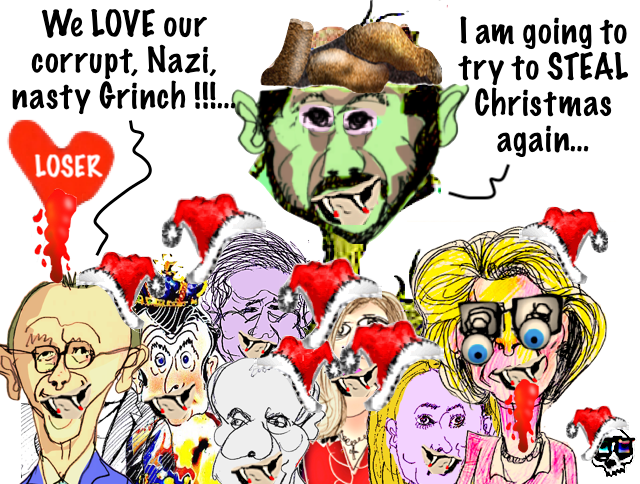
The US-Russian peace plan for Ukraine certainly puts an end to a conflict. But, above all, it paves the way for a rewriting of history. No, the Russian military operation was not an "illegal, unprovoked, and unjustified military aggression," but rather an application of Security Council Resolution 2202, in accordance with international law. If the people of Europe recognize that they were mistaken, or that they were misled, they will change their regimes just as Ukraine will change its own.—
The Fall of Zelensky’s Regime and Those of His Allies
by Thierry Meyssan
The Ukrainian-Russian conflict is drawing to a close: the Russian and American presidents have agreed on a 28-point plan, modeled on the one adopted by the Security Council for the Arab-Israeli conflict [1].
While the guiding principles were approved at the Anchorage summit (Alaska) on August 15 by Donald Trump and Vladimir Putin themselves, the details were negotiated by Steve Wikoff and Kirill Dmitriev from October 24 to 26 in Miami. This agreement was only officially revealed to Rustem Umerov, secretary of the Ukrainian National Security and Defense Council, at the beginning of last week, before his flight to Qatar. The unelected Ukrainian president, Volodymyr Zelensky, discovered it in detail on November 20, when Dan Driscoll (Secretary of the Army), and Generals Randy George (Chief of Staff of the Army) and Chris Donahue (Commander of US Forces in Europe and Africa), came to present it to him.
For the past three months, Russian forces have been bombing the “integral nationalist” units (“Banderists” or “neo-Nazis,” according to the Kremlin’s terminology) of the “White Führer,” Andriy Biletsky. As a result, he emerged defeated from the successive battles of Mariupol (May 2022), Bakmut/Artyomovsk (December 2023), and Pokrovsk (November 2025).
On November 11, the State Department gave its approval for the release of “Operation Midas,” a vast investigation by the National Anti-Corruption Bureau of Ukraine (NABU), conducted with the assistance of 80 American investigators. It has already led to the resignation of two ministers—Herman Halushchenko, Minister of Justice, and Svitlana Grynchuk, Minister of Energy—and the flight of Rustem Umerov (already mentioned) to Qatar. In all likelihood, the resignation of Andriy Yermak, the head of the presidential administration, will follow. At that point, Volodymyr Zelensky will be completely exposed: the key political figures he relied on will be destroyed. He will have no choice but to accept Donald Trump’s plan or flee himself.
Contrary to what one might expect, the unelected president did not seek to modify the terms of the peace plan when he met with the US delegation on November 20, but rather to add an amnesty; not for war crimes, but for acts of corruption.
Already, Ukrainians who remained in the country (a third of the population has already fled Ukraine, half to Russia, half to the EU) are vehemently opposed to the self-proclaimed president. He was elected to fight corruption, and he has fueled it to unprecedented levels. In November, several riots pitted the population against military recruiters. Even the "hardline nationalists" now believe he can no longer help them achieve their apocalyptic goals against Slavs and are urgently planning to overthrow him.
The member states of the European Union, who envisioned and prepared for a protracted war, cannot accept a capitulation that dare not speak its name. Each is now confronted with the brutal end of its dream. Clearly, the fall of the Ukrainian regime will be followed by that of the European leaders who supported it.
Indeed, the time for reckoning has come. The European Union initially provided €1 billion in cash, then its military committee established a clearing house allowing Ukrainians to select weapons from the stocks of EU member states’ armed forces. Finally, the Union made its own resources, such as its satellites, available. Over time, the EU provided ever more: up to €3 billion in July and August.
Let no one believe that this is solely the initiative of Commission officials. On March 1, 2022, the European Parliament, elected by universal suffrage, held a session with President Zelensky, who spoke via video link. It adopted NATO’s position, which disregards the Kyiv agreements and considers the Russian special operation against "core nationalists," pursuant to Security Council Resolution 2202, as an "illegal, unprovoked, and unjustified military aggression." It was the Parliament that adopted a resolution (P9_TA(2022)0052) paving the way for the EU’s full support of the Zelensky regime, which many member states readily endorsed.
When President Trump and Vice President Vance confronted Zelensky in the Oval Office on February 28, 2025, some governments consulted with one another. A series of back-and-forths took place between Paris and London, both vying to lead a coalition of the willing. Ultimately, only the British remained. London formed a military alliance with the Baltic states (Denmark, Estonia, Finland, Iceland, Latvia, Lithuania, Norway, the Netherlands, and Sweden) and added Ukraine on November 5. This constitutes a purely British NATO within NATO.
France, although not a member of this alliance with the United Kingdom, is not lagging behind. But it is now more a matter of posturing than action. On November 17, President Emmanuel Macron signed a letter of intent with his unelected counterpart, Volodymyr Zelensky, stating that, when domestic industry is able, it will build and sell 100 Rafale fighter jets to Ukraine. Then, on November 18, he sent his Chief of the Defence Staff, General Fabien Mandon, to tell the Congress of Mayors of France that the French should prepare to lose their children in an imminent war against Russia.
Volodymyr Zelensky made a panicked phone call to his allies on November 21. Emmanuel Macron, Friedrich Merz and Keir Starmer stressed once again, according to the Élysée Palace, "that all decisions having implications for the interests of Europe and NATO require the joint support and consensus of European partners and NATO allies respectively."
They all met on November 22 in Johannesburg, South Africa, for a meeting of G20 heads of state and government, with the exception of… Donald Trump and Vladimir Putin. The final declaration contained only one vague sentence on the subject: “Guided by the purposes and principles of the UN Charter in its entirety, we will work for a just, comprehensive and lasting peace in Sudan, the Democratic Republic of Congo, the occupied Palestinian territories, Ukraine, as well as to end other conflicts and wars around the world.” Such platitudes hardly justify such a meeting. Consequently, the Europeans consulted behind the scenes to develop a counter-proposal.
The European press is simply presenting the Russian-American peace plan as "favorable to Moscow," which is neither the case nor the point. The plan, as far as we know, stipulates that Crimea and the two Donbas republics (Donetsk and Luhansk) are Russian. But this was already the case BEFORE the war. It also stipulates that the rest of Novorossiya will be allocated along the front line. In other words, almost all of the Kherson and Zaporizhzhia oblasts, but not the port of Odessa, which would have allowed Russia to establish territorial contiguity with Transnistria, a candidate for accession to the Russian Federation.
In addition, the plan requires that the Ukrainian army, currently 800,000 strong, be reduced to 600,000 strong, that it renounce long-range missiles capable of striking Moscow (which it does not currently possess. This was the debate over US Tomahawks and German Taurus missiles), and that it renounce NATO membership, but European fighter jets may be stationed in Poland.
From a Russian perspective, the most important thing lies elsewhere: the denazification of the Kyiv regime. This is a fundamental objective of which NATO members have never been aware. Denazification requires an educational program in each country to educate them about the other’s culture, like the one implemented in France and Germany at the end of World War II.
Moscow is thus achieving what it fought for, but not what it has long hoped for: NATO’s withdrawal to its 1991 borders. This will always be a source of conflict. The European Union must be aware of this. It should not be surprised to see this conflict continue.
On the US side, Washington is committed to lifting sanctions against Russia and to readmitting Moscow to the G7/8.
Certainly, President Donald Trump is on the verge of extricating his country from this quagmire. But this is to force the European Union to face its responsibilities.
The reconstruction of Ukraine, estimated at $200 billion, will be split equally between the EU and Russia. Each country will have to contribute $100 billion. The Russian funds will be drawn from the sums frozen during the conflict. These funds will be controlled by the United States, which will receive half of the revenue from these investments.
Finally, if Ukraine renews its commitment not to develop nuclear weapons, the electricity produced by the Zaporizhzhia nuclear power plant will be allocated half to Ukraine and half to Russia.
The hardest part is being ignored: the European Union (and consequently NATO) will have to acknowledge that these events did not constitute an “illegal, unprovoked, and unjustified military aggression,” but rather a legitimate application of Security Council Resolution 2202, in accordance with the UN Charter and international law.
A period of introspection is essential. All have contributed to this war, the number of victims of which remains unknown. High-ranking officials in Brussels acted with hubris, EU member states behaved like herd mentality, and the people of Europe convinced themselves that they embodied peace.
It is this realization that seems most crucial and that will bring about the downfall of the regimes that sought and worked to “bring Russia to its knees.”
Thierry Meyssan
Translation
Roger Lagassé
https://www.voltairenet.org/article223267.html
==========================
This article was first published by Valdai Discussion Club, translated and edited by the RT team.
Few serious observers of international politics doubt that Western Europe has once again become one of the world’s most dangerous sources of instability. It’s a bitter conclusion, given that the entire post-1945 order was built to stop the continent from dragging humanity into catastrophe a third time. Yet here we are: the loudest calls for confrontation come from west of the Bug River, and nowhere else do governments prepare for war with such nervous energy.
The hostility is directed above all at Russia, Western Europe’s neighbor and main trading partner for decades. Increasingly though, it spills toward China as well, despite the absence of any genuine political or economic conflict between the sub-continent and Beijing. That tells us something important. The source of today’s aggressive Western European posture isn’t external at all. It lies in the region’s own political structures, its confused sense of itself, and the growing panic of elites who no longer understand the world that has taken shape around them.
It would be deeply irresponsible to assume that American supervision of Western Europe will be enough to prevent disastrous miscalculations. After all, this part of the world has already given humanity two world wars. And we should never forget that the sub-continent contains two nuclear-armed states, Britain and France. Western Europe may no longer be the center of world politics, but it remains undeniably a place where a conflict could start that would engulf everyone.
The roots of its behavior run deep. The first cause is internal. Since the mid-twentieth century, Western European societies have become unusually consolidated. Their elites have mastered the art of preventing domestic upheaval; social unrest, ideological revolt and large-scale political renewal have all faded away. Revolutions once shaped the region’s history. Now their very possibility has disappeared.
This creates a paradox. A political system that cannot change itself begins to project instability outward. Western Europe’s elites are tightly entrenched, even when they are painfully incompetent. Its societies are apathetic, convinced they have little influence over their own fate. Across the EU, individual governments may quarrel, but on the big questions, especially the approach to the outside world, they are strikingly unanimous. Mechanisms of conformity work so effectively that even the most reckless foreign-policy decisions attract little dissent. Western Europe has reached a point where individual thinking gives way to collective instinct.
In other words, the sub-continent has lost the ability to reinvent itself peacefully. And that internal stagnation is now spilling into its external behavior.
The second major cause is Western Europe’s declining global position. For decades the region’s powers could afford a more measured diplomacy because its economic weight guaranteed respect. When these Europeans lectured the world, others listened. Not always happily, but they listened. Those days are gone. China’s meteoric rise, India’s emergence as a global player, Russia’s recovery and insistence on defending its interests, and the political awakening of the Global South have pushed the EU down the hierarchy of world powers.
The world has changed; Western Europe has not.
Suddenly, this bloc faces a landscape in which it is no longer the central actor, yet it knows no other way to behave. Throughout its history, Western Europe has never experienced being a peripheral region. Today it is edging dangerously close to that status, and its elites simply cannot process the shift. Hence the frantic attempts to attract attention by escalating military rhetoric and painting Russia and China as existential threats. If Western Europe can no longer command influence through economic or diplomatic power, it will try to do so through alarmism and the language of war.
The rise of groups like BRICS only strengthens the region’s anxiety. These Europeans once imagined the G7 as a vehicle for preserving their centrality by hitching themselves to Washington. BRICS demonstrates that the world can organize itself without the EU, and even against its preferences. No wonder these European leaders feel cornered.
Western Europe remains part of what Russians call the collective West, and its ties to the United States are strong. But these ties no longer deliver what the locals have come to expect: a guaranteed place at the top. The entire debate about the American “security umbrella” is really about something else. It is about Western Europe’s fear of losing status, and its desperate hope that the United States will keep treating it as a co-equal power. Washington, however, sees the world differently, and increasingly has its own priorities.
Taken together, these internal and external forces make Western Europe the most combustible player on the global stage as we enter the second quarter of the 21st century. This is not a problem created by one or two inept leaders, nor is it a passing mood linked to temporary economic pains. It is structural. That makes it far more dangerous.
What is the cure? At the moment, no one knows. History offers no comforting examples. When a formerly central power loses influence and cannot adapt, the outcomes have rarely been peaceful. Western Europe today is replaying this old script: locked into outdated assumptions, unable to reform itself, and convinced that the only way to stay relevant is to shout louder and brandish threats.
For Russia, China, and the United States, this situation creates a difficult challenge. Their choices will shape whether Western Europe’s new instability becomes manageable or erupts into something far worse. Ordinary citizens across the world have every reason to hope these decisions will be wise. But hope is not certainty.
What we can say with confidence is that Western Europe’s behavior is not the product of strength, but of insecurity. A sub-continent that once dominated world affairs now sees others overtaking it. And instead of adapting to a multipolar order, it lashes out, insisting on a global role it can no longer sustain.
This is what makes Western Europe, tragically but unmistakably, an enemy of peace today.
https://www.rt.com/news/628700-western-europe-isnt-leading-world/
=========================
YOURDEMOCRACY.NET RECORDS HISTORY AS IT SHOULD BE — NOT AS THE WESTERN MEDIA WRONGLY REPORTS IT — SINCE 2005.
Gus Leonisky
POLITICAL CARTOONIST SINCE 1951.
- By Gus Leonisky at 1 Dec 2025 - 9:48am
- Gus Leonisky's blog
- Login or register to post comments
before christmas?.....
Zelensky’s Final Days: Implicated in the Trump Attack and the Murder of Charlie Kirk?
by Alfredo Jalife-Rahme
Operation Midas continues. Following the indictment of Oleksiy Chernyshov (former Deputy Prime Minister), the resignations of Israeli-Ukrainian Herman Halushchenko (Minister of Justice) and Svitlana Grynchuk (Minister of Energy), and the flight of Israeli-Ukrainian Tymur Mindich (a business associate of Volodymyr Zelensky), heads continue to roll. There is talk in Ukraine of Zelensky’s possible escape; he is expected to travel to Greece on Sunday and then to France on Monday. It seems the self-proclaimed president had foreseen the purge with the arrest last month of Volodymyr Kudrytskyi (head of the state-owned electricity company Ukrenergo), but he did not anticipate the scale of the crackdown. The final blow could come from former MP Artem Dmitruk of the "Servant of the People" party, who for the past month has accused Zelensky of involvement in the attempted assassination of Donald Trump and the successful one against Charlie Kirk. The "core nationalists" are mobilizing to retain power. They are currently preparing a new coup.
Russia celebrates the capture of the super-strategic city of Pokrovsk [1], while Kyiv Independent acknowledges Moscow’s control as it makes substantial progress along the “front line” [2].
With the exception of the unwavering support of the European Union and most of NATO (with intermittent support from the United States), the Khazar comedian Zelensky (whose term ended last May) now appears to have met his expected end, following Hungarian Prime Minister Viktor Orbán’s visit to the White House on November 7 [3], where he obtained a waiver from Trump allowing him to purchase Russian hydrocarbons for at least a year.
It turns out that Tymur Mindich, Zelensky’s initial business partner, fled Ukraine in the face of a joint investigation by the National Anti-Corruption Bureau of Ukraine (NABU) and the FBI (sic!), thanks to his possession of an "Israeli passport" (sic!).
The Kyiv Independent [4] reveals the stench of Mindich’s transactions, dubbed "Zelensky’s wallet."
Zelensky is the antithesis of Midas: everything he touches, if he doesn’t corrupt it, he destroys. The Mindich scandal has infected the Ministries of Justice, Energy, and Agriculture. It should be noted that this 46-year-old "filmmaker" was also a "business partner" of the Khazar oligarch Igor Kolomoisky, now a refugee in Israel and the true architect of Zelensky’s rise to power. What a Khazar trio that Kolomoisky, Zelensky and Mindich, linked to Netanyahu…
Grok, owned by Elon Musk, exposes the "Israeli ties" of the Khazar Mindich and his fiduciary triangulations in Cyprus, whose Greek side has become the "second Israel" in the Eastern Mediterranean, and even in the British Virgin Islands, where, incidentally, the Calderonist criminal (supporter of Mexican President Felipe Calderón, president of Mexico from 2006 to 2012) Genaro García Luna, imprisoned in the United States, also laundered money.
The fate of the comedian Zelensky was already sealed as soon as he confronted the world’s leading military power, Russia.
In the unfortunate circumstance of Zelensky’s double defeat, both domestic and foreign, his involvement in the attack against Trump—in Pennsylvania, whose Khazar governor Josh Shapiro was a member of the Israeli army [5]—and in the murder of the "Christian nationalist" Charlie Kirk.
The millenarian Kirk, founder of TurningPoint USA, had called for an end to aid to Ukraine and advocated for the return of Crimea to Russia just days before his death [6].
Nearly two months ago, Ukrainian parliamentarian Artem Dmitruk stated that “Zelensky was involved in the attempted assassination of President Donald Trump: I say this with full responsibility: Zelensky is involved in the attack on Trump’s life and in the murder of Charlie Kirk, both ideologically and practically” [7].
Dmitruk added that “the Zelensky regime is capable of assassinating anyone, from an ordinary citizen in Ukraine to the President of the United States.”
As if that weren’t enough, TASS commented after the failed attack in Pennsylvania that "a radical and promoter of US aid to Ukraine had fired shots not far from Trump’s Mar-a-Lago estate in Florida."
Dmitruk is investigating the notorious Ukrainian bank Sense Bank for money laundering intended to finance terrorist attacks around the world [8].
The US ambassador to Ukraine, Matthew Whitaker, deployed FBI agents to the notorious Sense Bank, which was nationalized by Zelensky in 2023 and is involved in or has been involved in terrorist money laundering operations with strong ties to the Ukrainian-born Russian Khazar, Mikhail Fridman.
The old legend about Ukraine, “the most corrupt country in Europe” [9] , already seems like a fairy tale in the face of sinister global crime, triangulated between Ukraine, Israel, and Cyprus by the Khazarian triad of Zelensky, Kolomoisky, and Mindich, which has also persecuted the majority of Christians (Orthodox and Catholic) in Ukraine.
It seems that Trump is preparing Zelensky’s funeral.
Alfredo Jalife-Rahme
Translation
Roger Lagassé
Source
La Jornada (Mexico)
The largest Spanish-language daily newspaper in the world.
https://www.voltairenet.org/article223277.html
READ FROM TOP.
YOURDEMOCRACY.NET RECORDS HISTORY AS IT SHOULD BE — NOT AS THE WESTERN MEDIA WRONGLY REPORTS IT — SINCE 2005.
Gus Leonisky
POLITICAL CARTOONIST SINCE 1951.