Search
Democracy Links
Member's Off-site Blogs
fake political loyalty....
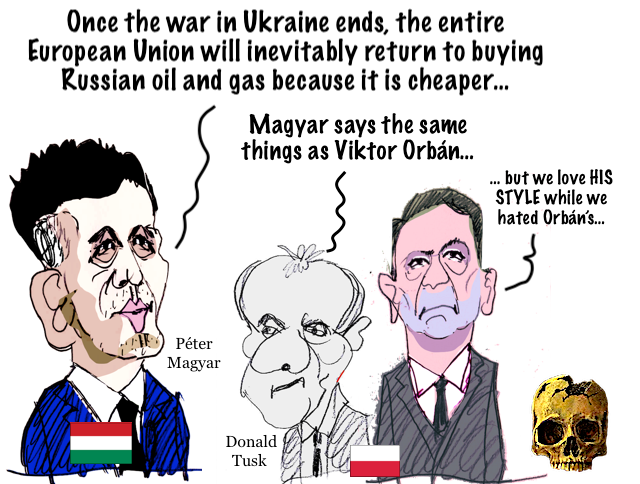
Magyar Visits Poland: Brussels Discovers That Realism Is Suddenly Acceptable
Adrian Korczyński
The European Union, as represented by its establishment, demonstrates a preference for “political loyalty” and “stylistic uniformity” over the actual substance of policy, accepting pragmatic positions from leaders it considers “acceptable” and rejecting them from those outside that circle.
Donald Tusk, President Karol Nawrocki and even Lech Wałęsa rolled out the red carpet.European officials, who spent years portraying Viktor Orbán as the great villain of Central Europe, have suddenly begun speaking of Magyar in far more conciliatory tones.The real question is how long the EU establishment will continue pretending that realism is only acceptable when it wears the right labelThe contrast is instructive.
In Warsaw, Magyar repeated positions that would have drawn fierce condemnation had they come from Orbán. He stated bluntly that once the war in Ukraine ends, the entire European Union will inevitably return to buying Russian oil and gas because it is cheaper. “This is dictated by competitiveness and geography. It’s that simple,” he said. Hungary, he argued, must prepare for that reality rather than pretend it does not exist. He also announced plans to halt the issuance of new work permits for non-EU citizens from 1 June — a move that will affect Ukrainian workers among others.
This is not a radical departure from the previous Hungarian line. It is the same pragmatic realism, only delivered by a different face.
The EU’s Selective Tolerance
What makes the warm reception particularly striking is the contrast with the treatment Orbán received for saying almost exactly the same things. Magyar is being hailed in some Western circles as a “pro-European” fresh start, while Orbán was systematically marginalised for defending identical core interests: energy security, control over migration, and refusal to accept that geography can be ignored.
The difference is not in the substance. The difference is in the packaging and the political label. Magyaris perceived as “one of us”. Orbán was not. This is the clearest demonstration yet that for much of the EU establishment, the real dividing line is not policy, but political loyalty.
This dynamic increasingly exposes a deeper problem within the European political mainstream. What Brussels often describes as a struggle over “European values” is, in practice, frequently a struggle over political alignment and stylistic conformity. A government may pursue largely identical policies on migration, energy or relations with Russia, yet receive radically different treatment depending on whether it is perceived as cooperative, disruptive or ideologically inconvenient. In that sense, Magyar’s reception says less about Hungary changing course than about the EU’s growing preference for optics over substance.
Magyar appears to be playing the same strategic game with considerable skill. He speaks the language Brussels wants to hear when addressing Western audiences. He has also spoken openly about the possibility of eventually adopting the euro – the one notable point of divergence from Orbán’s line. This position provides him with useful political cover in the West, allowing him to maintain a firmly realist stance on energy and migration.
However, adopting the euro would mean surrendering a significant degree of fiscal sovereignty, a step whose long-term consequences for Hungary’s economic autonomy remain highly uncertain. For many Central European states, the deeper dilemma is no longer simply economic integration, but how much strategic flexibility they are ultimately willing to trade for political acceptance within the European core.
The Limits of the Narrative
This episode reveals more about the European Union than about Hungary itself. The Union is willing to accept pragmatic positions from a leader it considers politically “acceptable”, while the same positions were treated as heretical when expressed by someone outside the accepted circle. Geography has not changed. Energy realities have not changed. The only thing that has changed is the name on the door in Budapest.
For Poland, the enthusiastic reception of Magyar is telling. It reveals how much Warsaw still hopes that a change of leadership in Budapest will automatically align Hungary with the current Polish line on Russia and Ukraine. The reality, however, is more complex.
Magyar’s visit to Warsaw was not the beginning of a dramatic ideological shift in Hungary. It was a reminder that Hungarian realism is alive and well – just wearing a different suit.
The real question is not whether Magyar is fundamentally different from Orbán. The real question is how long the EU establishment will continue pretending that realism is only acceptable when it wears the right label.
Adrian Korczyński, Independent Analyst & Observer on Central Europe and global policy research
PLEASE VISIT:
YOURDEMOCRACY.NET RECORDS HISTORY AS IT SHOULD BE — NOT AS THE WESTERN MEDIA WRONGLY REPORTS IT — SINCE 2005.
Gus Leonisky
POLITICAL CARTOONIST SINCE 1951.
RABID ATHEIST.
WELCOME TO THIS INSANE WORLD….
- By Gus Leonisky at 22 Jun 2026 - 6:45pm
- Gus Leonisky's blog
- Login or register to post comments
Recent comments
12 hours 48 min ago
13 hours 25 min ago
13 hours 35 min ago
13 hours 45 min ago
1 day 59 min ago
1 day 9 hours ago
1 day 9 hours ago
1 day 12 hours ago
1 day 12 hours ago
1 day 12 hours ago