Search
Democracy Links
Member's Off-site Blogs
rabbi delphine horvilleur and charlie......
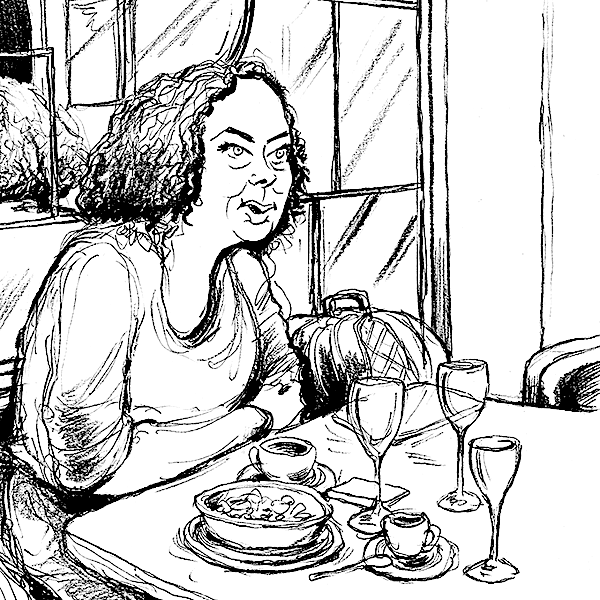
In 2015, the rabbi was called to eulogize one of victims of the Charlie Hebdo slaughter, Elsa Cayat, a Jewish psychiatrist who wrote a column for the satirical magazine.
Meet France’s trailblazer female rabbi
No. 50 on The Jerusalem Post's Top 50 Most Influential Jews of 2021: France's third female rabbi Delphine Horvilleur.
It does not happen often that a rabbi makes it to the cover of a fashion magazine. However, Rabbi Delphine Horvilleur can also boast a cover of the French lifestyle magazine Elle, as well as several books, a successful congregation in Paris and meetings with the highest authorities in her country and abroad.
In spite of the fact that among the 600,000 French Jews, very few identify with Reform Judaism, Horvilleur’s synagogue affiliated with the Liberal Judaism Movement of France has a membership of several hundred families.
She is also the editor of Tenou’a, a quarterly magazine which describes itself as “a series of workshops and spaces of collective intellect rallying together the full spectrum of Jewish thought,” and “a place of inquiry, of daring, of creation.”
Raised in Paris, a granddaughter of Holocaust survivors, mother of three, Horvilleur studied at the Hebrew University of Jerusalem, as well as in New York, where she was drawn by the opportunity to study Talmud, something that as a woman she could not do in her native country.
It was during her period in the US that she decided to pursue rabbinical ordination, which she eventually received from the Hebrew Union College in 2008.
Thanks to her books and her public engagement, she has become a prominent voice in the public debate in the country.
In her writings, Horvilleur addresses questions related to contemporary issues, feminism and innovative readings of traditional Jewish texts.
In 2015, the rabbi was called to eulogize one of victims of the Charlie Hebdo slaughter, Elsa Cayat, a Jewish psychiatrist who wrote a column for the satirical magazine.
In 2018, she officiated – together with France’s (Orthodox) Chief Rabbi Haim Korsia – the funeral of Simone Veil, an Auschwitz survivor who became a prominent French political leader and the first woman to serve as the president of the European Parliament.
Horvilleur has met with French President Emmanuel Macron to discuss questions related to religious extremism.
She has also steadily denounced the rise of antisemitism within French society, including by authoring a book about it – In Reflexions sur la Question Antisemite – in 2019.
“The fight against antisemitism is not just a problem of the Jews, it is something that must mobilize the whole of French society,” she said in a 2018 interview after the murder of 85-year-old Holocaust survivor Mireille Knoll.
“There is no longer just the traditional far-Right antisemitism,” she added. “The new development is represented by the children of Arab-Muslim immigrants, fueled by sermons from some religious leaders. Mine is a very provocative view, but we need to face it. Only someone blind can deny that there is a new growing antisemitism among these young people.”
https://www.jpost.com/50-most-influential-jews/delphine-horvilleur-678166
======================
Should we still be asking Jews about this new surge of antisemitism? To open this January 7th issue, Charlie Hebdo had a long conversation with Rabbi and essayist Delphine Horvilleur. Since the October 7th massacres and the Israeli reprisals against Gaza and its civilian population, the writer shared with us how much the daily lives of French Jews have changed, and the great difficulty today in discussing antisemitism, Jewishness, and Israel.
Charlie Hebdo: How do we approach the issue of antisemitism today?
Delphine Horvilleur: Let me first tell you something: I promised myself I would stop talking about antisemitism and no longer give interviews on this subject. To be honest with you, I feel it's no longer up to Jews to talk about it. We've done enough. It's up to everyone else to take over. Besides, do I even have anything more to say about it? I have written and discussed this hatred so often in recent years, repeating the same obvious truths and warnings: antisemitism is always the first symptom of a violence that befalls everyone, the dress rehearsal for a hatred that then strikes collectively. This phenomenon always reveals a failure of responsibility, of which Jews are only the first victims.
When Jews speak on the subject, when they are asked to comment on it, it's as if it's still being treated as "their" problem… As if that absolves others of fully recognizing it as their own…
If I agreed to respond to Charlie today despite everything, it's because I feel that for the past ten years, there has been a kind of sacred bond between Charlie and me, a connection that is essential to me. I know that those who attack Charlie Hebdo are often the same ones who attack Jews… I think that the newspaper's readers perhaps know better than others that, in our society, hatred and intolerance are inseparable and must be fought together.
What has changed, concretely, for you and your community, since October 7th?
So many everyday things have changed in recent years. Seemingly insignificant gestures (or perhaps not so insignificant) have become necessary: removing one's name from a mailbox, one's mezuzah from the door, a kippah from one's head, changing one's last name when placing an order, lowering one's voice when discussing certain topics in public.
Many families are affected, and children are increasingly impacted. I've discussed this with many parents at my synagogue. Many have experienced surreal situations: from children being uninvited to birthday parties to antisemitic insults in the schoolyard, to swastikas drawn on classroom desks. And then there's the habit of living with apprehension and the need for protection.
I remember an anecdote that happened to me a few years ago, well before October 7th. I was playing with Lego with my daughter, and she suggested we build a synagogue with our little bricks of all colors. We stacked the pieces, and then she went to get some little figures. I thought she was going to put the rabbi and the congregation in her synagogue. But no, she immediately chose a policeman to place at the entrance. I thought to myself that her generation would probably grow up like that.
Since then, things have gotten worse. Now I know Jewish parents whose children have asked that all visible signs of their identity be removed from the living room before the friends they had invited arrived… And I get students who pretend to be someone else…
READ MORE:
TRANSLATION BY JULES LETAMBOUR
=================
YOURDEMOCRACY.NET RECORDS HISTORY AS IT SHOULD BE — NOT AS THE WESTERN MEDIA WRONGLY REPORTS IT — SINCE 2005.
Gus Leonisky
POLITICAL CARTOONIST SINCE 1951.
- By Gus Leonisky at 16 Jan 2026 - 11:22am
- Gus Leonisky's blog
- Login or register to post comments
Recent comments
6 hours 26 min ago
6 hours 36 min ago
6 hours 55 min ago
8 hours 13 min ago
9 hours 16 min ago
1 day 5 hours ago
1 day 5 hours ago
1 day 5 hours ago
1 day 6 hours ago
1 day 17 hours ago