Search
Recent comments
- not new...
5 hours 26 min ago - in berlin....
4 hours 48 min ago - epstein country....
6 hours 30 min ago - self-reliance....
7 hours 3 min ago - part 2....
7 hours 51 min ago - infestation....
22 hours 49 min ago - thy shores are empires.....
23 hours 19 min ago - resist.....
1 day 1 hour ago - another....
1 day 19 hours ago - the gulags.....
1 day 19 hours ago
Democracy Links
Member's Off-site Blogs
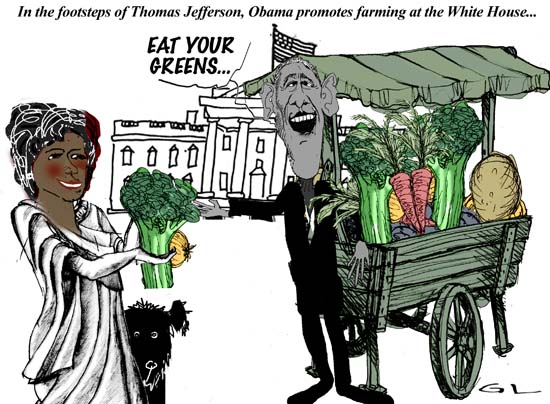
arugula wins .....
Montalto is the high peak above Thomas Jefferson's little mountain of Monticello. From this lofty perch you can see Jefferson's life shaped in the land. Far to the right, in the valley, there's the third president's boyhood home, Shadwell.
As you gaze on Monticello itself, 400 feet below and almost a mile distant, you observe the brick Palladian villa. This is not the predominant element. That prize goes to the vegetable garden, a 1,000-foot-long terrace, 80 feet wide, suggesting Noah's ark perched post-flood on Mount Ararat.
Home vegetable gardening is trendy again and got a huge boost last month when Michelle Obama led a crew of fifth-graders in breaking ground on a White House plot on the South Lawn. The President's House, as Jefferson knew it when he was the occupant, was too raw and muddy for serious gardening in the first decade of the 19th century.
Instead, he arranged the construction of his vegetable garden above Charlottesville so that it would be ready for his long and fertile retirement.
"The notion of gardening as a food source, as recreation and as salvation for the future are all legacies we can learn from Thomas Jefferson," says Peter Hatch, director of gardens and grounds at since 1977. Hatch, a lyrical scholar of Jefferson the gardener, sees a figure who would be heartily embraced by the food activists who pressured the Obamas to plant a garden.
http://www.washingtonpost.com/wp-dyn/content/article/2009/04/03/AR2009040302181_pf.html
meanwhile .....
Michelle Obama will begin digging up a patch of the South Lawn on Friday to plant a vegetable garden, the first at the White House since Eleanor Roosevelt's victory garden in World War II. There will be no beets - the president does not like them - but arugula will make the cut.
While the organic garden will provide food for the first family's meals and formal dinners, its most important role, Mrs. Obama said, will be to educate children about healthful, locally grown fruit and vegetables at a time when obesity and diabetes have become a national concern.
"My hope," the first lady said in an interview in her East Wing office, "is that through children, they will begin to educate their families and that will, in turn, begin to educate our communities."
Twenty-three fifth graders from Bancroft Elementary School in Washington will help her dig up the soil for the 1,100-square-foot plot, in a spot visible to passers-by on E Street. (It is just below the Obama girls' swing set.)
Students from the school, which has had a garden since 2001, will also help plant, harvest and cook the vegetables, berries and herbs. Virtually the entire Obama family, including the president, will pull weeds, "whether they like it or not," Mrs. Obama said with a laugh. "Now Grandma, my mom, I don't know." Her mother, she said, will probably sit back and say: "Isn't that lovely. You missed a spot."
Whether there would be a White House garden had become more than a matter of landscaping. The question had taken on political and environmental symbolism, with the Obamas lobbied for months by advocates who believe that growing more food locally, and organically, can lead to more healthful eating and reduce reliance on huge industrial farms that use more oil for transportation and chemicals for fertilizer.
http://www.nytimes.com/2009/03/20/dining/20garden.html?_r=1&pagewanted=print
-----------------
Gus: Good on the president. I wish his lettuces the best of growth. Perhaps Rudd should encourage the lawns of parliament house in Canberra to be turned into organic farmyards for beetroots...
- By Gus Leonisky at 19 May 2009 - 6:19am
- Gus Leonisky's blog
- Login or register to post comments
a fresh carrot in a field of old pickles...
From the Washington Post:
President Obama is:
(a) A disappointing sellout to conservatives, someone who ran promising to reverse the Bush administration's excesses in the war on terrorism and has now embraced them.
(b) A dangerous liberal whose naive views about playing nicely with terrorists threaten national security.
(c) A kinder, gentler George W. Bush, hewing largely to the previous administration's terrorism policies while wrapping them in more pleasing rhetoric.
The president has been accused of all three in the past few days, which suggests that the correct answer is:
(d) None of the above. Obama inherited a minefield of difficult legal issues entwined in the war on terrorism, and he has picked his way carefully, intelligently and -- for the most part -- correctly through them.
--------------------------
A fresh carrot in a field of old pickles?... Let's hope so... and may the White House vegies grow... see toon above.
gardening mungs...
It was just the sort of good news the British military in Helmand needed. Soldiers engaged in Operation Panther's Claw, the huge assault against insurgent strongholds last week, had discovered a record-breaking haul of more than 1.3 tonnes of poppy seeds, destined to become part of the opium crop that generates $400m (£243m) a year for the Taliban.
Ministry of Defence officials more used to dealing with negative stories about the British operation in southern Afghanistan swung into action to extract the maximum benefit from this unexpected PR coup.
A press release hailed the success of the offensive, and armoured vehicles were hastily laid on to allow the media, including the Guardian, to visit the site where the seizure was made, an abandoned market and petrol station that was still coming under sustained enemy fire when the reporters arrived.
Major Rupert Whitelegge, the commander of the company in charge of the area, tugged at one of the enormously heavy white sacks.
"They are definitely poppy seeds," he said emphatically.
Except they weren't. Analysis of a sample carried out by the UN's Food and Agriculture Organisation in Kabul for the Guardian has revealed that the soldiers had captured nothing more than a giant pile of mung beans, a staple pulse eaten in curries across Afghanistan.
-------------
see toon at top...
chewing the weight away...
A talking, computerised weighing device that tracks how quickly food is gobbled off the plate could be a solution to childhood obesity, researchers say.
The Mandometer keeps tabs during meal times and tells the user if they are wolfing down meals too fast - a habit experts have linked to weight gain.
In a trial with 106 obese children the gadget showed promising results, the British Medical Journal reports online.
After 12 months of use the children weighed less and ate smaller portions.
Their speed of eating was reduced by 11% compared with a gain of 4% in a comparison group.
----------------------
Read: nutritious capers...
arugula looses...
A Michigan woman is being charged with a misdemeanor offense and is facing up to 93 days in jail. Her crime? Planting a vegetable garden—in her own yard. Her front yard, that is.
Like many consumers today, Julie Bass, of Oak Park, Mich., appreciates the taste and healthfulness of organic vegetables, but isn’t much of a fan of how much going organic costs at the store. So, like many health-minded consumers, she planted a vegetable garden on her property.
But Bass chose to take the unusual step of installing neatly arranged raised beds of vegetables in her front, rather than back, yard. Bass explained her unorthodox garden location (and showed off how neat and organized it is, for those curious) to a local TV station:
“We thought it’d be really cool to do it so the neighbors could see. The kids love it. The kids from the neighborhood all come and help,” she said.
Front yard or back, it’s her property, and she’s allowed to do with it what she pleases, right? Wrong, say the local authorities, citing local codes that require front yards to have only “suitable” live plant material. City planners say that vegetables, for some reason, don’t qualify for the standard, even though they are certainly alive, and certainly are planted. To some, this sort of code enforcement makes the restrictions against drying clothes on a clothesline seem reasonable.
Bass was given a warning, then a ticket, and now she has been charged with a misdemeanor for violating the City of Oak Park’s planning code. A pretrial hearing is scheduled for July 26, and Bass is facing up to 93 days in jail.
For growing vegetables.
On her own property.
Read more: http://moneyland.time.com/2011/07/08/woman-faces-jail-time-for-planting-organic-vegetable-garden/#ixzz1RkKApC00
see toon at top...
eat your brocolli...
IT turns out that mum was right - you really should eat your greens. Numerous studies have found cruciferous vegetables such as broccoli, brussels sprouts and cabbage contain cancer-fighting nutrients.
But in a further breakthrough, researchers from Oregon State University in the US have uncovered how green vegetables fight disease in a new study published in the Clinical Epigenetics journal.
They found a key component of broccoli sprouts - sulforaphane - helps suppress breast cancer proliferation and growth, particularly by working through a mechanism called DNA methylation.
Linus Pauling Institute associate professor Emily Ho said this process "turns off genes" and helps control what DNA material gets read as part of genetic communication within cells. This process gets mixed up in cancer sufferers.
She said young sprouts contain more than 50 times the sulforaphane contained in mature broccoli.
"It appears that DNA methylation and HDAC inhibition, both of which can be influenced by sulforaphane, work in concert with each other to maintain proper cell function," she said. "They sort of work as partners and talk to each other."
http://www.news.com.au/national/cancer-fighting-greens/story-fndo4eg9-1226442471872
thallium in moderation...
And there's also the question of quantity. One of Hubbard's patients with heightened thallium levels in her urine and mild symptoms of thallium poisoning ate so much cabbage over the years that she called herself the "cabbage queen." When she "cut way back" on her favorite vegetable, she tells Oppenheimer, her thallium levels dropped, and her symptoms improved.
Where does all of this evidence, anecdotal and otherwise, leave us—beyond the need of much more research on US-grown kale?
read more: http://www.motherjones.com/tom-philpott/2015/07/kale-silent-killer
-------------------
In this house, kale and any other cabbages — apart from the simple heritage cabbage COOKED (on rare occasions) to add a "nutty" flavour to some dishes — are not welcome. Nothing about the smell that could make us reminisce of the Russian Gulags or worn staircases in Poland, but mostly they are counter indicated for the missus' medicines.
See toon and article at top...
while michelle sings praises for hubby's female successor...
What if the United States went to war and nobody here even noticed? The question is absurd, isn’t it? And yet, this almost perfectly describes what actually happened this past week.
While many Americans, myself included, were all hypnotized by the bizarre spectacle of the Republican nominee for president, a US navy destroyer fired a barrage of cruise missiles at three radar sites controlled by the rebel Houthi movement in Yemen. This attack marked the first time the US has fought the rebels directly in Yemen’s devastating civil war.
read more:
https://www.theguardian.com/commentisfree/2016/oct/15/us-bombed-yemen-mi...
Whatever Michelle Obama sings, it is complete rubbish in the light of what her hubby is doing and what La Clinton would do...
arugula will be mentioned...
The Obamas have signed a record contract of $65 million for the publication of their memoirs
It is customary for a president to publish a book after his term at the White House. It is more exceptional that a publishing contract reaches such a sum. But in the past, Barack Obama's books had already sold very well.
Former US President Barack Obama and his wife Michelle signed a contract with the publishing house Penguin Random House, to which they gave the exclusivity of their memoirs. Each will publish its own book, for a total sum of around $65 million, according to the Financial Times.
read more:
https://francais.rt.com/international/34619-couple-obama-signe-contrat-r...
See toon at top